
Quo review
Shared business phone system for calls and texts, with an AI agent that answers when nobody can.
The quickest shared phone system for a small team to stand up and actually use, though field crews on patchy cellular data report call quality problems a desk-bound team never sees.
Pros
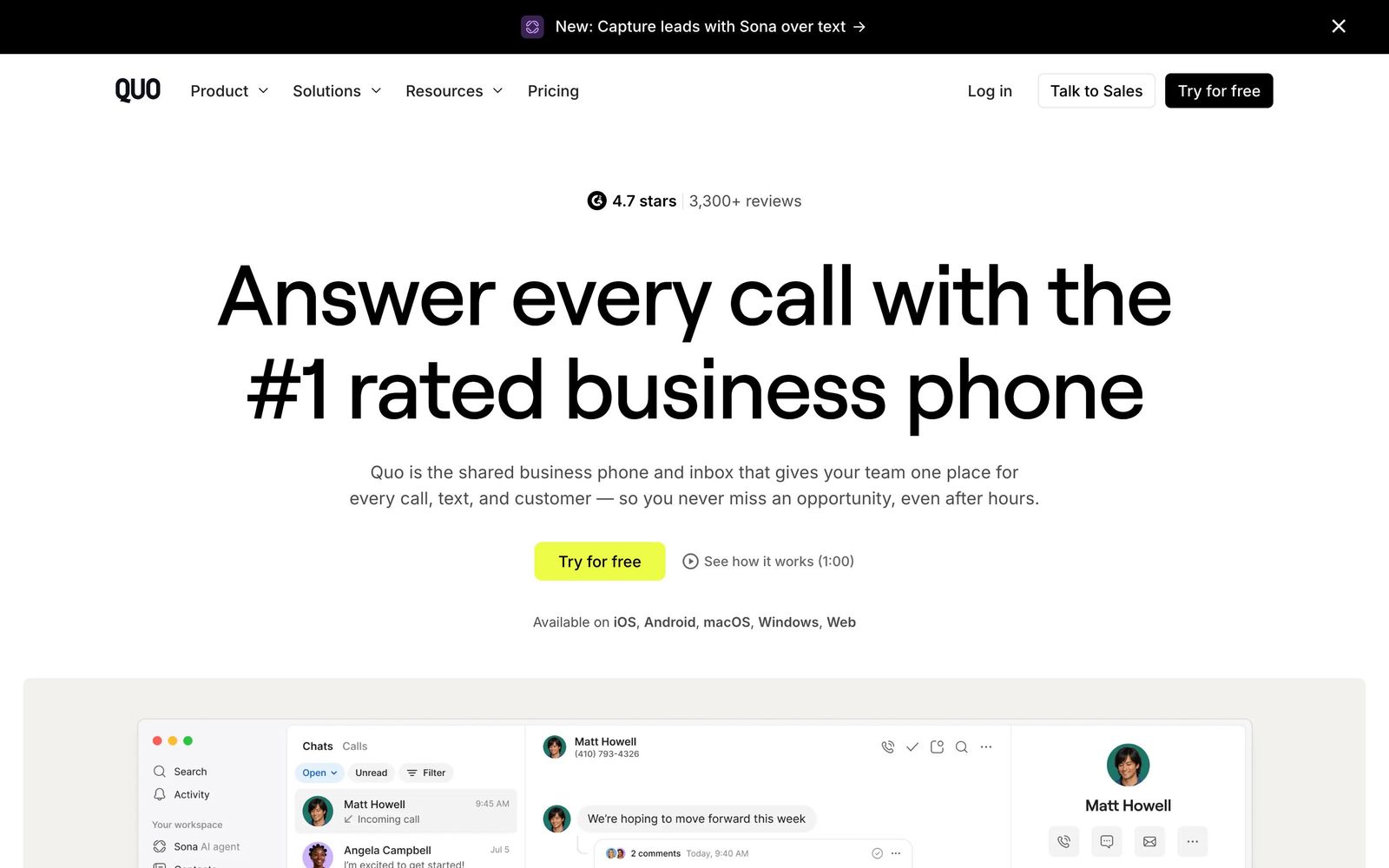
- A single business number can be shared by several people, so the conversation is visible to the team rather than trapped on one phone
- Calls, texts and voicemails sit in one inbox, which makes customer history a single scroll instead of two systems
- The Sona AI agent answers outside hours, captures caller details and transfers live calls
- Call and text records log to HubSpot, Salesforce and Pipedrive against the right contact
- Numbers can be ported rather than replaced, and setup takes minutes rather than a deployment project
Cons
- Field teams repeatedly report calls dropping on the handoff between wifi and cellular data, a complaint concentrated among trades and real estate users
- CRM integrations, automatic call recording and phone menus all require the middle tier or higher
- Routing logic is deliberately simple, so teams needing conditional or skills-based distribution outgrow it
Quo pricing
List prices in USD per month, taken from the vendor at review time.
| Plan | Per month | What it covers |
|---|---|---|
| Starter | $19 | per user; $15/mo billed annually |
| Business | $33 | per user; $23/mo billed annually; adds CRM integrations and call recording |
| Scale | $47 | per user; $35/mo billed annually |
What Quo actually does
Quo, until recently called OpenPhone, is a business phone system that runs over the internet rather than a desk handset. A company buys numbers, assigns each to a person or a team, and everyone works from apps on desktop and mobile. The idea that distinguishes it is the shared number: several people can watch and answer the same line, and every call, text and voicemail on it appears in one threaded inbox that the whole team can read. Nothing important is stranded in a single employee's phone when that person is on holiday or leaves.
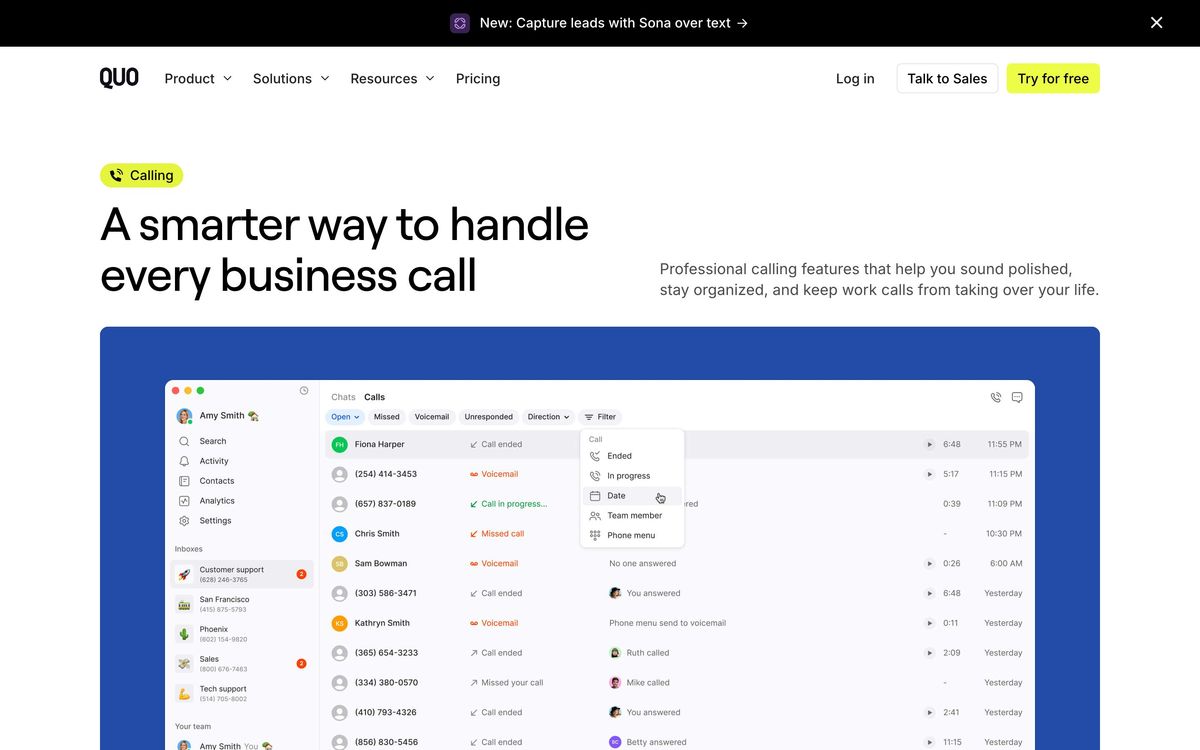
Around that inbox sit the pieces a small business needs to look organised. Texting supports snippets, scheduled sends and auto-replies. Calls produce AI transcripts and summaries, so the notes exist without anyone typing them. Sona, the AI agent, answers when the team cannot, takes the caller's details, answers routine questions and transfers live calls. Business-hours routing, phone menus and group calling handle basic call flow. Integrations push call and text records into a CRM so the contact history stays in one place. Numbers can be ported in, and provisioning a new one takes about a minute.
Key features
What a subscription includes:
- Shared phone numbers with team inboxes and per-number assignment
- SMS and MMS with snippets, scheduled sends and auto-replies
- AI call summaries, transcripts and voicemail transcription
- The Sona AI agent for out-of-hours answering, lead capture and transfers
- Phone menus, group calling and business-hours routing
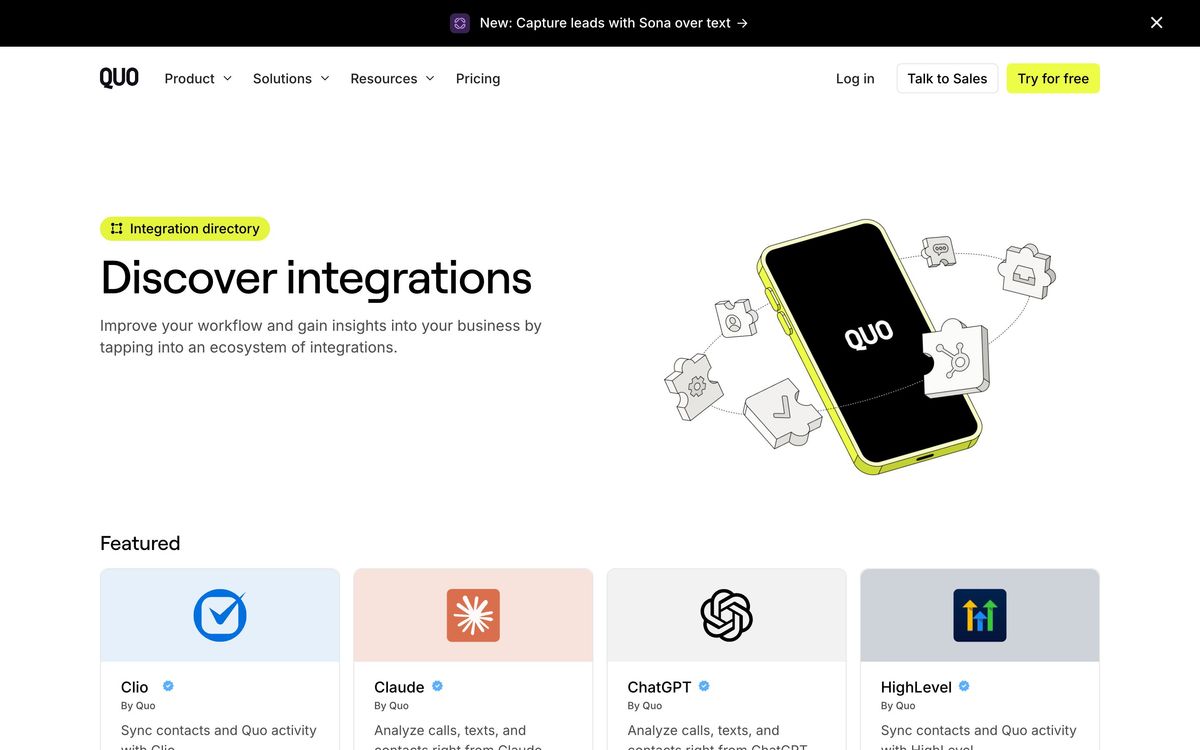
- CRM and automation integrations that log conversations to contact records
Who it's for
The best fit is a business of roughly two to fifty people where several staff handle the same customers by phone and text: a home services company, a clinic, a small agency, a property team, an inside sales desk. Those teams gain most from shared numbers and the single inbox, because the alternative is customers reaching one person's mobile and nobody else knowing what was said. It also suits distributed teams that want local numbers in several areas without hardware.
It is a weaker choice for organisations with real telephony requirements: a contact centre with queues and skills-based routing, a company needing conditional call flows across departments, or anywhere compliance dictates specific recording and retention rules. Businesses whose staff spend the day in vehicles on unreliable mobile data should also test carefully before committing, since that is exactly where the reliability complaints cluster. Anyone who needs a CRM integration should budget for the middle tier from the start rather than expecting to begin at the entry price.
How it compares
RingCentral is the traditional alternative, with far deeper call control, contact centre features and enterprise administration, plus a longer deployment and a higher bill. Dialpad is the closest match on AI, offering real-time transcription, coaching and sentiment analysis that go further than Quo's summaries, and it is priced accordingly. Grasshopper is simpler and cheaper for a single shared number across unlimited users, and offers little of the texting workflow or CRM logging. Quo sits in the middle: modern, fast to adopt, deliberately light on telephony depth.
Verdict
Quo is the phone system a small team will actually adopt, because it looks like the messaging apps people already use and because shared numbers solve a real organisational problem rather than a technical one. Its ratings across review sites are high for good reason. The caveat is reliability at the edges. Persistent reports of dropped calls when moving between wifi and mobile data, together with support that reviewers describe as slow when something breaks, mean a field-heavy business should run a paid pilot with real technicians before moving the main line across.
Ready to try Quo?
More service-businesses tools like Quo
KrispCall
4.2AI cloud phone: numbers from 100+ countries, unified callbox, AI Copilot, 100+ CRM integrations.
Read KrispCall review →Aircall
4.1Cloud phone system with a shared call inbox and automatic CRM logging, for support and inside-sales teams.
Read Aircall review →Vida
4.1AI phone agents that also text, email and web-chat, answering for businesses 24/7 in 10 languages.
Read Vida review →Calilio
4.0AI-powered cloud phone system with a unified callbox and virtual numbers from 100+ countries.
Read Calilio review →Distance
4.0AI agents for service businesses that answer leads on every channel, qualify them and book jobs 24/7.
Read Distance review →Nextiva
3.9Cloud phone system that extends into a contact centre with shared inboxes, chat and AI call handling.
Read Nextiva review →