
Ruby review
Live virtual receptionists and managed website chat answering for small businesses around the clock.
The premium answering service and the quality difference is audible on the call, though per-minute billing at the top of the market makes it costly for any business whose call volume moves around.
Pros
- Calls are answered by live receptionists rather than an automated menu, in an average of under ten seconds, with English and Spanish on every plan
- Coverage runs around the clock, so evening and weekend enquiries reach a person instead of a voicemail box
- Receptionists work from the business's own scripts: qualifying leads, taking intake details, booking appointments and collecting payments
- Messages and voicemail notifications post into Clio Manage and Clio Grow, where a firm can attach them to a matter and bill the time
- Call handling instructions can be changed for a single afternoon from the mobile app, without phoning an account manager
Cons
- Pricing sits at the top of the category: the entry plan buys under an hour of receptionist time a month, and a handful of long calls exhausts it
- Overage rates are not published, so a month with unexpected volume is difficult to forecast and reviewers report bills arriving well above expectation
- The software layer is thin, only a small set of documented integrations, and there is no lower-cost automated tier for routine calls that do not need a person
Ruby pricing
List prices in USD per month, taken from the vendor at review time.
| Plan | Per month | What it covers |
|---|---|---|
| Receptionist Starter | $250 | 50 receptionist minutes a month |
| Receptionist Small Business | $395 | 100 receptionist minutes a month |
| Receptionist 200 | $720 | 200 receptionist minutes a month |
| Receptionist Growing Business | $1,725 | 500 receptionist minutes a month |
| Live Chat Starter | $143 | 10 managed chats a month; around 20% less when bundled with receptionist service |
What Ruby actually does
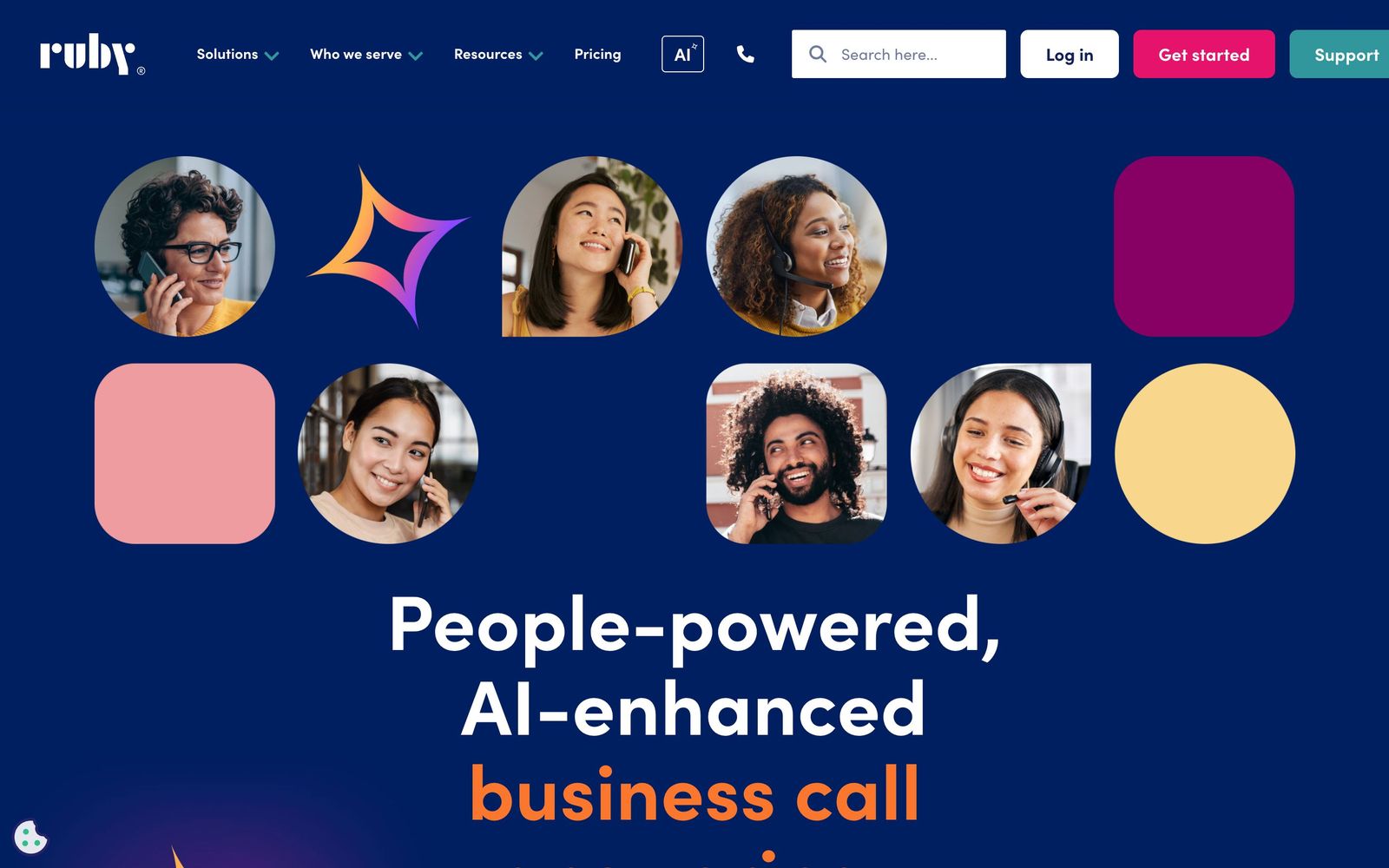
Ruby answers the phone. A small business forwards its line, and calls are picked up by trained receptionists working from that business's own instructions: who the caller is likely to be, what to ask, when to transfer, when to take a message, what to do at seven in the evening. The average answer time is under ten seconds, English and Spanish are covered on every plan, and the receptionists do more than route, they qualify leads, take intake details, book appointments into a calendar and collect payments. The second service is managed live chat, where the same staff answer website visitors and capture leads, sold on its own or bundled with the phone service at a discount.
What the customer sees of the software is a dashboard and a mobile app: call history, message notifications, and controls to change how calls are handled today without a support ticket. Behind it, robocall filtering screens a large volume of junk before it reaches a receptionist, and healthcare clients can run under HIPAA-compliant handling. Integrations are deliberately narrow. Clio Manage, Clio Grow and MyCase receive messages and voicemail notifications directly, which lets a law firm associate a call with a matter and bill for it, and Zapier covers the long tail. Billing is by receptionist minute, in tiers.
Key features
The product is people, wrapped in enough tooling to control and review what they did.
- Live receptionists answering around the clock in English and Spanish
- Custom handling rules by time of day, caller type and transfer destination
- Lead intake and qualification run from the business's own script
- Appointment booking and payment collection taken during the call
- Managed website chat with lead capture, standalone or bundled
- Mobile app and dashboard for call history, messages and same-day instruction changes
Who it's for
Ruby makes sense where the value of a single answered call is high and the caller is judging the business by the first thirty seconds: personal injury and family law firms, dental and medical practices, financial advisers, home services contractors during storm season. For those businesses the arithmetic is simple, one retained client covers months of service, and the warmth of the answer is not a soft benefit but the actual product. Firms already on Clio get more from it than anyone else, because the call becomes a billable, matter-linked record without retyping.
It is a poor fit for high-volume, low-value call traffic: appointment reminders, delivery queries, support triage. Minute-based billing punishes exactly that pattern, and a business fielding hundreds of short routine calls will find an automated answering service or an internal receptionist cheaper. Anyone on a strict budget should also be wary, because the plans are priced well above the category average before any overage.
How it compares
Smith.ai is the closest like-for-like competitor and generally the better value, with published per-call pricing, a wider integration list and its own automated options; Ruby's edge is consistency and a longer track record. Answering Service Care and similar traditional services undercut on price and show it in call quality. The newer AI receptionists answer instantly at a fraction of the cost and handle straightforward calls capably, but still stumble on the unusual ones, which is precisely the call Ruby exists to catch. The choice is really between paying for a person and accepting that some percentage of callers will notice they are not talking to one.
Verdict
Ruby delivers what it promises: callers reach a competent, friendly human quickly, at any hour, and small businesses stop losing enquiries to voicemail. The Clio integration turns the service into billable record-keeping for law firms, and the handling controls are flexible enough to survive a busy week. The problem is the price and the meter. Plans start high, minutes disappear faster than owners expect, overage rates are not published, and reviewers describe repeated increases and surprise bills. Businesses with steady, high-value call volume will find it worth every minute; anyone with unpredictable traffic should price a competitor with transparent per-call billing before signing.
Ready to try Ruby?
More service-businesses tools like Ruby
Aircall
4.1Cloud phone system with a shared call inbox and automatic CRM logging, for support and inside-sales teams.
Read Aircall review →Nextiva
3.9Cloud phone system that extends into a contact centre with shared inboxes, chat and AI call handling.
Read Nextiva review →KrispCall
4.2AI cloud phone: numbers from 100+ countries, unified callbox, AI Copilot, 100+ CRM integrations.
Read KrispCall review →Quo
4.2Shared business phone system for calls and texts, with an AI agent that answers when nobody can.
Read Quo review →Zendesk
4.2Omnichannel support platform: ticketing, messaging, voice, help centre and AI agents in one agent workspace.
Read Zendesk review →Textline
4.1Shared inbox for business texting, with HIPAA-grade controls for support, logistics and clinic teams.
Read Textline review →