
Alvys review
Cloud transportation management system covering dispatch, driver app, settlements, IFTA and native EDI.
A modern, quick-to-learn TMS for carriers and brokers leaving spreadsheets or a legacy system, though reviewers report lag and slow EDI onboarding as the platform grows.
Pros
- One system covers dispatch, driver communication, safety files, invoicing and carrier settlements instead of three stitched together
- Unlimited users are included, so dispatchers, billing clerks and safety staff do not each carry a seat cost
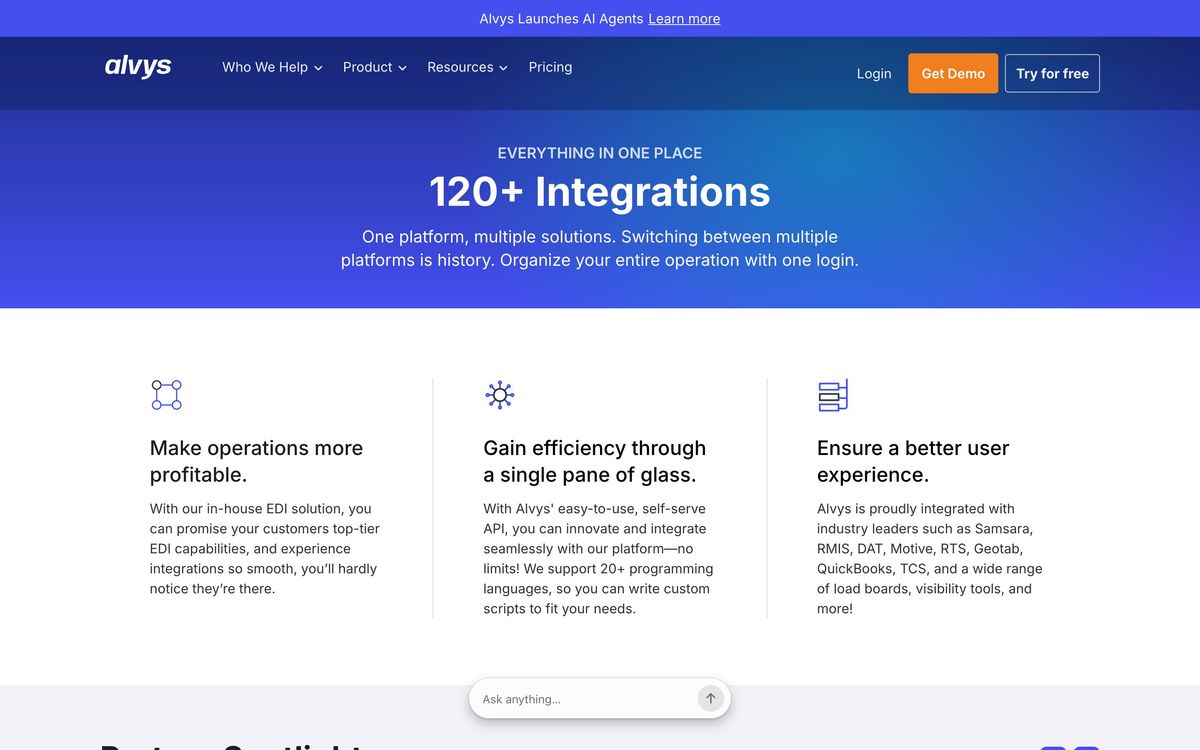
- Native EDI and a documented public API remove the middleware most legacy systems need for shipper connections
- The driver app scans and attaches bills of lading and proofs of delivery in the field, which shortens the billing cycle
- Load boards, ELD platforms and QuickBooks connect directly rather than through file exports
Cons
- Capterra reviewers repeatedly cite upload times and general system lag on document-heavy workflows
- Data migration from a previous TMS often imports incompletely and needs manual correction, which stretches go-live
- EDI connections to individual shippers have taken longer to activate than sales conversations imply, and invoice editing after posting is restricted
What Alvys actually does
Alvys is a cloud transportation management system for companies that move freight: asset-based trucking carriers, freight brokers, hybrid operations that do both, and private fleets. It sits where the load lives. A load is created or imported, dispatched to a driver or a covering carrier, tracked through pickup and delivery, documented with a scanned bill of lading and proof of delivery, invoiced to the customer, and settled with the driver or carrier, all inside one record rather than across a dispatch board, a spreadsheet and an accounting file.
The delivery model is browser-based with a companion driver app, which is the main departure from the on-premise systems that still run much of the industry. Around that core sit the parts a carrier cannot skip: a compliance module for driver files, trucks, trailers and maintenance intervals; settlements and IFTA reporting; native EDI for shippers that require it; and a documented public API for reporting. Alvys also leans on AI to read emailed rate confirmations and build the load rather than having a dispatcher key it.
Key features
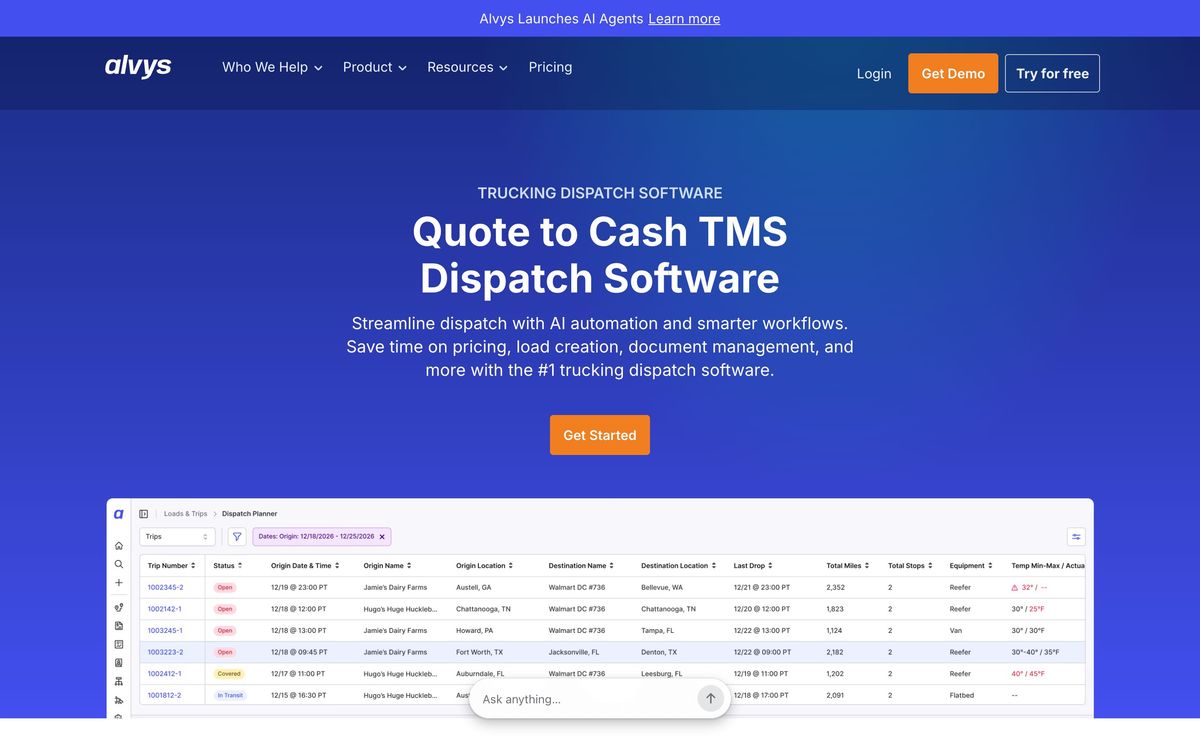
The modules are organised around the lifecycle of a single load.
- Load dispatch with attached documents, status updates and board-level visibility for the whole team
- Driver mobile app that scans paperwork, tracks assets and carries in-field messaging
- Compliance and safety records for drivers, tractors, trailers and maintenance schedules
- Billing, carrier settlement and IFTA reporting in the same ledger the dispatcher works in
- Native EDI connections for shipper data exchange, with a public API for custom reporting
- AI-assisted load creation that extracts details from rate confirmations and inbound documents
Who it's for
The strongest fit is a carrier or brokerage between roughly ten and a few hundred loads a week that has outgrown spreadsheets, or one running an aging on-premise TMS whose per-seat licensing discourages putting dispatch, billing and safety staff on the same system. Unlimited users matter here: back-office headcount in freight is high relative to revenue, and seat pricing quietly determines who gets access to the truth.
It is a weaker fit for very small owner-operator fleets, where the monthly commitment outruns the paperwork it saves, and for large enterprise shippers with mature EDI estates and custom integration requirements, who will find the connection queue slower than promised. Anyone migrating a long operating history should also budget real time for data cleanup rather than expecting a clean import.
How it compares
McLeod remains the deep incumbent, with accounting and workflow depth Alvys does not match, but it is heavier to implement and priced for larger operations. Rose Rocket competes closest on modern interface and speed of onboarding, and edges Alvys on customer-facing portals, while offering less on driver settlements. Turvo sells collaboration and shipper visibility above all, which suits brokerages that live in customer communication but costs more and does less on the asset side. Alvys sits between the legacy depth and the lightweight newcomers, which is both its appeal and the source of its growing pains.
Verdict
Alvys earns its position for operations that need one system rather than a stack, and the combination of unlimited users, native EDI and load-lifecycle coverage is genuinely hard to assemble elsewhere at this level. What holds the rating down is not the feature list but the execution around it. Reviewers on public sites describe upload lag on document-heavy days, imports arriving incomplete, and EDI activations that slipped past the timeline set during the sales process. Pricing is quote-based and consultative rather than published, which makes comparison shopping slower than it should be. Ask for a reference customer at your load volume and insist on a written EDI timeline before signing.
Ready to try Alvys?
More service-businesses tools like Alvys
Weave
4.5All-in-one phone, texting, scheduling and payments platform for dental, vet and optometry practices.
Read Weave review →Jane
4.4Practice management and EMR for allied health clinics: booking, charting, billing and payments in one record.
Read Jane review →Synthflow AI
4.4No-code voice AI agents for inbound and outbound calls: booking, lead qualification and support, 24/7.
Read Synthflow AI review →Bókun
4.3Booking system and OTA channel manager for tour, activity and rental operators, owned by Tripadvisor.
Read Bókun review →Boulevard
4.3Booking, point of sale and client records for salons, spas and medspas that run on appointments.
Read Boulevard review →Buddy Punch
4.3Online time clock for hourly staff, with GPS, geofencing and photo verification on every punch.
Read Buddy Punch review →