
TestGorilla review
Pre-hire skills testing with a 350-test library, AI interviews and scored shortlists that replace CV screening.
The broadest skills-testing library available to a small hiring team, though the annual contract and credit model deserve more scrutiny than the free plan suggests.
Pros
- More than 350 tests spanning cognitive ability, personality, language, software skills and role-specific knowledge
- Every candidate answers the same questions under the same conditions, which makes comparison defensible when a rejection is challenged
- Assessments combine up to five tests plus custom questions, so one link covers the whole first-round screen
- AI interviews, job simulations and ID verification extend screening past multiple choice on the upper tier
- The free plan is a real trial: monthly credits, resume scoring and a set of essential tests without a card
Cons
- Paid plans are annual commitments, and buyers repeatedly report discovering this after assuming a monthly subscription, with cancellation requests refused
- Everything meaningful consumes credits - one per skills test, two per AI interview or simulation - so screening cost scales with applicant volume
- ATS integrations and custom coding challenges sit behind the top self-serve tier, which is several times the price of the entry plan
TestGorilla pricing
List prices in USD per month, taken from the vendor at review time. Custom means quote-only.
| Plan | Per month | What it covers |
|---|---|---|
| Free | Free | 10 credits per month, 5 essential tests, resume scoring, 1 seat |
| Core | $142 | billed annually at $1,704; full 350+ test library, 2 seats, sourcing access |
| Plus | $400 | from, billed annually from $4,800; adds AI interviews, simulations, ID verification, ATS integrations, unlimited seats |
| Enterprise | Custom | custom pricing with scientific validation, security review and tailored terms |
What TestGorilla actually does
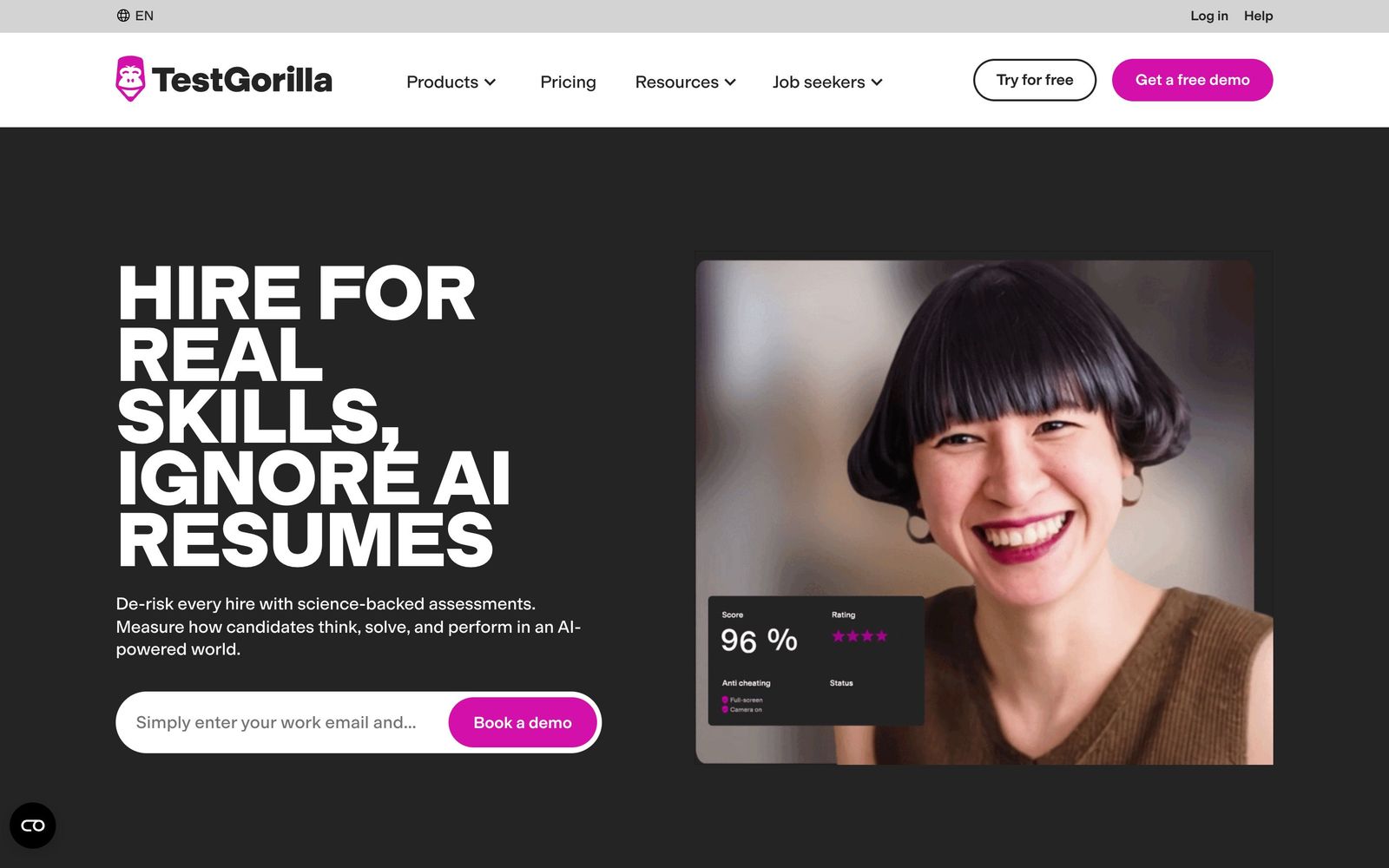
TestGorilla is an assessment platform built on a simple premise: a CV is a poor predictor of whether someone can do a job, so measure the work instead. A hiring team assembles an assessment from a library of more than 350 tests - cognitive ability, personality and culture-add, language proficiency, software tools, role-specific knowledge - adds a few custom or video questions, and sends one link to every applicant. Results come back as a ranked shortlist with per-test scores, so a first round that used to mean reading two hundred CVs becomes a sorted table.
The platform has grown past testing. AI-led video and audio interviews now run structured first conversations with automatic scoring, job simulations put candidates into role-realistic tasks, custom coding challenges cover technical hiring, and ID verification and proctoring address the obvious integrity questions. Resume scoring and access to a pool of already-tested candidates extend it towards sourcing. Everything is metered by credits rather than by seat: a skills test consumes one credit per candidate, an AI interview or simulation two. That model is the most important commercial fact about the product, because screening cost rises with applicant volume rather than with team size.
Key features
The parts that carry the screening process:
- Library of 350+ tests covering cognitive ability, personality, language, software and job-specific skills
- Assessments combining several tests with custom, video and qualifying knock-out questions
- AI video and audio interviews with structured follow-ups and automatic scoring
- Job simulations and custom coding challenges for role-realistic evaluation
- Resume scoring and sourcing against a pool of candidates who have already tested
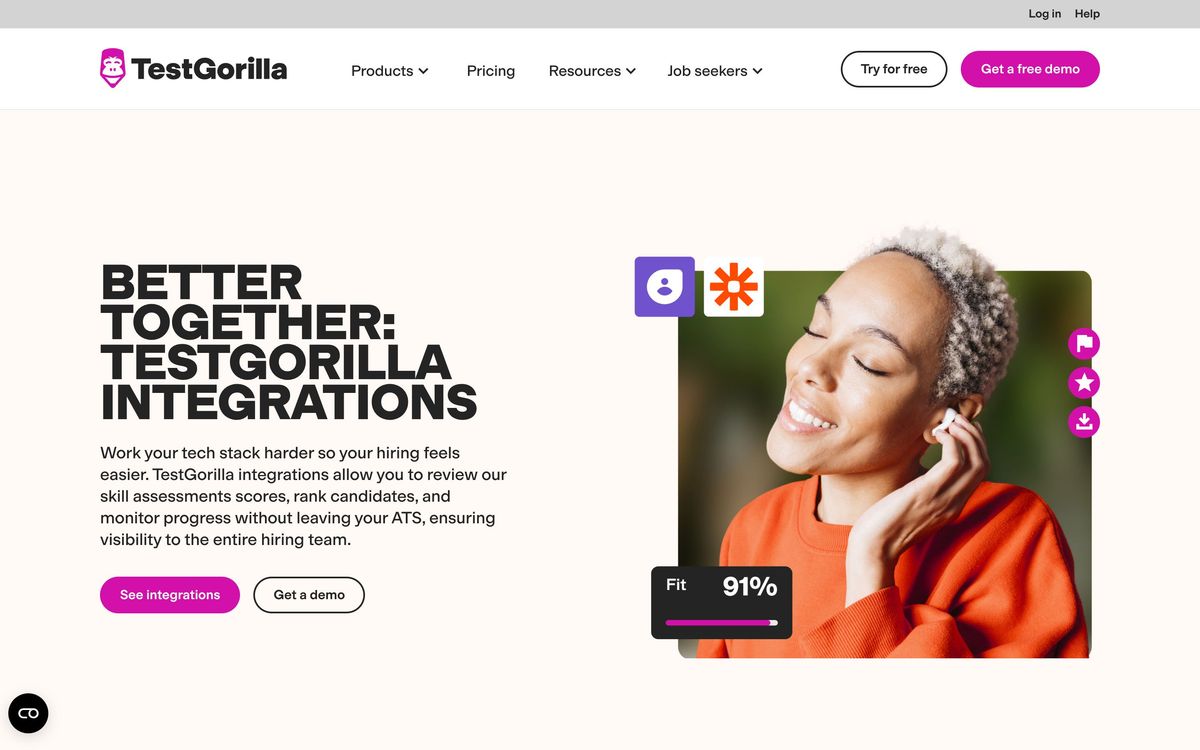
- ATS integrations that write scores back into Greenhouse, Lever, Workable, Teamtailor and others
Who it's for
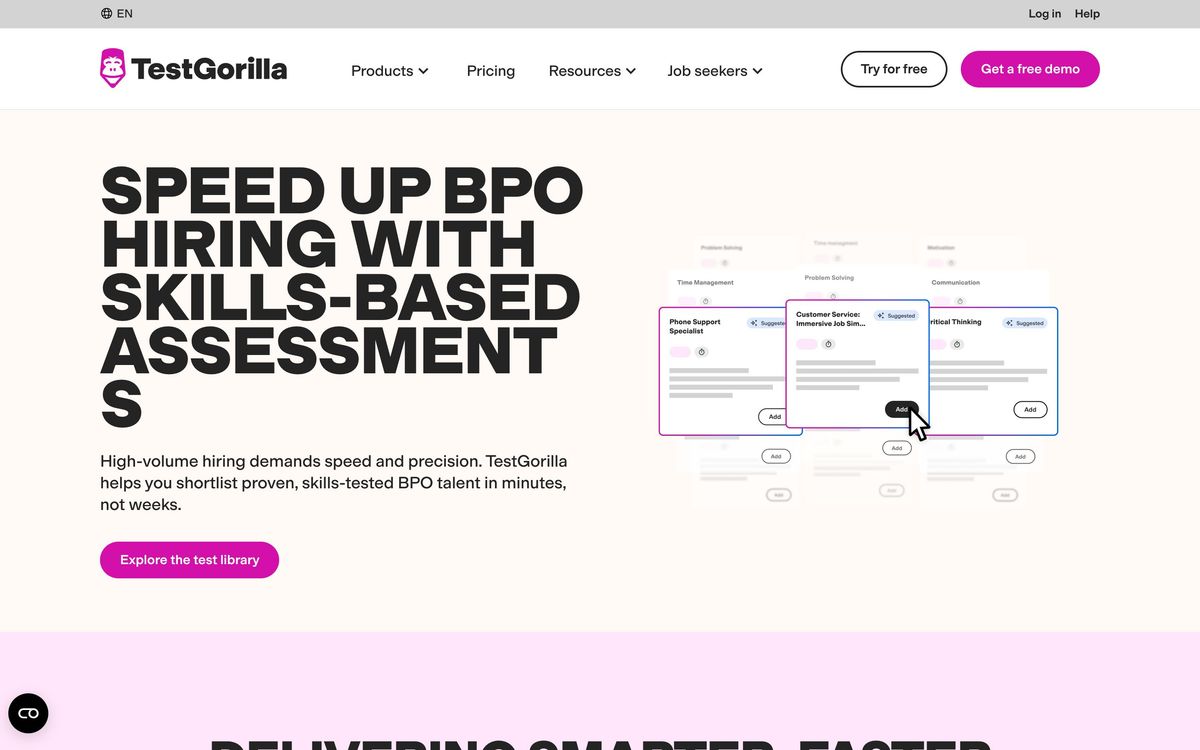
The strongest case is a team hiring at volume for roles where credentials say little: customer support, sales development, operations, outsourcing and shared-services roles, entry-level positions with hundreds of applicants. For those funnels, a scored shortlist saves days of reading and produces a defensible audit trail if a rejected candidate asks why. Teams deliberately hiring without degree requirements get the most, because the tests give them something concrete to stand on.
It fits badly at the other end of the market. A company making four senior hires a year will burn a full annual subscription on a handful of assessments, and executive candidates tend to refuse timed tests anyway. Engineering teams should trial the coding experience with their own developers first, since candidate complaints about the code editor and environment are a recurring theme in reviews. Any buyer should also treat the free plan as a product trial rather than a pricing signal: the step from free to paid is an annual commitment, not a monthly one.
How it compares
Criteria and Wonderlic occupy the psychometric end of the market with longer validation histories and stronger defensibility for regulated or high-stakes hiring, but narrower libraries and less self-serve tooling. Vervoe leans harder on simulations of the actual job and grades open-ended work more intelligently, which suits practical roles, though its test catalogue is smaller. HackerRank and CodeSignal beat TestGorilla comfortably for software engineering, with better editors, richer languages and interview tooling that candidates do not complain about. TestGorilla wins on breadth across non-technical roles and on how quickly a small team can get a screen running; it loses on technical depth and on scientific pedigree.
Verdict
As a way to replace CV sorting with something measurable, this is the most accessible product in the category, and the library is broad enough that most non-technical roles are covered without custom work. The rating is held back by commercial mechanics rather than by the assessments: the annual commitment behind an apparently monthly price, the refusal of mid-term cancellations reported by numerous buyers, and a credit model that makes the true cost of a high-volume funnel hard to predict. Anyone signing should get the contract term, renewal date and credit consumption in writing before the first assessment goes out.
Ready to try TestGorilla?
There's a free tier, so you can test it before committing.
More recruiters tools like TestGorilla
Rippling
4.4One employee record driving HR, payroll, benefits, devices and spend, with onboarding automated end to end.
Read Rippling review →HiBob
4.3HRIS for mid-sized, multi-country companies, covering the employee record, performance, compensation and payroll sync.
Read HiBob review →Recruit CRM
4.3An all-in-one ATS and CRM built specifically for recruitment and executive-search agencies.
Read Recruit CRM review →Breezy HR
4.2Drag-and-drop applicant tracking and hiring automation built for small and growing recruiting teams.
Read Breezy HR review →CoRecruit
4.2Records recruiter calls across phone, video and in person, then writes the notes and candidate submittals into the ATS.
Read CoRecruit review →Deputy
4.2Shift scheduling, time clocking and break compliance for businesses that run on hourly staff.
Read Deputy review →