
Teamtailor review
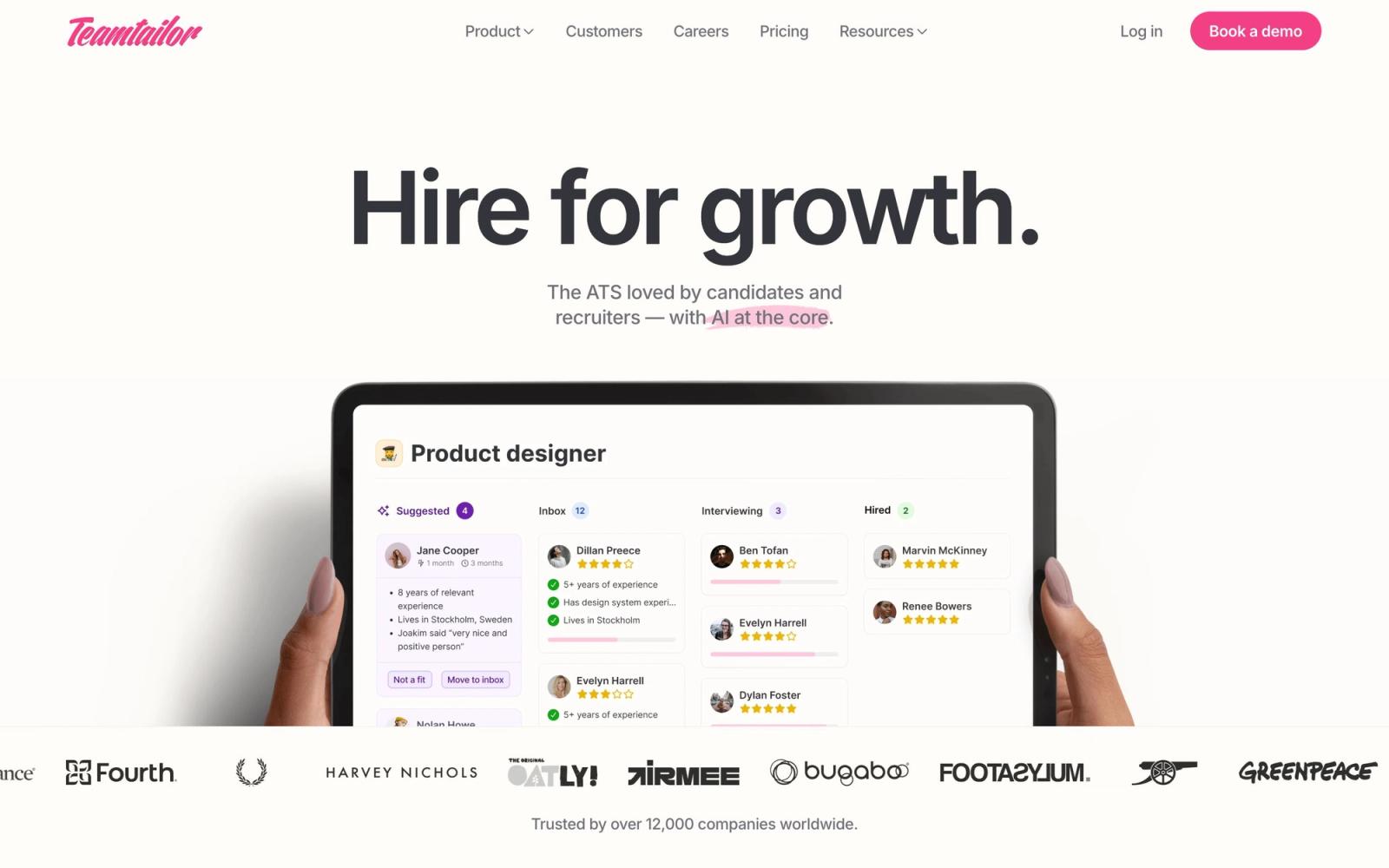
An employer-branding-first ATS built for mid-market and scaleup talent teams.
A strong pick if career-site branding and candidate experience matter most; weak on deep screening, analytics, and price transparency.
Pros
- Best-in-class drag-and-drop career sites and employer-branding tools that need no developer
- CRM/talent-pool layer makes re-engaging past applicants genuinely easy
- Contracts typically include unlimited users and unlimited job postings
Cons
- Quote-only, job-slot pricing with a 12-month minimum and no public tiers makes budgeting hard
- Reporting/analytics and structured screening are shallower than enterprise ATS competitors
Key features
- No-code career site builder with dynamic, location/department-targeted content blocks
- Candidate CRM with tagging, segmentation, and automated re-engagement nurture
- AI assistant for job descriptions and resume summaries plus trigger-based workflow automation
Teamtailor pricing
List prices in USD per month, taken from the vendor at review time. Custom means quote-only.
| Plan | Per month | What it covers |
|---|---|---|
| Free trial / demo | Custom | Time-limited trial or guided demo before purchase; no permanent free plan |
| Core (entry) | $229 | Reported entry point ~$229/mo; priced by number of concurrent open job slots, not per seat. Quote-only |
| Mid-market (typical) | $1,375 | Buyer-reported average contract ~$16,500/yr (~$1,375/mo); scales with job slots. 12-month minimum, 3-8% renewal escalators |
| Enterprise | Custom | Custom quote; large job-slot volumes reported up to ~$72,000/yr. Contact sales |
What it is and who it's for
Teamtailor is an applicant tracking system that leads with employer branding rather than pure pipeline mechanics. It's aimed at mid-market companies and scaleups, with deep adoption among in-house talent teams who want their careers page to act as a real recruiting channel. If your hiring problem is presentation, candidate experience, and re-engaging known talent, this is squarely in its lane.
Where it's strong
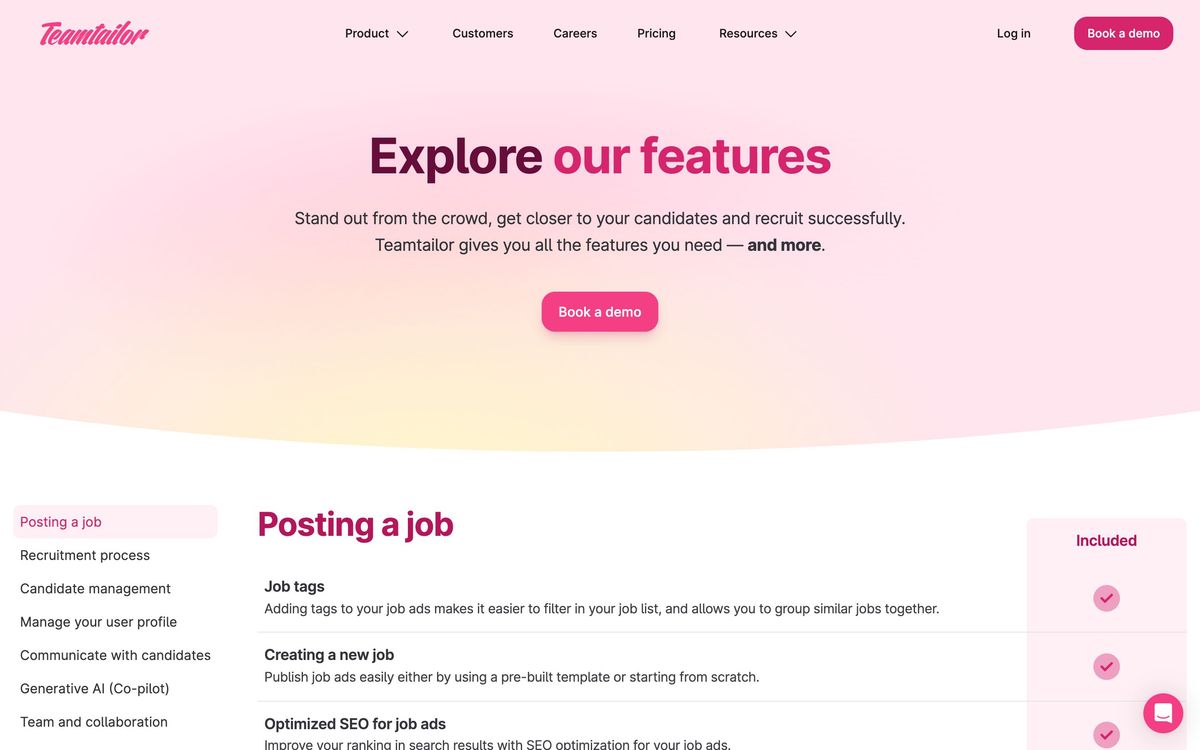
The career-site builder is the standout: recruiters can match brand guidelines with custom colors, fonts, video headers, and testimonials without touching a developer, and dynamic blocks can serve different content by location or department. The candidate CRM is also better than most similarly priced tools, letting you tag, segment, and run automated re-engagement on past applicants, which pays off for teams that hire from the same pools repeatedly. Trigger-based automation and an AI assistant for drafting descriptions and summarizing resumes round out a genuinely pleasant day-to-day workflow.
Where it falls short and what it costs
Reporting and analytics are functional but thinner than enterprise competitors, structured screening is modest, and several reviews flag that HRIS and calendar integrations can be clunky to set up. Pricing compounds the friction: it's quote-only and based on concurrent open job slots rather than seats, with reported entry deals around $229/mo but an average contract near $16,500/yr, a 12-month minimum, and 3-8% renewal escalators. The upside is unlimited users and postings; the downside is zero price transparency until you talk to sales.
Regional fit and verdict
On data handling it offers a choice of processing regions and a clear DPA, and it's usable worldwide. If employer brand and candidate experience top your priorities, it earns its reputation among recruiters; just go in clear-eyed about the opaque slot-based pricing and lock-in, confirm your contracted data region in writing, and run the trial against real hiring volume before signing.
The career site builder, specifically
This is the feature people buy Teamtailor for, so it is worth being precise about what it does. The builder is block-based drag and drop; you assemble a page from prefabricated blocks including job listings, homepage covers and testimonial templates, and publish. Teamtailor is explicit that coding is not required; developers can drop into HTML and CSS if they want finer control, but nothing about the normal path assumes one is available.
That matters because of who actually owns career sites. In most mid-market companies the page lives on the marketing team's CMS and every change is a ticket in someone else's backlog, which is why so many career pages are a stale list of job titles. Moving the page into the ATS puts it back under the recruiting team, and the practical effect is that it gets updated; not that it is prettier.
Multi-language support goes further than a translation toggle: you can add pages with translated content, or build genuinely different experiences per language rather than one page mechanically restated. For a company hiring across several markets that is the difference between a career site that works in its second market and one that merely exists there.
The honest limit is that a good career site fixes the top of the funnel and nothing below it. If candidates apply and then stall in a slow process, a better page increases the number of people experiencing the slow process. Teamtailor is the right purchase when applications are the constraint, and the wrong one when throughput is.
What the AI actually does
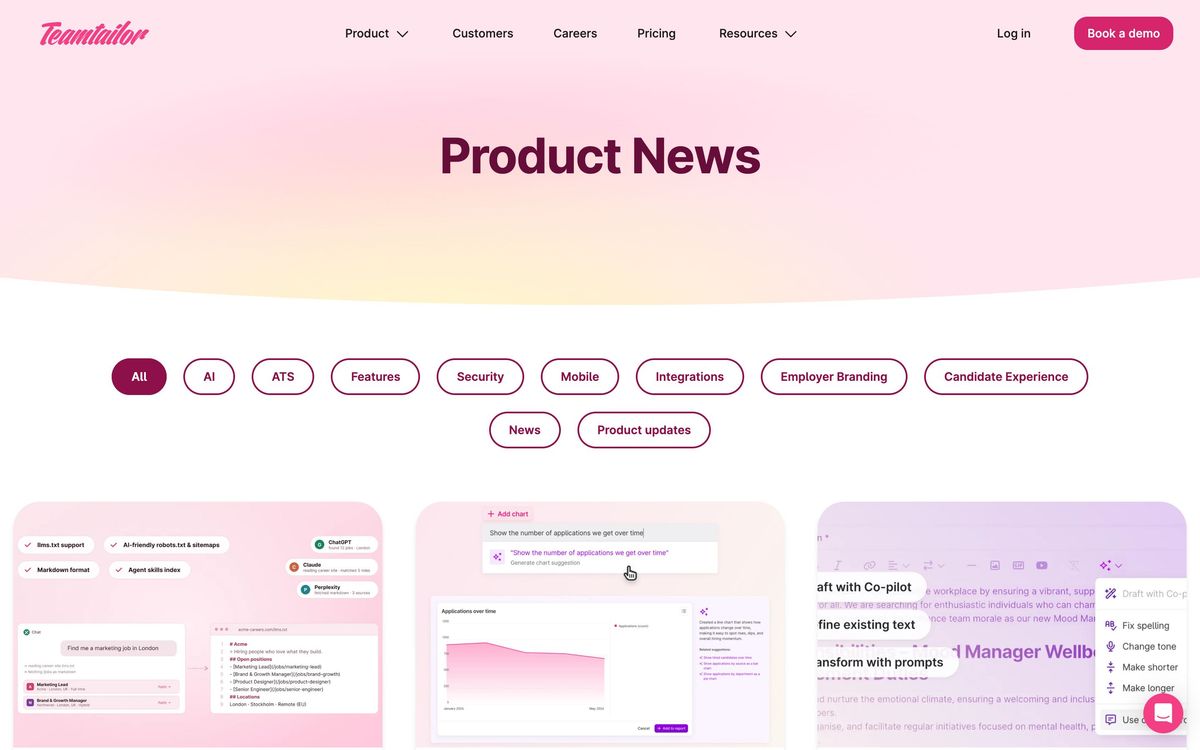
Teamtailor's AI is aimed at attraction rather than evaluation, which is a narrower claim than most ATS vendors make and matches where the product is strong. The AI Co-pilot writes and optimises job descriptions, with organic search performance as an explicit goal; the pitch is that a description written this way surfaces better and reads better to the right candidate, not that it screens anybody.
Note what is absent. There is no serious structured-screening or scoring layer here of the sort Workable ships, and our review flags structured screening as one of the platform's weak points. If your evaluation criterion is "which ATS uses AI to shortlist candidates for me", Teamtailor is not the answer and does not really claim to be. If it is "which ATS helps me write postings that attract the right people", it is squarely on target.
Treat that as a feature of the product rather than a gap to be filled later: attraction-side AI is measurable against application volume within a hiring cycle, whereas screening AI needs enough hires to validate and carries bias-audit obligations that a mid-market team is rarely resourced to meet.
Scaling from 100 to 1,000 employees
This is the band Teamtailor is built for, and the band where its pricing model turns from an advantage into a liability; in that order, which is why the answer changes as you grow.
On the product side, scaling is genuinely well handled. Contracts include unlimited users and unlimited job postings, so growing headcount does not mean buying seats, and hiring managers across a widening org can all be inside the system. The CRM and talent-pool layer compounds as you grow: at 150 people your applicant history is thin, at 800 it is a real sourcing channel and re-engaging past applicants beats starting cold.
On the commercial side it gets harder. Pricing is quote-only and metered on concurrent open job slots, and slot counts rise with hiring velocity, which is exactly what happens on the way from 100 to 1,000. Buyers report an entry point near $229/month and a mid-market average around $16,500 a year, with large slot volumes reaching roughly $72,000; a spread wide enough that the number you are quoted at 150 employees tells you very little about the number you will see at 700. Twelve-month minimums and renewal escalators in the 3-8% range mean each step up is locked for a year.
Two things to do before signing, both of which are cheaper now than at renewal: get slot pricing quoted at the volume you expect in eighteen months rather than today's, and confirm the escalator in writing. And check reporting against your actual requirements early; analytics is the platform's thinnest area, and it is precisely the thing a talent team gets asked to produce once the company passes a few hundred people.
Ready to try Teamtailor?
There's a free tier, so you can test it before committing.
More recruiters tools like Teamtailor
Employment Hero
4.0HR records, payroll, rostering and hiring in one platform for small and mid-sized employers.
Read Employment Hero review →Tellent
4.0Modular hiring and HR suite pairing the Recruitee ATS with an HRIS and performance reviews.
Read Tellent review →Top Echelon
3.8ATS and recruiting CRM for staffing agencies, paired with a split-placement network of other recruiters.
Read Top Echelon review →Rippling
4.4One employee record driving HR, payroll, benefits, devices and spend, with onboarding automated end to end.
Read Rippling review →HiBob
4.3HRIS for mid-sized, multi-country companies, covering the employee record, performance, compensation and payroll sync.
Read HiBob review →CoRecruit
4.2Records recruiter calls across phone, video and in person, then writes the notes and candidate submittals into the ATS.
Read CoRecruit review →