
Rippling review
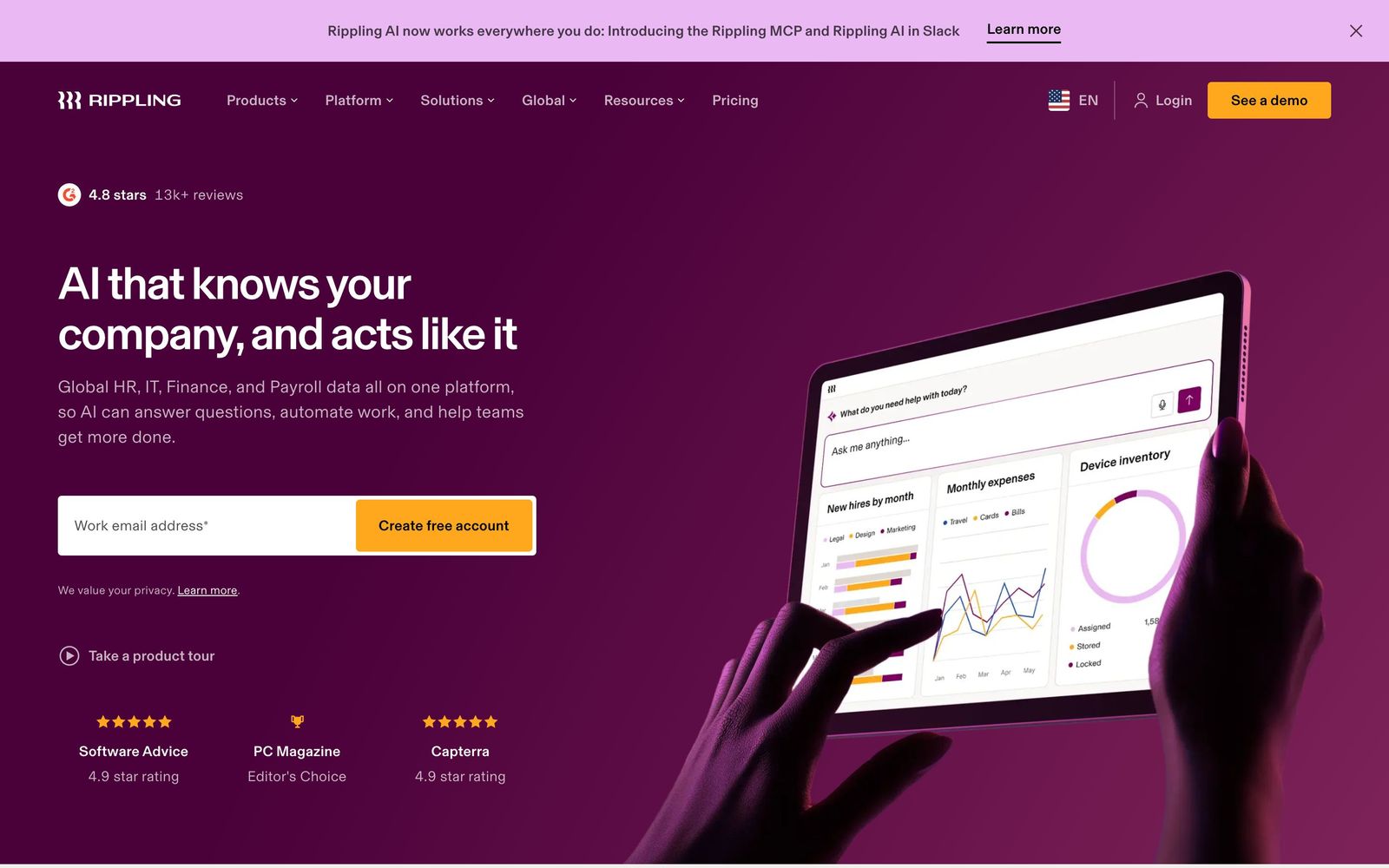
One employee record driving HR, payroll, benefits, devices and spend, with onboarding automated end to end.
The only platform that genuinely unifies HR, IT and finance on one employee record, though nothing about its real cost is published and support is thin for the price.
Pros
- A single employee record drives payroll, benefits, app access and device state, so one hire or termination updates everything at once
- Native device management ships configured laptops with MDM enrolment to dozens of countries, which no other HR platform does in-house
- Workflow automation is no-code and genuinely broad: triggers on any employee field can provision apps, assign training or move approvals
- Payroll runs natively in several countries and reaches many more through global payroll and employer-of-record arrangements
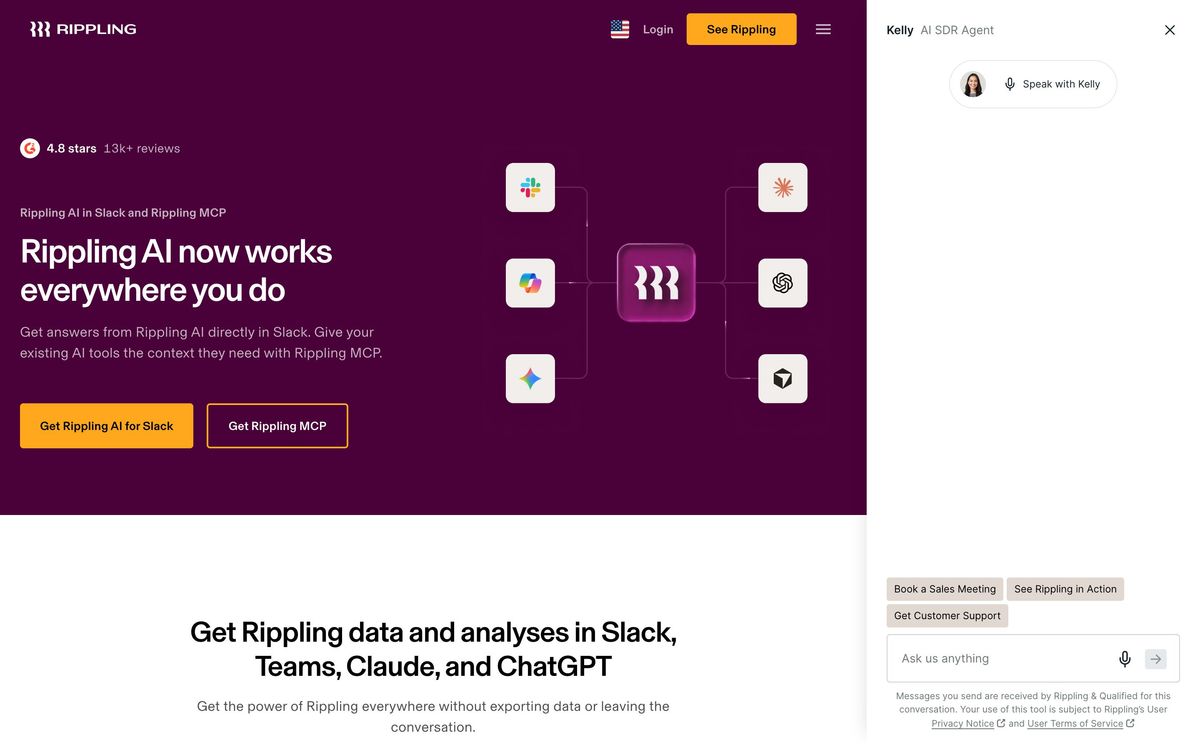
- An unusually large integration catalogue covering identity, collaboration, finance and engineering tools
Cons
- Only the base platform fee is published; every module is quoted, so total cost per employee is impossible to estimate before talking to sales
- Support runs business hours with no phone line and is gated behind chat for administrators only, which is poor for a payroll system
- Multi-module configuration has a real learning curve and implementation cost, making it heavy for a team under about twenty-five people
Rippling pricing
List prices in USD per month, taken from the vendor at review time. Custom means quote-only.
| Plan | Per month | What it covers |
|---|---|---|
| Platform base | $8 | per employee per month, the only published figure; a flat platform fee applies on top |
| Modules | Custom | payroll, benefits, IT, finance and EOR are quoted individually and not published; contracts are custom |
What Rippling actually does
Rippling starts from an unusual architectural decision: one employee record, shared by every function that touches an employee. Hiring someone in the HR module is what enrols them in payroll, assigns benefits, orders a laptop, enrols that laptop in device management, creates their accounts in the company's SaaS tools, and starts their onboarding checklist. Offboarding runs the same sequence in reverse, including a remote wipe and a recovery shipment. That single record is the whole product thesis; the modules are what sit on top of it.
Those modules span three domains that are normally three separate vendors. HR covers records, onboarding, time and attendance, performance and recruiting. Payroll runs natively in a handful of countries, extends to many more through global payroll, and covers dozens of jurisdictions through employer-of-record entities where a company has no legal presence. IT covers identity, app provisioning, device procurement and mobile device management. Finance covers corporate cards, expense management and bill pay. Underneath all of it sits a no-code automation layer that can fire on any field change - a promotion, a location move, a contract end date - and take action across every connected system. The company reports more than thirty thousand business customers.
Key features
What separates it from a conventional HRIS:
- A unified employee record driving HR, payroll, benefits, IT and finance modules together
- Payroll with native runs in several countries plus global payroll and employer-of-record coverage
- Device procurement, shipping, MDM enrolment, remote wipe and equipment recovery
- App provisioning and deprovisioning across hundreds of connected SaaS products
- No-code workflow automation triggered by any change to an employee record
- Spend management with corporate cards, expense capture, reimbursements and bill pay
Who it's for
The natural buyer is a company between roughly fifty and a thousand employees where the same two or three people handle HR and IT and are drowning in the handoffs between them. The value shows up on hiring days and departure days, when a process that normally spans four systems and a checklist becomes one form. Companies with employees in several countries benefit most, because the alternative is stitching a domestic HRIS to a separate EOR provider and reconciling the two by hand.
Smaller teams should hesitate. Under about twenty-five people, the configuration work and implementation fee outweigh the coordination saved, and simpler payroll products will do the job with less setup. Companies whose IT stack is already standardised on a dedicated identity provider and MDM will pay for capabilities they will not switch to. Anyone in a regulated industry needing round-the-clock payroll support should test the support model before signing: it is chat-first, administrator-only and business hours, which is a genuine mismatch with the criticality of the system.
How it compares
Gusto is the obvious comparison for smaller US companies: cheaper, published pricing, warmer support, and far easier to run without a project plan, but with no device management and much weaker international reach. Deel wins on pure global hiring, with deeper contractor tooling and entity coverage in more countries, though its domestic HR and IT features are thinner and its platform feels assembled from acquisitions. Justworks takes the PEO route and shoulders compliance and benefits risk directly, which suits firms that want fewer decisions rather than more control, at the cost of flexibility. Rippling wins whenever HR and IT are the same problem to the same person; it loses on price transparency and on service to all three.
Verdict
This is the most technically ambitious product in its category and the automation is not marketing - onboarding and offboarding really do collapse into a single action, and that alone justifies the platform for teams doing both frequently. The caveats are commercial rather than functional. Nothing beyond a base platform rate is published, so budgeting requires a sales conversation and every renewal is a negotiation; the support model is weak for a system that pays people; and the implementation is a project rather than a signup. Buyers should price the specific modules they need, in writing, before comparing it to anything else.
Ready to try Rippling?
More recruiters tools like Rippling
Oyster HR
4.0Employer of record and contractor payments for teams hiring in countries where they have no entity.
Read Oyster HR review →Paylocity
4.0US payroll and HCM suite that adds engagement, recognition and survey tools to the core HR record.
Read Paylocity review →Payoneer Workforce Management
4.0Employer of record, contractor management and cross-border payouts for teams hired in 160-plus countries.
Read Payoneer Workforce Management review →Papaya Global
3.9Runs global payroll, employer of record hiring and cross-border workforce payments from one platform.
Read Papaya Global review →Niural
3.7US payroll, PEO, employer of record and cross-border payments for teams that are domestic and global at once.
Read Niural review →Checkr
4.4AI-powered background check platform: criminal, identity, MVR, drug, and verification screening at scale.
Read Checkr review →