
RemotePeople review
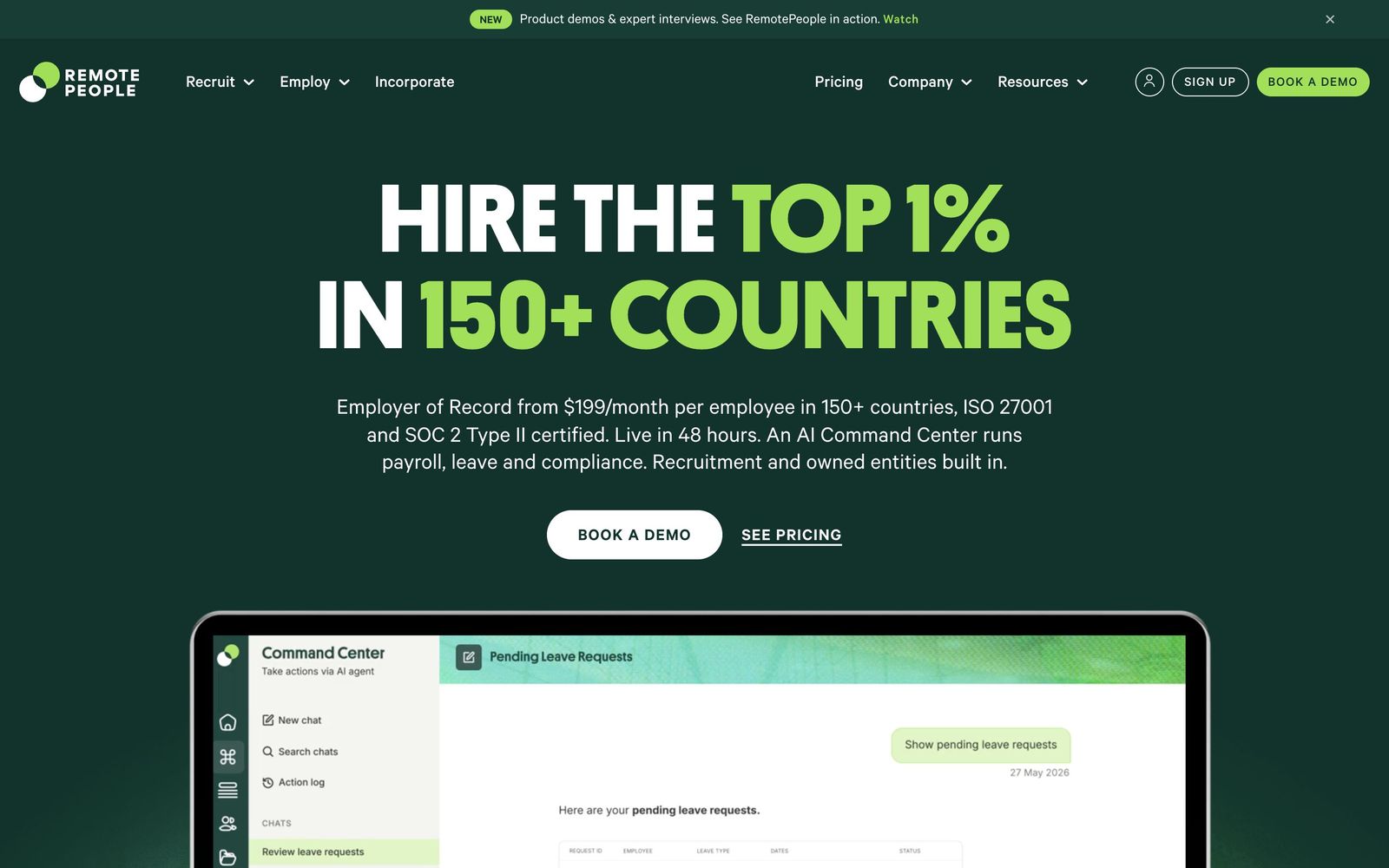
Employer of record and global payroll in 150-plus countries, with in-country recruiters attached.
One of the few employer of record providers that will also source the candidate, priced below the market leaders, though support quality varies by region in a way the reviews make plain.
Pros
- Employer of record pricing per employee sits below the published rates of most established competitors
- In-country recruiters are part of the same engagement, so sourcing and employment are not two vendors and two contracts
- Coverage spans more than 150 countries with local infrastructure rather than a chain of third-party partners
- Contractor management, contractor of record and a US PEO offering sit alongside EOR, so worker classification can change without changing vendor
- ISO 27001 and SOC 2 Type II certification, with entity incorporation and visa support available when a country stops being temporary
Cons
- Trustpilot reviews describe support quality varying by region and by assigned contact, so service levels are worth pinning down in the contract
- The platform is deliberately lean and does not replace an HRIS, so performance, onboarding and engagement stay in another system
- Recruitment is charged as a percentage of annual salary on top of the monthly employment fee, which changes the economics of a placement
RemotePeople pricing
List prices in USD per month, taken from the vendor at review time.
| Plan | Per month | What it covers |
|---|---|---|
| Employer of record | $199 | per employee per month, from |
| Global payroll | $25 | per employee per month, from |
| Contractor management | $29 | per contractor per month, from |
| US PEO | $99 | per employee per month, from |
What RemotePeople actually does
RemotePeople is an employer of record. When a company wants to hire someone in a country where it has no legal presence, the provider employs that person through its own local entity, issues a compliant contract, runs payroll, withholds tax and social contributions, administers benefits, and invoices the client for the total. The worker reports to the client and does the client's work; the paperwork belongs to the provider. Founded in 2018 and based in New York, the company covers more than 150 countries and says it operates on its own local infrastructure rather than reselling partner entities.
What distinguishes it from the better-known names is that recruitment is part of the offer. In-country recruiters will source and shortlist candidates before the employment relationship exists, which collapses two vendor relationships into one for a company opening a new market. Around that sits a full ladder of engagement models: global payroll for countries where the client already has an entity, contractor management with payment in a wide range of currencies, a contractor of record service that absorbs misclassification risk, a US PEO for domestic staff, and entity incorporation or visa support for teams that outgrow the arrangement. The platform itself is a dashboard for contracts, payroll runs, leave, expenses and documents, with integrations into common HRIS and accounting systems and an API for anything else.

Key features
The service list is broader than most providers of this size carry.
- Employer of record employment with localised contracts, statutory benefits and filings in 150-plus countries
- Global payroll in 150-plus currencies, with local tax and social contribution handling
- Contractor management and a contractor of record option that shifts classification risk to the provider
- In-country recruitment with vetted shortlists, charged as a percentage of annual salary
- US PEO covering benefits, payroll and state compliance for domestic employees
- Entity incorporation and visa or immigration support in a large share of covered countries
Who it's for
The clearest case is a company making its first two or three hires in a country it does not intend to incorporate in yet, where the alternative is a local law firm, an accountant and several months. Startups and mid-market teams hiring engineers in Eastern Europe, support staff in the Philippines or sales in Latin America are the recognisable pattern. The bundled recruiting matters most here: a company that does not know the local salary bands or where candidates come from is buying market knowledge as much as compliance.
It is a weaker choice for a company that already has an HR technology strategy and wants employment infrastructure to disappear into it, since the platform is functional rather than deep and will not stand in for an HRIS. It is also the wrong shape for organisations with complex, high-stakes hiring in a single market, who should press hard on named support and escalation paths before signing, given the variation reviewers describe.
How it compares
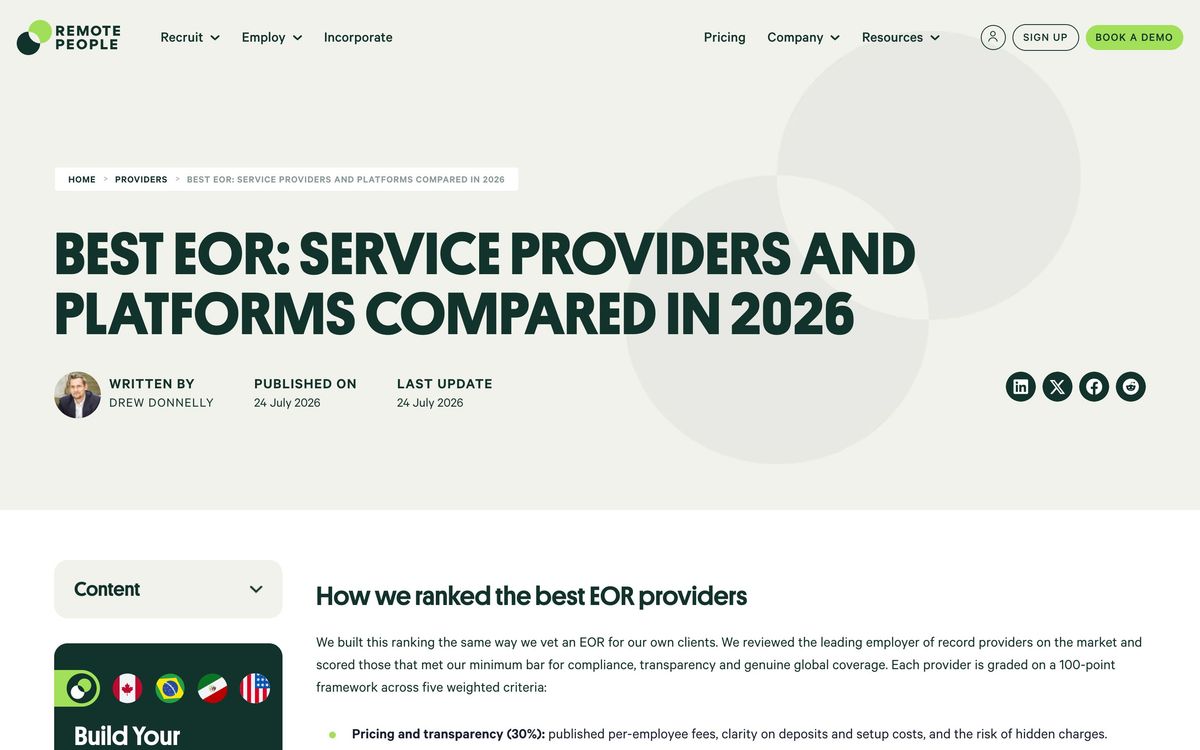
Deel and Remote are the reference points. Both have larger platforms, deeper integration ecosystems and more polished self-service, and both list higher standard rates for employer of record. Deel is the broadest on adjacent products, Remote the strongest on owned entities and transparency. Papaya Global aims at enterprise payroll consolidation and is oversized for a handful of hires. Against that field, RemotePeople competes on price and on the recruiting bundle, and concedes product depth. For a company hiring five people abroad rather than five hundred, that trade is often the right one.
Verdict
This is a capable, well-certified employer of record that is cheaper than the market leaders and unusual in offering to find the person as well as employ them, which is genuinely useful when entering an unfamiliar market. The rating reflects a real service with a thin platform rather than a polished product. The caveat is consistency: independent reviews are strong in aggregate but scattered with complaints about support depending on region and assigned contact, so the diligence that matters is asking who exactly handles your countries and what happens when a payroll run goes wrong.
Ready to try RemotePeople?
More recruiters tools like RemotePeople
Oyster HR
4.0Employer of record and contractor payments for teams hiring in countries where they have no entity.
Read Oyster HR review →Payoneer Workforce Management
4.0Employer of record, contractor management and cross-border payouts for teams hired in 160-plus countries.
Read Payoneer Workforce Management review →Papaya Global
3.9Runs global payroll, employer of record hiring and cross-border workforce payments from one platform.
Read Papaya Global review →Niural
3.7US payroll, PEO, employer of record and cross-border payments for teams that are domestic and global at once.
Read Niural review →Employment Hero
4.0HR records, payroll, rostering and hiring in one platform for small and mid-sized employers.
Read Employment Hero review →Paylocity
4.0US payroll and HCM suite that adds engagement, recognition and survey tools to the core HR record.
Read Paylocity review →