
HiBob review
HRIS for mid-sized, multi-country companies, covering the employee record, performance, compensation and payroll sync.
The strongest HRIS for a distributed knowledge-work company of a few hundred people, though pricing stays behind a demo and the frontline features are not there.
Pros
- The employee record is genuinely configurable, with custom fields and custom reports built without vendor involvement
- Multi-country structure is handled natively rather than bolted on, including local fields and permissions per site
- Performance reviews, calibration, goals, surveys and compensation cycles sit on the same data as core HR
- Payroll Hub syncs to local providers for countries where HiBob does not run payroll itself
- Adoption is unusually high for an HRIS because the employee-facing side is pleasant enough to actually use
Cons
- Pricing is quote-only and rises with every hire, and the published plans give no way to model a budget in advance
- Native payroll runs in the United States and United Kingdom only, so everywhere else needs an outside provider and a sync
- Shift scheduling, clock-in kiosks and mobile-first frontline workflows are absent, which rules out deskless workforces
What HiBob actually does
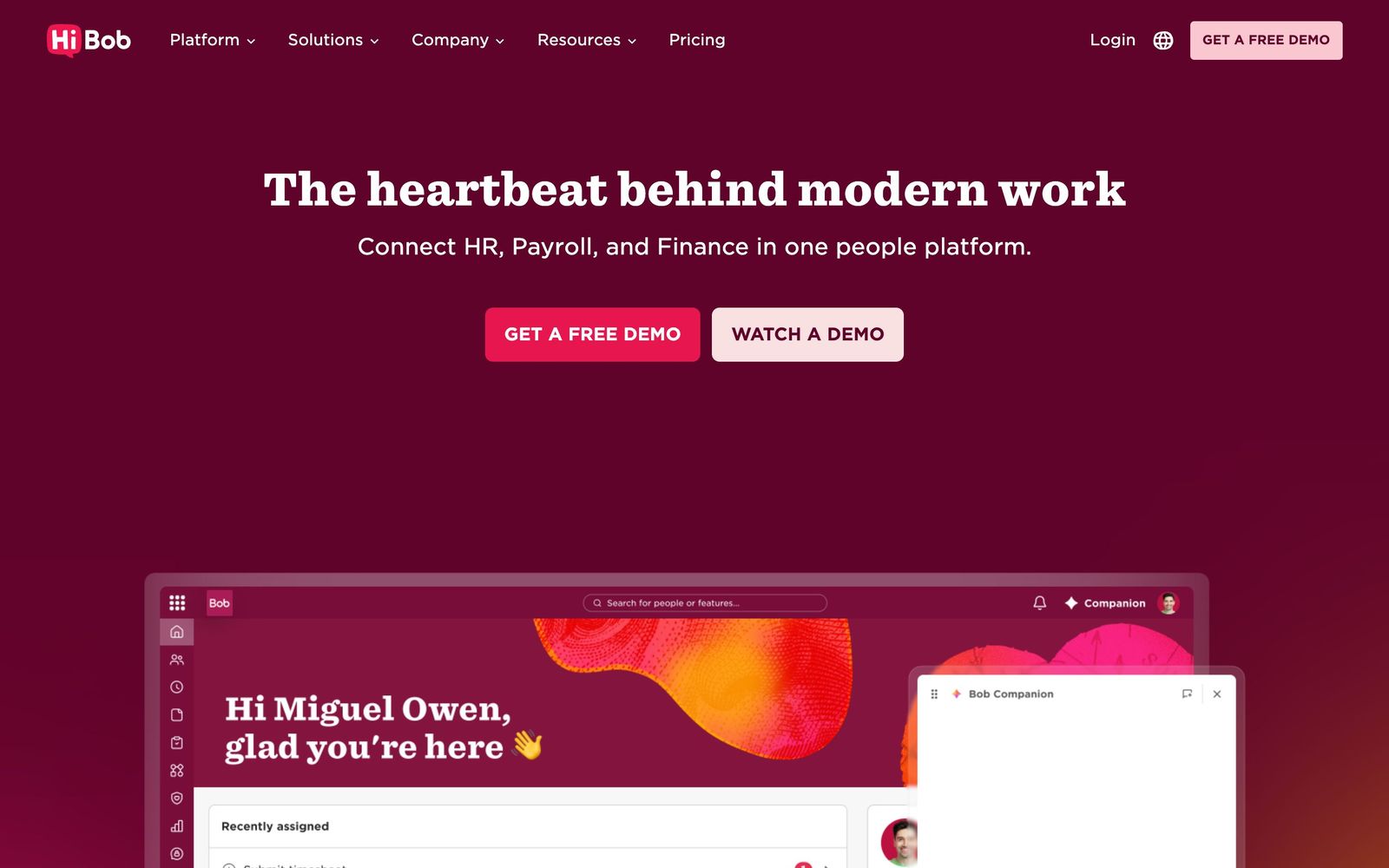
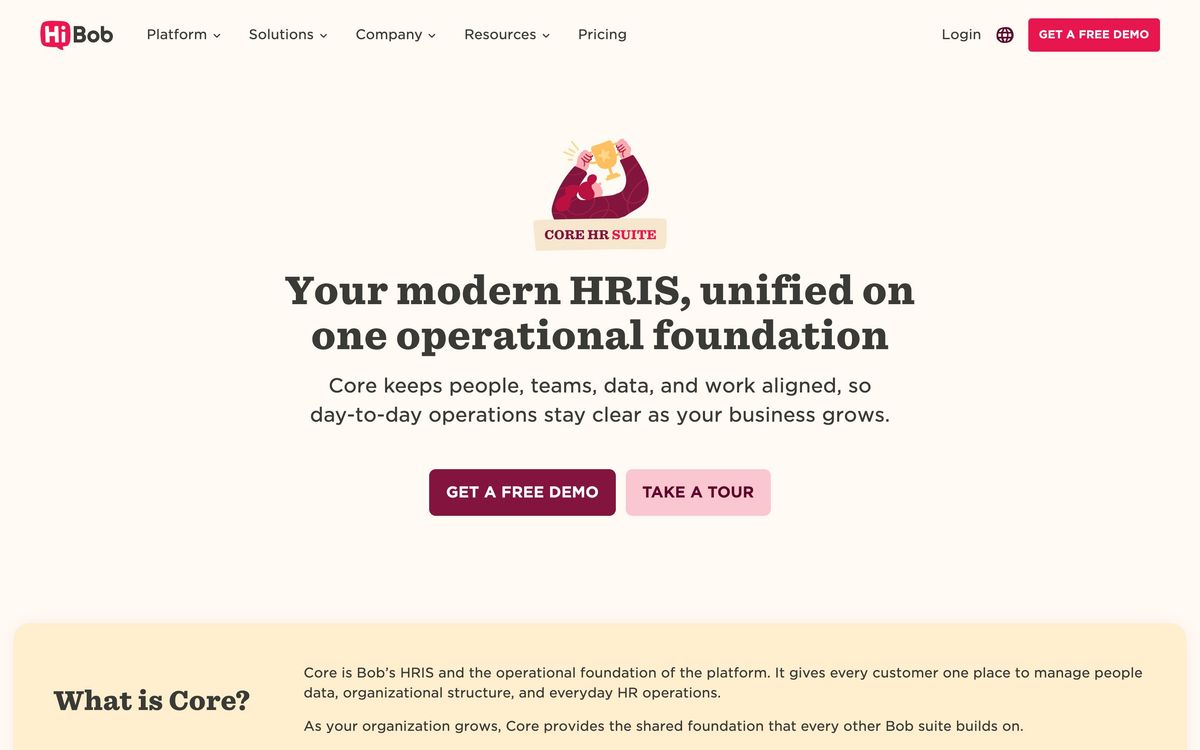
HiBob, usually called Bob by the people who administer it, is a human resources information system: the authoritative record of who works at a company, under what terms, reporting to whom, in which country. Everything else the platform does hangs off that record. Onboarding and offboarding run as workflows against it. Documents and signed contracts attach to it. Time off, attendance and org structure derive from it. The employee-facing side is a homepage with announcements, org charts, shout-outs and a directory, which is unusual for an HRIS and is a large part of why adoption tends to be higher than with older systems.
Around the core sits a wider suite that a mid-sized company would otherwise buy separately. Performance covers review cycles, calibration sessions, goals and one-to-ones. Compensation runs merit cycles against pay bands, with Mercer benchmarking available. There is hiring, learning, workforce planning and a survey tool. Payroll runs natively in the United States and the United Kingdom; everywhere else, Payroll Hub pushes changes to local providers and pulls results back so the record stays consistent. Bob AI answers questions about the data in plain language, drafts review text and job descriptions, and exposes the data to outside AI tools through a Model Context Protocol server.
Key features
These are the parts that decide most evaluations.
- A configurable employee record with custom fields, document storage and e-signature
- Lifecycle workflows for onboarding, offboarding, promotions and location changes
- Performance reviews with calibration, goals, one-to-ones and engagement surveys
- Compensation cycles with pay bands and Mercer benchmarking
- Native US and UK payroll plus Payroll Hub sync to local providers elsewhere
- Reporting with custom dashboards and natural-language querying through Bob AI
Who it's for
HiBob is aimed at companies of roughly one hundred to one thousand people, mostly desk-based, usually with staff in several countries. That shape is where it beats both the small-business systems and the enterprise suites: it handles multi-entity structure, local field requirements and per-country permissions without a consulting engagement, and a people team of two or three can configure it themselves. Companies that care about engagement data and want managers to actually open the tool get more from it than they would from a pure system of record.
It is the wrong system for a deskless or shift-based workforce. There is no shift scheduling, no clock-in kiosk, and the mobile experience assumes an office worker with a laptop. Very small companies will find it heavier and dearer than they need, and a company running payroll in a dozen countries should be clear that HiBob is syncing rather than paying people in most of them.
How it compares
BambooHR is simpler and cheaper and suits smaller, single-country companies, but its reporting and multi-entity handling are thinner. Rippling covers HR, IT provisioning and device management in one system, which is compelling if the buyer also owns IT, though its interface is denser and its module pricing stacks up. Deel and its peers win outright when the main problem is employing people abroad through an employer of record rather than managing a workforce already hired. Personio is the closer European comparison and handles local compliance well, while lagging on performance and engagement tooling.
Verdict
HiBob earns its reputation among mid-sized, distributed companies: the record is flexible, the reporting is usable without a data team, and the performance and compensation modules sit on the same data instead of pretending to. Bob AI is a real convenience rather than a demo trick. The caveats are commercial and structural. Pricing is per employee, quote-only, and grows with headcount, so the cost of success is not visible during evaluation, and native payroll covers only two countries. A company that is mostly frontline should not shortlist it at all.
Ready to try HiBob?
More recruiters tools like HiBob
Checkr
4.4AI-powered background check platform: criminal, identity, MVR, drug, and verification screening at scale.
Read Checkr review →Deel
4.4Global EOR, contractor management and payroll for hiring across 150+ countries from one platform.
Read Deel review →Rippling
4.4One employee record driving HR, payroll, benefits, devices and spend, with onboarding automated end to end.
Read Rippling review →Recruit CRM
4.3An all-in-one ATS and CRM built specifically for recruitment and executive-search agencies.
Read Recruit CRM review →Breezy HR
4.2Drag-and-drop applicant tracking and hiring automation built for small and growing recruiting teams.
Read Breezy HR review →CoRecruit
4.2Records recruiter calls across phone, video and in person, then writes the notes and candidate submittals into the ATS.
Read CoRecruit review →