
Tellent review
Modular hiring and HR suite pairing the Recruitee ATS with an HRIS and performance reviews.
A sensible one-vendor path from applicant tracking to reviews for mid-sized European teams, though reporting depth and sales-led pricing both frustrate buyers.
Pros
- Recruitee is one of the more collaborative applicant tracking systems, with hiring-manager scorecards and shared pipelines
- Careers site and job templates are editable without developer help, including multi-language postings
- Modules can be bought separately, so an ATS-only team is not forced to take the HRIS
- Marketplace covers job boards, assessment vendors and calendar tools rather than requiring custom API work
- Employee record, absence and performance data live in one place once both modules are in use
Cons
- Reporting is the most common complaint: limited data extraction and weak handling of continuously open roles
- Candidate search inside a large talent pool is slow and awkward compared with dedicated sourcing tools
- Pricing is quote-only and scales with headcount, and SSO, Journeys and WhatsApp hiring are paid add-ons
What Tellent actually does
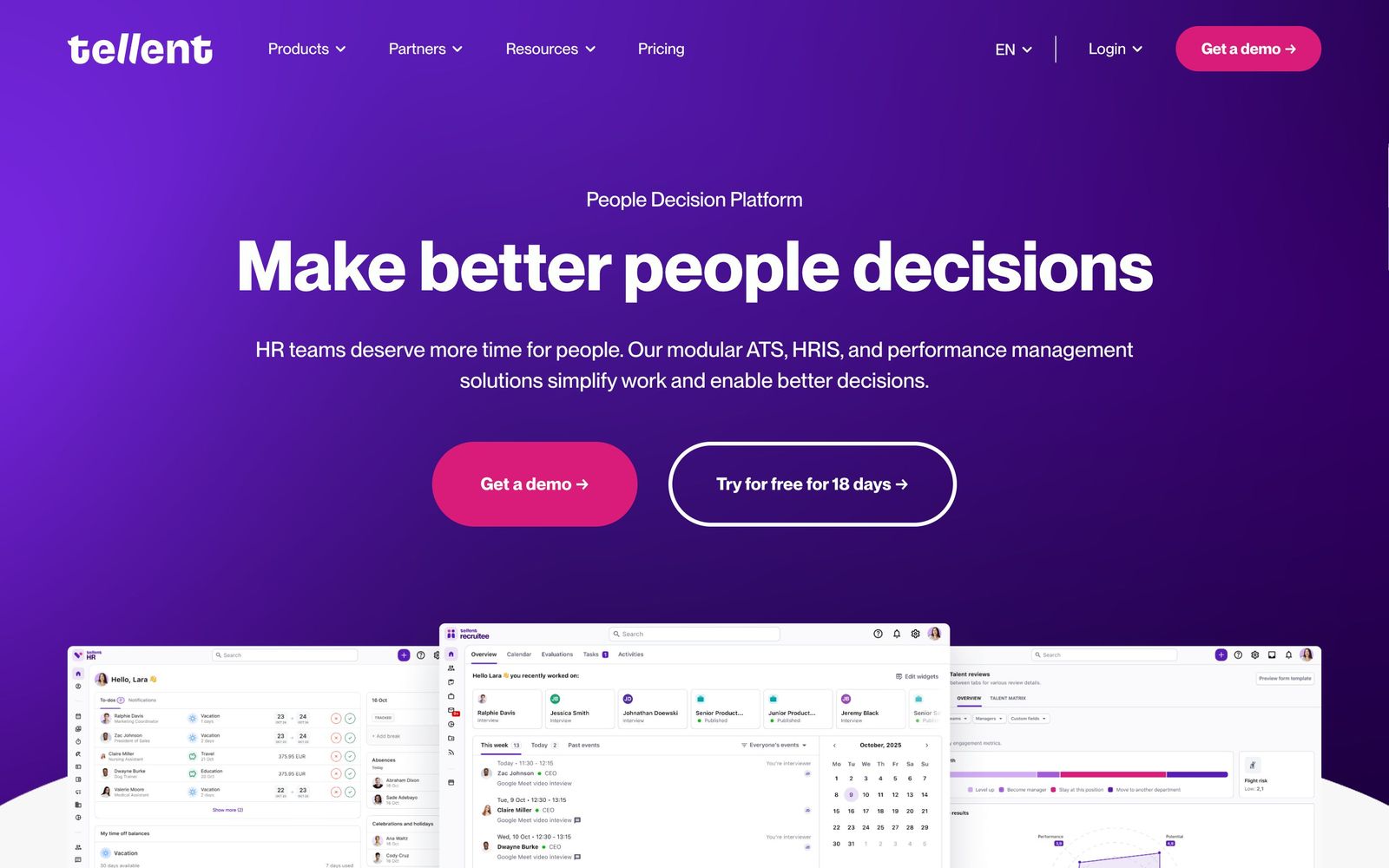
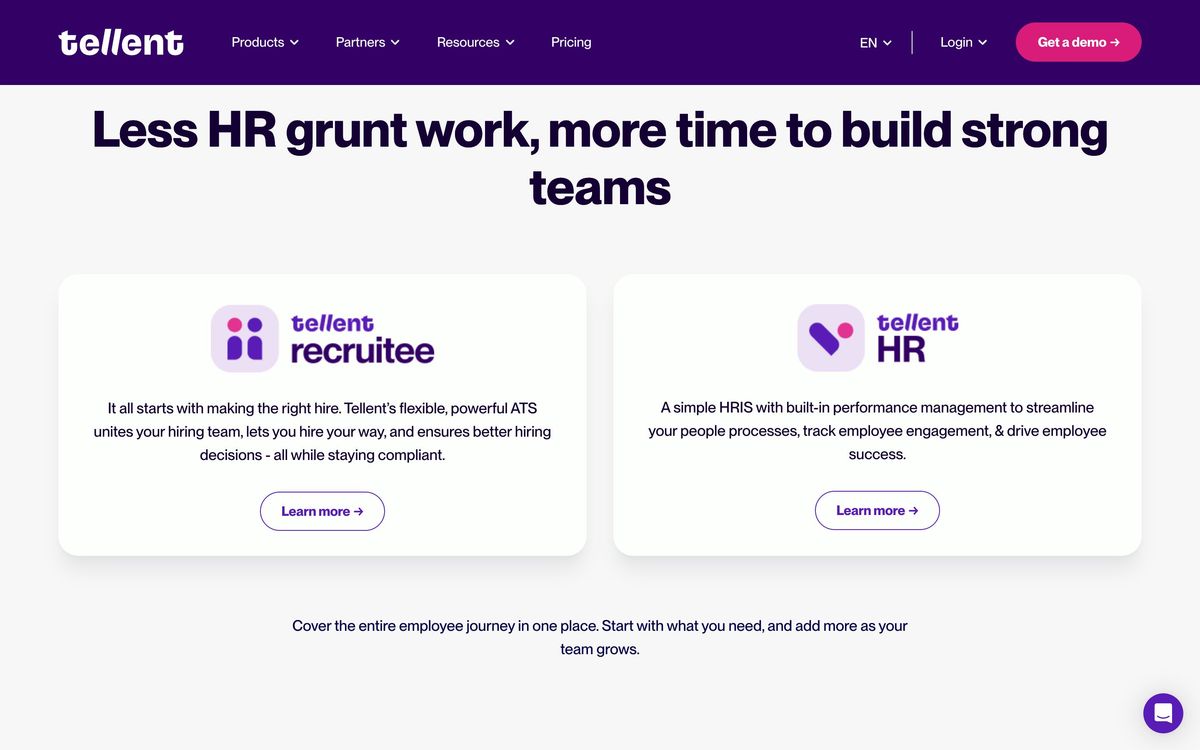
Tellent is the parent brand for a set of people tools that were sold separately until recently. The centre of it is Recruitee, an applicant tracking system with a strong collaborative streak: pipelines are shared with hiring managers, candidates are scored against defined criteria, and the careers site is edited by recruiters rather than by a developer. Around it sits Tellent HR, split into a records-and-absence module and a performance-and-engagement module, with the older Javelo and KiwiHR products being folded in.
The delivery model is modular by design. A company can license the ATS alone, add the HRIS when spreadsheets stop coping with absence and contracts, and add review cycles later. Everything is browser-based with mobile apps for approvals and candidate review, and pricing is set by employee count rather than by seats, which matters for HR teams where many occasional users need access. The suite leans European in its defaults, with multi-language job postings, works council friendly permissions and GDPR handling as standing features rather than enterprise extras.
Key features
The hiring module is the mature part; the HR modules are newer and narrower.
- Configurable hiring pipelines with evaluation scorecards and per-stage hiring team permissions
- Careers site builder with branded job pages and postings in several languages
- Job board distribution plus a browser extension for adding sourced candidates
- Employee records with absence, time and expense handling in the Manage module
- Review cycles, goal setting and engagement surveys in the Grow module
- Automation for screening questions, interview scheduling and candidate messaging
Who it's for
The suite fits a company in the 50 to 500 employee range with an internal talent partner or two and hiring managers who are expected to participate rather than delegate. Recruitee's collaboration model assumes that non-recruiters will open the tool, leave structured feedback and move candidates along, and teams that work that way get a genuinely faster process. The modular pricing also suits organisations that want the HRIS decision separated from the ATS decision instead of buying one large platform.
It is a poor fit for high-volume agency recruiting, where dedicated recruiting CRMs handle candidate ownership and client submissions better, and for analytics-led talent teams: reviewers repeatedly describe reporting as the weakest area, with limited export options and awkward handling of roles that never close. Global enterprises with complex approval matrices and deep custom reporting requirements will also hit the ceiling.
How it compares
Teamtailor is the closest European rival and is stronger on employer branding and candidate experience, though its analytics are similarly light. Workable brings a wider integration catalogue and better sourcing tools, and publishes its pricing, but feels more transactional and less collaborative day to day. Personio covers HR administration and payroll for European companies far more thoroughly than Tellent HR does, while its hiring module is thinner than Recruitee. The trade is between one vendor across the employee lifecycle and best-of-breed depth in each stage.
Verdict
Tellent is a solid, unflashy hiring platform that has grown a competent HR suite alongside it, and the modular structure means a team can buy only the part that hurts. The ATS deserves its reputation for making hiring managers useful participants rather than bottlenecks, and the European compliance posture saves work for companies hiring across several countries. The caveats are real: reporting remains thin enough that data-minded HR leads will export to a spreadsheet, candidate search inside a large pool is frustrating, and everything is quote-only, so comparing cost against competitors requires a sales conversation and a headcount projection. Buyers who care most about collaboration will be satisfied; buyers who care most about measurement should test the reports before signing.
Ready to try Tellent?
More recruiters tools like Tellent
Teamtailor
4.2An employer-branding-first ATS built for mid-market and scaleup talent teams.
Read Teamtailor review →Workable
4.2All-in-one ATS with AI sourcing and a 400M-profile candidate database, priced by company headcount.
Read Workable review →Employment Hero
4.0HR records, payroll, rostering and hiring in one platform for small and mid-sized employers.
Read Employment Hero review →Paylocity
4.0US payroll and HCM suite that adds engagement, recognition and survey tools to the core HR record.
Read Paylocity review →Time Doctor
4.0Time tracking and workforce analytics for distributed teams, with configurable screenshots and activity monitoring.
Read Time Doctor review →Top Echelon
3.8ATS and recruiting CRM for staffing agencies, paired with a split-placement network of other recruiters.
Read Top Echelon review →