
Uniqode review
Dynamic QR codes with scan analytics, bulk management and digital business cards for distributed teams.
The most governable QR platform for a company running codes across many locations, though annual-only billing and per-tier code limits make it an awkward purchase for a single campaign.
Pros
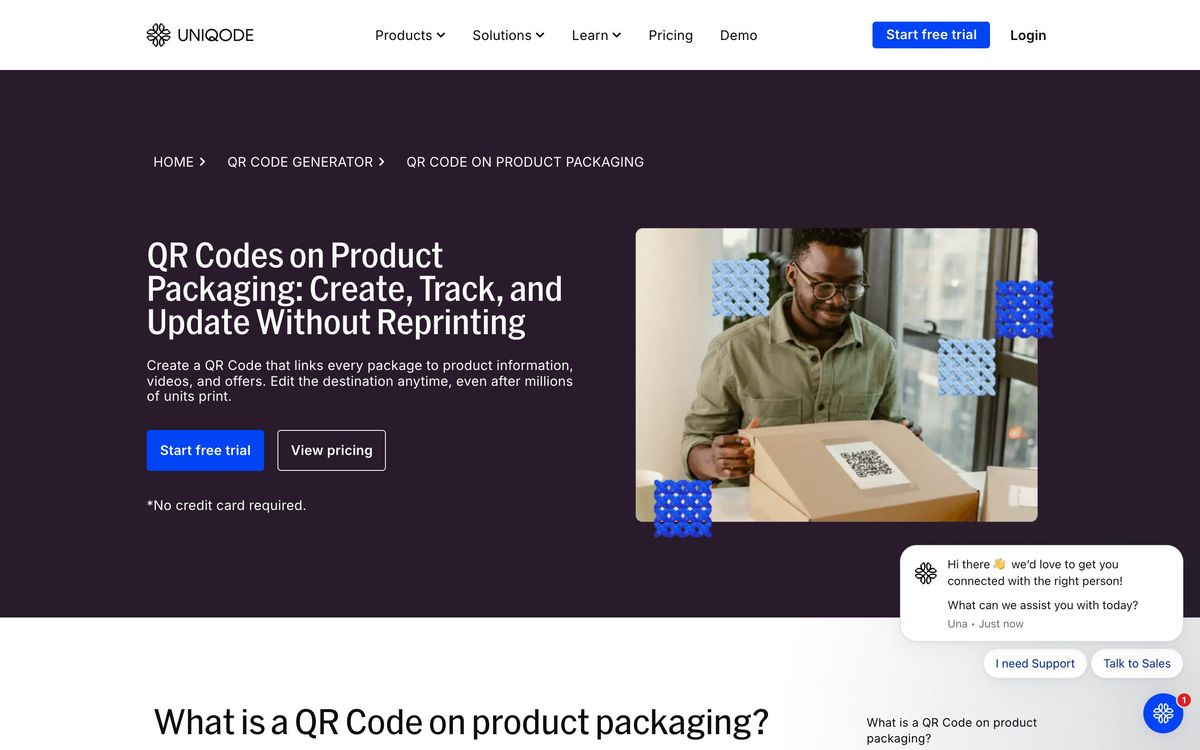
- Dynamic codes can be repointed after printing, which turns a packaging or signage run into an editable asset rather than a sunk cost
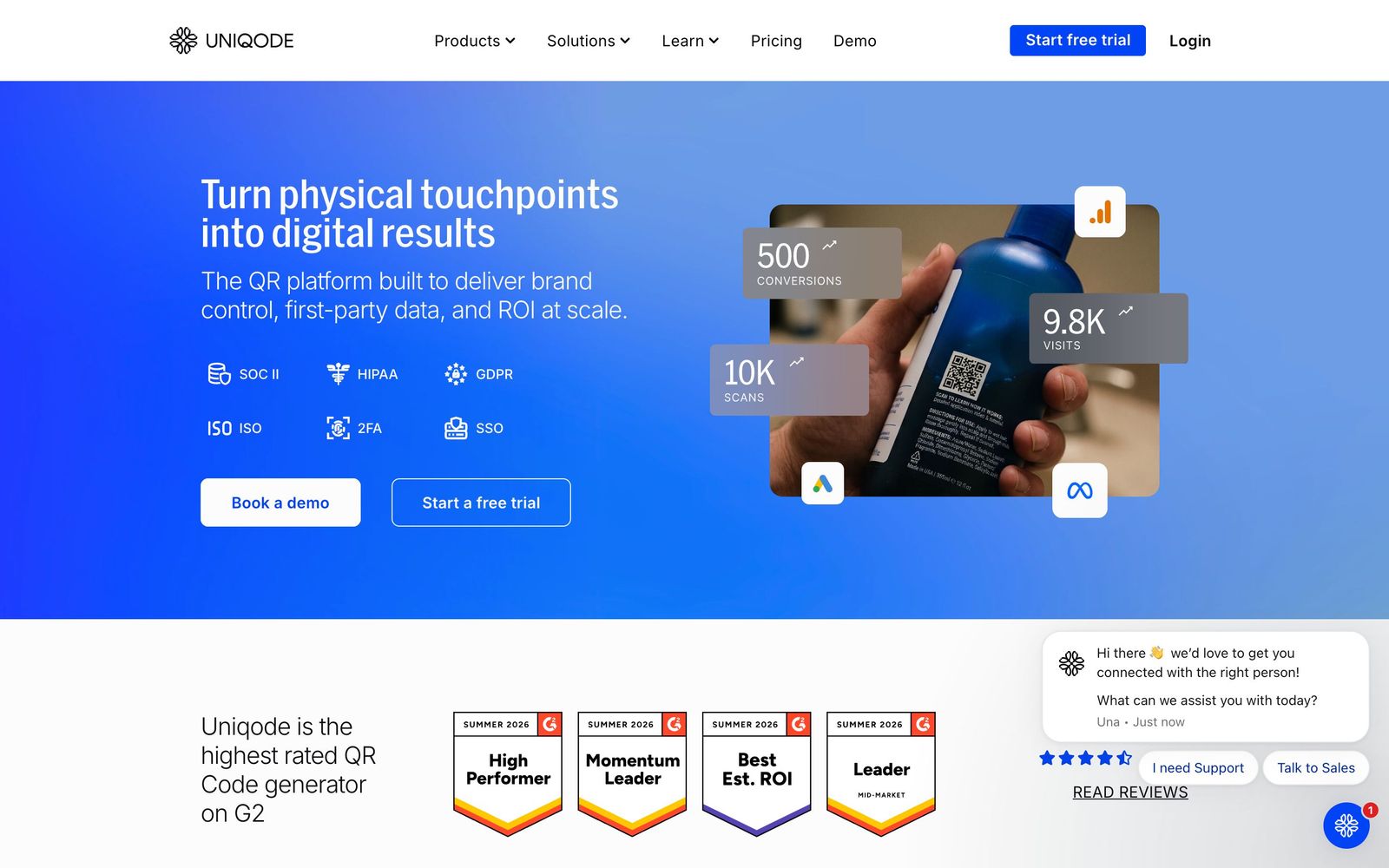
- Scan data comes back by location, device, time and campaign, and can be pushed into Google Analytics, Meta or a CRM as first-party signal
- Bulk generation with folders, tags and role-based permissions keeps thousands of codes across sites manageable by more than one person
- Conditional routing sends a scanner to a different destination based on country, language, device or time of day
- Security posture is unusually serious for this category, with SOC 2, HIPAA and GDPR coverage, SAML single sign-on and two-factor authentication
Cons
- QR plans bill annually only, so a seasonal or one-off campaign pays for a year or lives inside the two-week trial
- Each tier caps dynamic codes and annual scans, and a campaign that outperforms forecasts hits the ceiling mid-flight
- Lower tiers are single-user, which means a second marketer or an agency partner forces an upgrade for seats rather than features
Uniqode pricing
List prices in USD per month, taken from the vendor at review time.
| Plan | Per month | What it covers |
|---|---|---|
| Essential | $9 | billed yearly, single user |
| Core | $49 | billed yearly, adds API access and smart rules |
| Plus | $99 | billed yearly, 3 seats and optional custom domain |
| Business+ | $399 | billed yearly, advanced security and team management |
What Uniqode actually does
Uniqode, formerly Beaconstac, generates and manages QR codes for businesses that print a lot of them. The distinction that matters is between static and dynamic codes: a static code encodes a destination permanently, so a typo or a retired landing page means reprinting everything. A dynamic code encodes a short redirect Uniqode controls, which means the destination can be changed at any time and every scan can be counted. Once scans are counted, a printed asset stops being a dead end and becomes a measurable channel, which is the entire argument for paying for something a free generator appears to do.
The platform is built around managing that at scale. Codes are created in bulk, organised into folders and tags, and assigned to teams with role-based permissions, so a retailer with four hundred stores or a manufacturer with a catalogue of products is not maintaining a spreadsheet of URLs. Analytics break scans down by location, device, operating system, time and campaign, and can be forwarded into Google Analytics, Meta or a CRM as first-party data. Smart rules route conditionally, sending a scan in Germany to a German page and a scan on iOS to the App Store. A second product line, digital business cards, delivers contact details to Apple and Google Wallet and drops the exchange into a CRM as a lead.
Key features
The feature set divides into creation, routing and governance.
- Dynamic codes whose destination changes after printing, with no reprint required
- Branded design controls covering logos, colours, frames and code shape
- Scan analytics segmented by location, device, operating system, time and campaign
- Smart rules routing a scan by country, language, device or time of day
- Bulk generation with folders, tags, role-based permissions and an API
- Digital business cards in Apple and Google Wallet, with captured contacts routed to CRM
Who it's for
The fit is an organisation where QR codes are infrastructure rather than a one-off idea: retail chains linking shelf signage to product pages, hospitality groups putting menus on tables, healthcare and finance operations that need audit and access controls on a customer-facing link, or a sales team standardising digital cards across the field. The compliance certifications and single sign-on are the reason enterprise buyers land here instead of on a free generator, and the permission model is the reason they stay once several teams are creating codes.
It is a poor purchase for a single campaign or a small business printing one poster. Annual-only billing on the QR plans means a seasonal campaign either commits for twelve months or squeezes into the trial, and the free tier only produces static codes, which cannot be edited or measured, precisely the two things worth paying for. Anyone in that position should either use a free generator honestly or find a competitor billing monthly.
How it compares
Bitly bundles QR generation with its link platform, which is the better choice when short links and codes are managed together, though its QR design and bulk governance are shallower. QR Code Generator competes directly on features and undercuts Uniqode at the small end, with a lighter administration and security story. Flowcode leans into consumer-facing design and event activations with a stronger creative studio and a weaker enterprise administration story. Uniqode's edge is the combination most of these lack at once: bulk management, conditional routing, permissions and a compliance posture that survives a security review.
Verdict
Uniqode is a mature product doing an unfashionable job carefully, and the parts that justify the price are the boring ones, permissions, audit, bulk operations, integrations that put scan data where the rest of the marketing stack can use it. The pricing model is where it loses points: annual commitment on every QR plan, code and scan ceilings that a successful campaign can hit, and single-user lower tiers that force an upgrade for a colleague rather than a capability. For a business with codes in the field year-round it is a sound choice, and for a one-off campaign it is the wrong shape.
Ready to try Uniqode?
There's a free tier, so you can test it before committing.
More marketers tools like Uniqode
Outgrow
4.0Builder for calculators, quizzes and assessments that qualify a visitor before asking for an email.
Read Outgrow review →Leadpages
3.9Landing pages, pop-ups and opt-in forms with unlimited traffic on every plan and Stripe checkout built in.
Read Leadpages review →Bread & Butter
3.8First-party visitor tracking that enriches traffic, scores intent and syncs the result into a CRM.
Read Bread & Butter review →Pingtree
3.8Lead distribution and funnel platform: capture leads, ping buyers in real time, route each one to the best bid.
Read Pingtree review →POWR
3.8Sixty-odd embeddable widgets, forms, popups, galleries, reviews, for sites built on someone else's platform.
Read POWR review →Hello Bar
3.7Notification bars, popups and slide-ins for capturing emails on an existing site, installed with one script.
Read Hello Bar review →