
Bread & Butter review
First-party visitor tracking that enriches traffic, scores intent and syncs the result into a CRM.
A reasonable first attribution-and-intent layer for a small demand gen team, though the enrichment credit system makes a heavy month hard to budget.
Pros
- Server-side, first-party tracking keeps recording when ad blockers strip client-side scripts
- The free tier tracks unlimited traffic and keeps 200 lead profiles, enough to judge data quality on real traffic before paying
- Attribution history on the paid plan is retained for ten years, so long B2B cycles stay intact end to end
- Enrichment turns a captured email into role, employer and recent company news without a separate data vendor
- Sync into HubSpot, Salesforce and Pipedrive puts the intent score where reps already work
Cons
- Deep Profile Enrichment is metered at 10 to 150 credits per profile, so monthly spend is hard to forecast in advance
- The paid plan is billed per website, which multiplies badly for agencies or brands running several domains
- The free tier withholds attribution reporting, CRM sync and the AI scoring, the three things most buyers are trying to evaluate
Bread & Butter pricing
List prices in USD per month, taken from the vendor at review time.
| Plan | Per month | What it covers |
|---|---|---|
| Free | Free | 200 lead profiles, unlimited traffic, 30-day attribution retention |
| Pro | $49 | per website, 5,000 lead profiles and 3,000 credits a month |
What Bread & Butter actually does
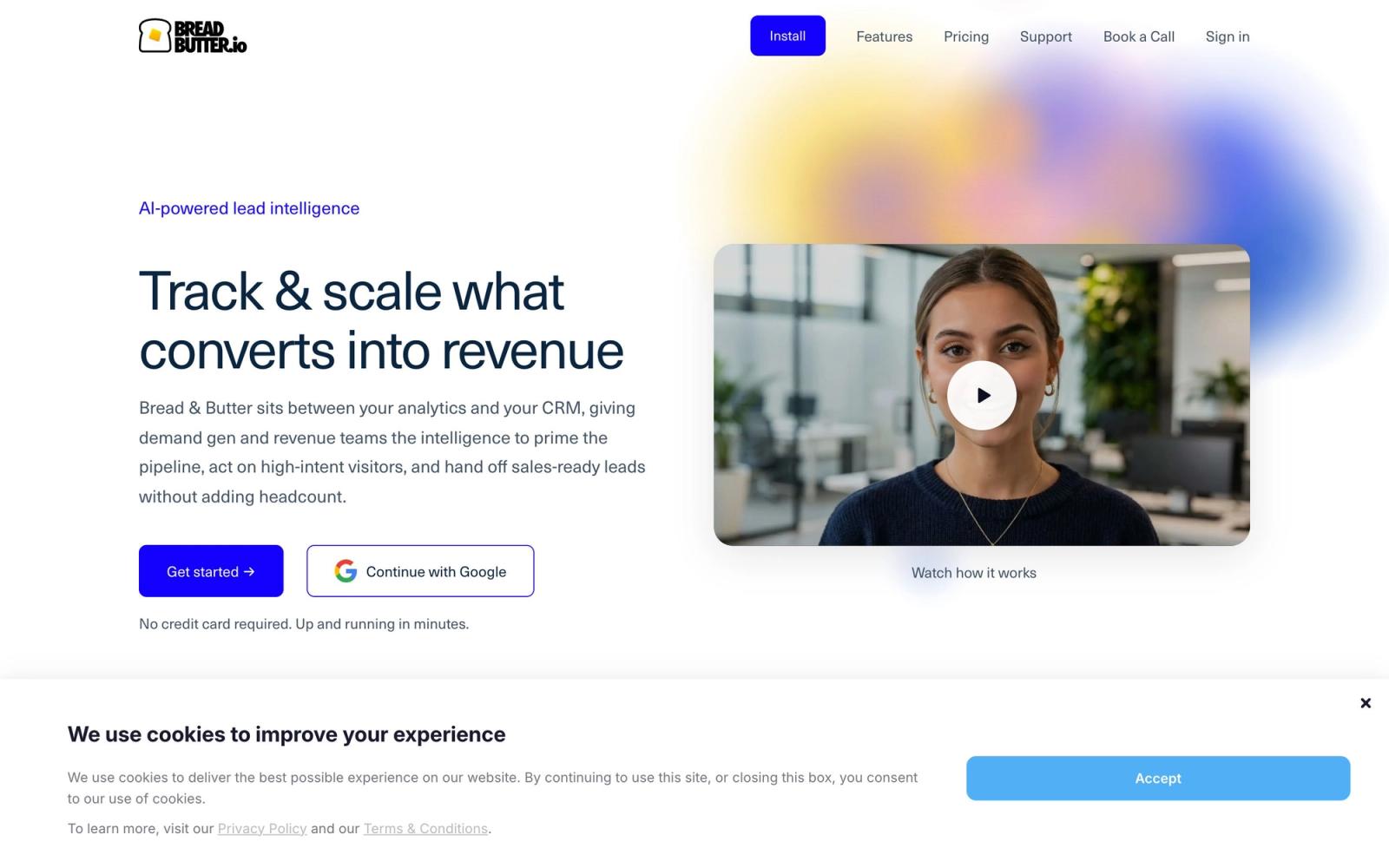
Bread & Butter is a lead intelligence layer that sits between a website's analytics and its CRM. It tracks visitors server-side from first-party domains, attaches a name and an employer to the ones who identify themselves through a form or a social login, scores how close each looks to buying, and pushes the result into HubSpot, Salesforce or Pipedrive. The argument for it is that neither Google Analytics nor a CRM answers the question a demand gen team actually asks, which is not how much traffic arrived but which of it is worth a call.
Delivery is a script plus a hosted dashboard. Installation means a tag on the site and a connection to whatever capture already exists, and the common WordPress and Webflow form builders are supported, so most teams do not have to rebuild their forms. Because the tracking runs server-side, it keeps collecting when client-side scripts are blocked, which is the main technical case for it over a plain analytics install.
Key features
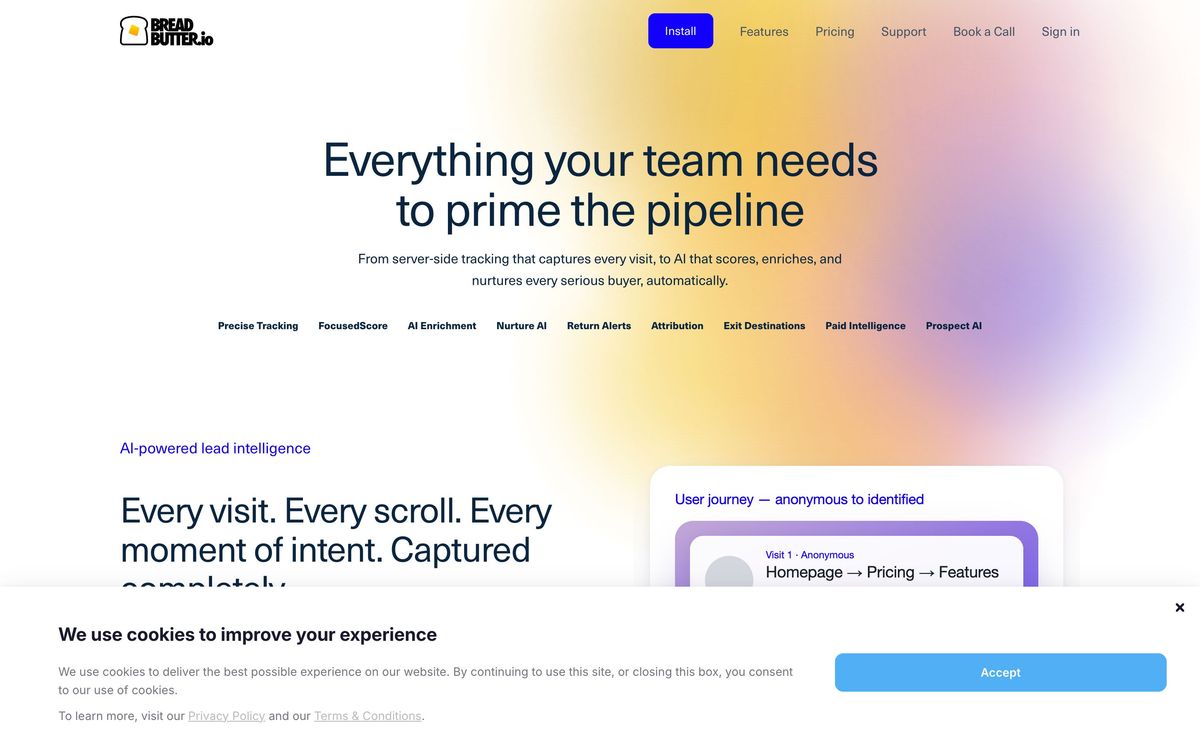
The product is a chain of four steps, capture, enrich, score, route, and each link is exposed on its own.
- Server-side first-party tracking, with unlimited traffic on every plan including the free one
- FocusedScore, an intent model that retrains as deals close and reorders the visitor list accordingly
- Deep Profile Enrichment, expanding a captured email into role, employer and recent company news
- Attribution across the full funnel, from first touch to closed deal, retained for ten years on the paid tier
- Return visitor alerts delivered to Slack or email when a previously identified lead comes back
- Nurture AI, which drafts outreach sequences against the enriched profile rather than a generic template
Who it's for
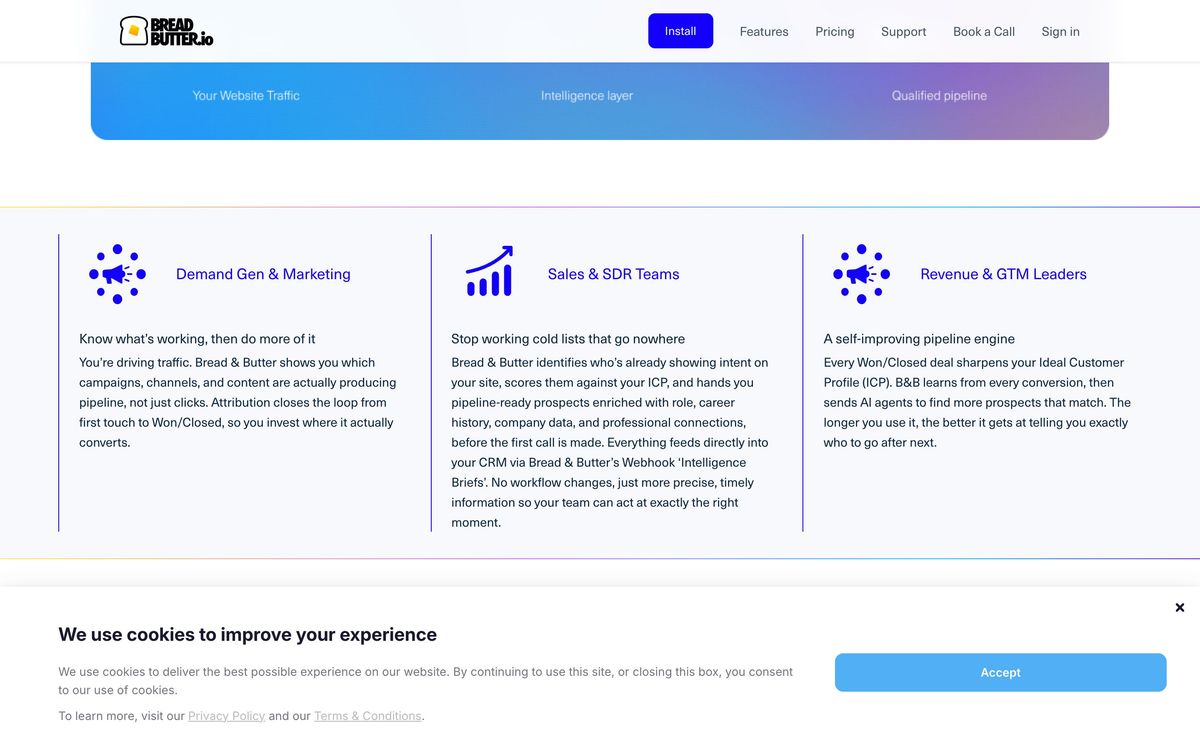
The natural buyer is a two- or three-person demand gen team at a B2B company with one main website, already spending on paid channels and unable to say which of them produce pipeline rather than form fills. For that team the free tier is a genuine trial: two hundred profiles is enough to see whether the enrichment is accurate on their own traffic before any money moves.
It is a poor fit for anyone running many domains, because the paid plan is priced per website and the arithmetic turns unpleasant at five or six. It is also the wrong purchase for a company that already owns a warehouse, a reverse-ETL job and a scoring model in the CRM, since that stack does the same work with more control. And identification still depends on people eventually giving up an email; a site with almost no form traffic will see thin results.
How it compares
Against Clearbit-style enrichment bought inside HubSpot, Bread & Butter is cheaper and covers attribution as well as enrichment, but its company data is thinner and its coverage outside North America is unproven. Against a dedicated visitor-identification product such as RB2B, it is broader, scoring, attribution and outreach drafting in one place, but less aggressive at de-anonymising traffic that never converts. Against Google Analytics paired with a CRM, which is what most of its buyers actually replace, it wins on person-level detail and loses on the depth of aggregate reporting GA4 gives away.
Verdict
Bread & Butter does a narrow job well enough. It turns a stream of anonymous sessions into a ranked list of people worth contacting, and it does that without asking a small team to assemble three separate tools. The tracking holds up, the CRM sync is real rather than an export, and the free tier is honest enough to test with. The reservation is commercial rather than technical: enrichment is metered in credits that swing widely per profile, billing is per website, and the features most buyers want to assess sit behind the paywall, so the first invoice is harder to predict than the pricing page suggests.
Ready to try Bread & Butter?
There's a free tier, so you can test it before committing.
More marketers tools like Bread & Butter
WhatConverts
4.3Tracks calls, forms, chats and transactions back to the campaign that produced them, in one lead log.
Read WhatConverts review →Pingtree
3.8Lead distribution and funnel platform: capture leads, ping buyers in real time, route each one to the best bid.
Read Pingtree review →Databox
4.2Analytics platform pulling 130+ data sources into dashboards, automated reports, goals, AI-queried metrics.
Read Databox review →Gravity Forms
4.2A WordPress form plugin for lead capture, payments and multi-step workflows, with data staying in your own database.
Read Gravity Forms review →Survicate
4.1Customer feedback platform for website, in-product, email and link surveys with AI theme analysis.
Read Survicate review →Wistia
4.1Video hosting, recording and analytics for marketing teams that need viewer data, not view counts.
Read Wistia review →