
SurveySparrow review
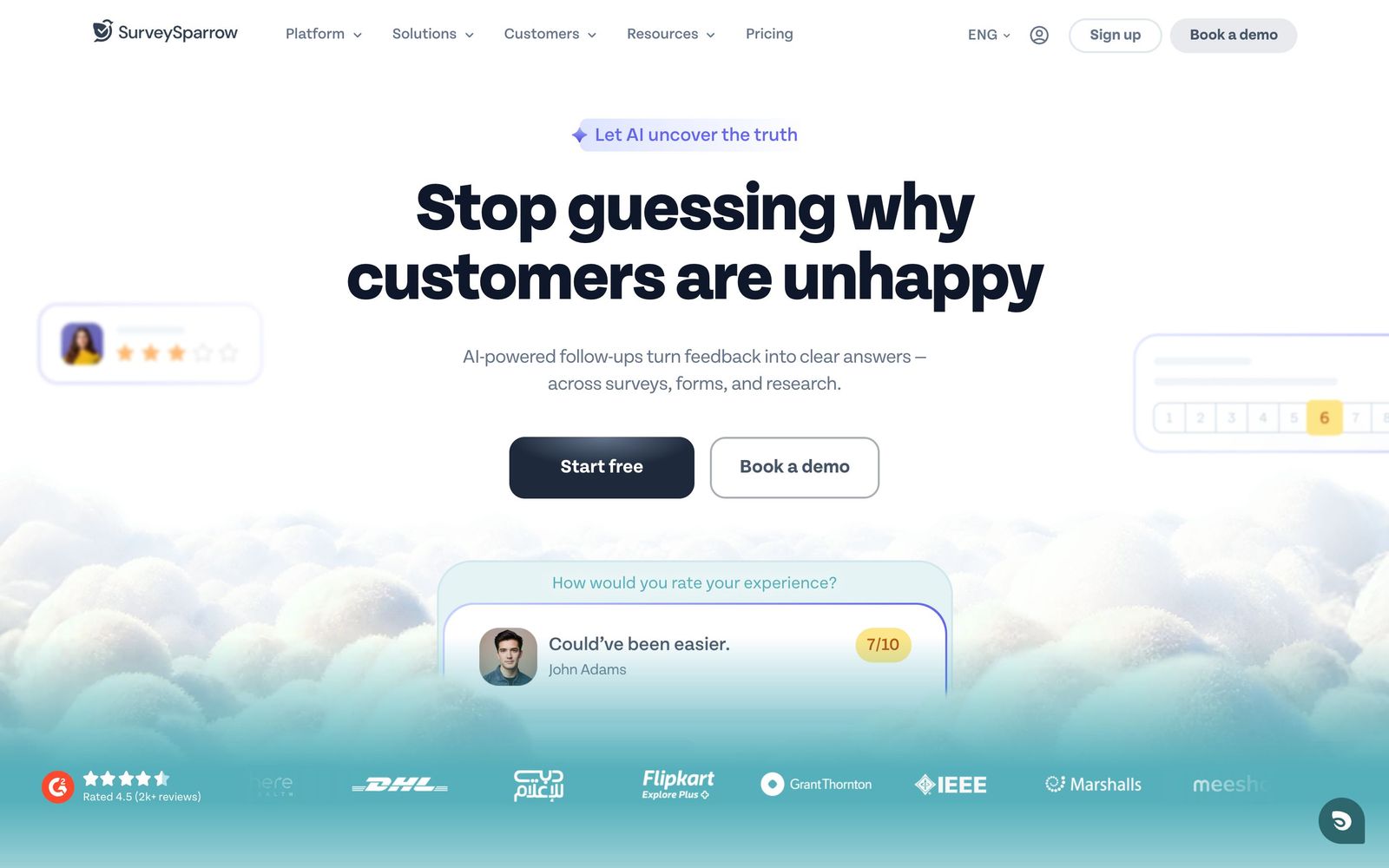
Conversational surveys, NPS and pulse feedback in one platform, with AI follow-up questions and theme analysis.
A capable feedback platform for mid-sized teams that want conversational surveys and NPS in one place, though reporting is shallower than the AI marketing suggests and the useful features start on the third tier.
Pros
- The chat-style survey format measurably lifts completion on mobile compared with a page of grid questions
- One account covers customer NPS, product feedback and employee pulse surveys, so a small team is not buying two systems
- Echo AI asks a contextual follow-up when an answer is vague, which produces usable verbatims instead of one-word ratings
- Recurring survey scheduling and behaviour-triggered micro-surveys mean a feedback programme runs without someone remembering to send it
- Handles large surveys with heavy branching logic without the interface stalling, which is where lighter form tools struggle
Cons
- Reporting is the consistent complaint in user reviews: cross-tabulation is limited and exports to spreadsheets need cleaning up afterwards
- Theme and design control is thinner than Typeform's, surveys look tidy but hard to make look like your brand without the top tiers
- Question groups and whole logic branches cannot be copied cleanly between surveys, so building variants means rebuilding them
SurveySparrow pricing
List prices in USD per month, taken from the vendor at review time.
| Plan | Per month | What it covers |
|---|---|---|
| Basic | $19 | per month, billed annually, 1 user |
| Starter | $39 | per month, billed annually, 1 user |
| Business | $79 | per month, billed annually, 3 users, adds custom branding and workflows |
| Professional | $249 | per month, billed annually, 5 users, adds sentiment analysis and translation |
What SurveySparrow actually does
SurveySparrow collects structured feedback and does something with it. The original hook was the format: instead of a page of questions, a survey arrives as a chat, one question at a time, which reads better on a phone and tends to hold people to the end. That conversational mode is still there, but the product has widened into a feedback platform, customer NPS and CSAT programmes, product feedback, employee pulse and 360-degree reviews, market research studies, all built from the same question bank and reported in the same place.
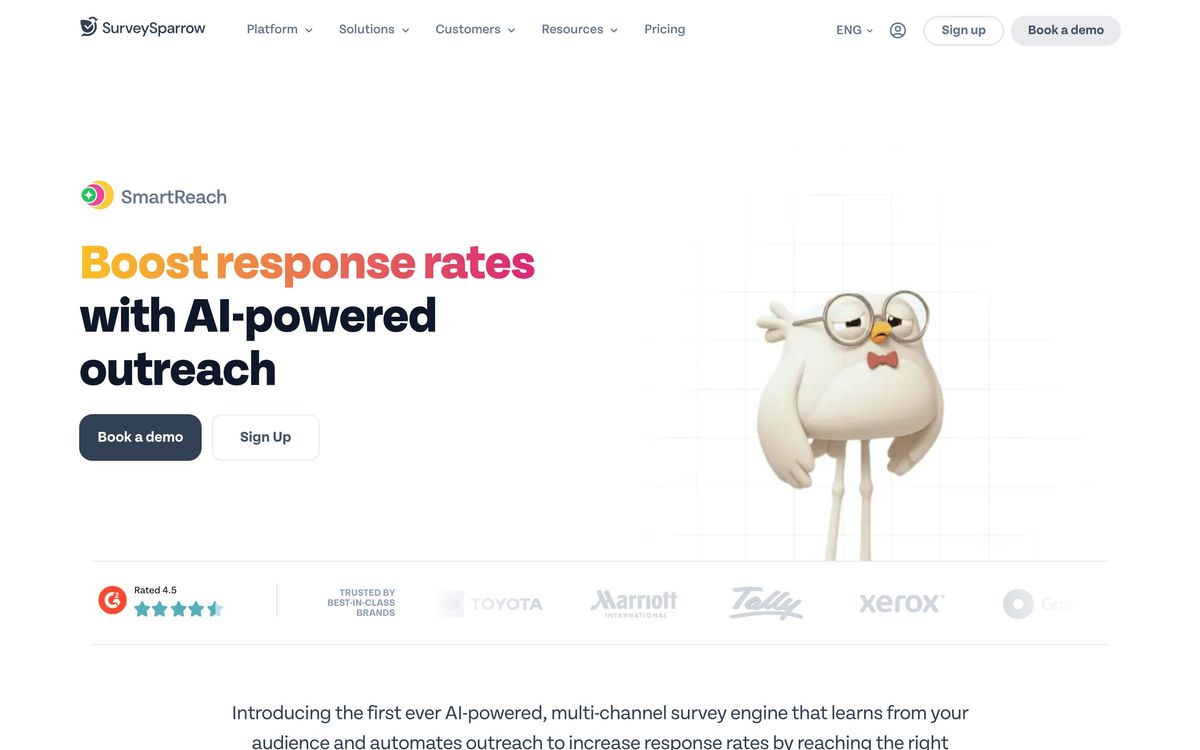
The recent work has gone into the layer above collection. Echo AI reads a vague open-text answer and asks a follow-up in the moment rather than leaving a useless verbatim in the export. CogniVue clusters open responses into themes and points at the drivers behind a score. Delivery is handled by scheduling and triggers: recurring NPS on a cadence, micro-surveys fired by in-product behaviour, distribution by email, link, QR code or SMS, and offline collection on a tablet for anyone gathering feedback in a shop or at an event. Responses can then push into HubSpot, Salesforce, Zendesk or Slack, which is what turns a survey into a workflow rather than a spreadsheet.
Key features
The platform is broad, and the tier you land on decides how much of it you actually get.
- Conversational chat-style surveys and classic forms, with offline collection on mobile devices
- NPS, CSAT and CES programmes with recurring cadence and automatic reminders
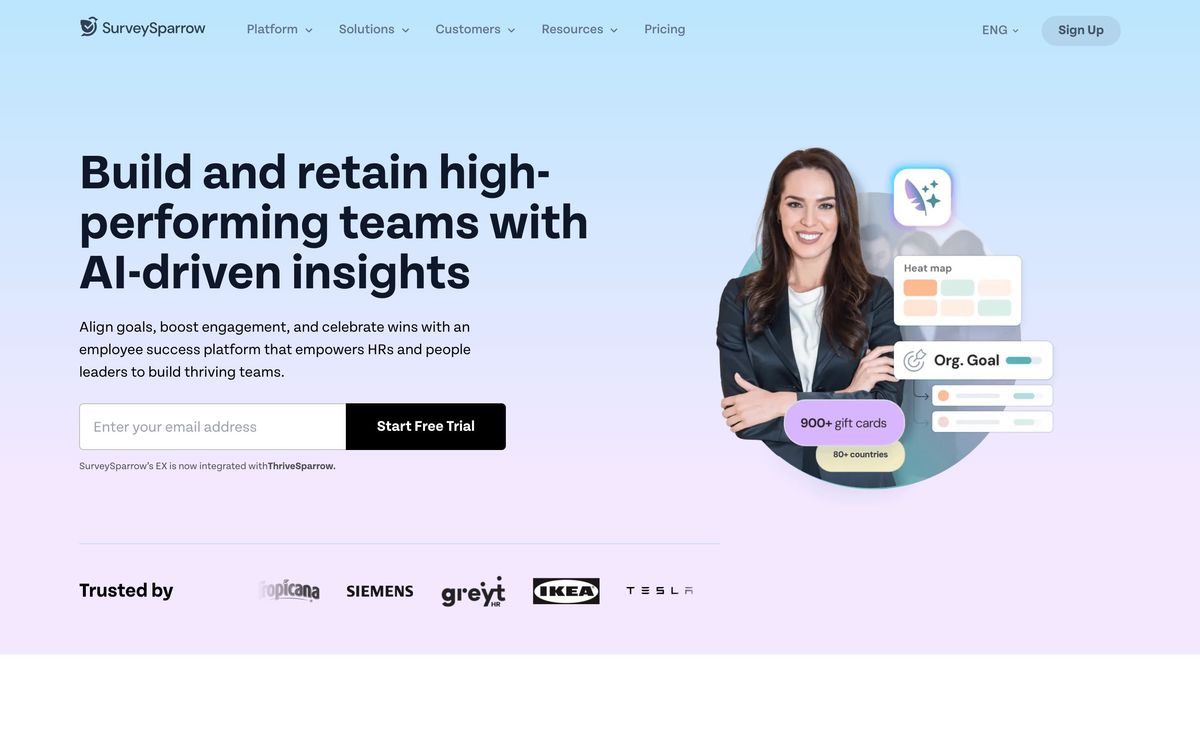
- Employee pulse and 360-degree review cycles sharing the same reporting
- Echo AI contextual follow-up questions plus theme and key-driver analysis on open text
- Behaviour-triggered micro-surveys inside a product or website
- Workflows and alerts into HubSpot, Salesforce, Slack, Zendesk and Zapier
Who it's for
The natural buyer is a customer experience, marketing or people team at a company of maybe fifty to a thousand staff that has decided feedback should be continuous rather than an annual exercise. If the plan is quarterly NPS with follow-up on detractors, plus a product survey and an employee pulse, SurveySparrow covers all three at a price a mid-sized company can defend, and the conversational format genuinely helps response rates when most respondents are on a phone.
It is not the right tool for a serious research function. Anyone doing conjoint analysis, weighting samples or running statistical significance testing will find the analysis shallow and should be looking at Qualtrics. At the other end, a founder who needs one signup form on a landing page is overbuying: a form builder will do that job for less, and the free tier here is capped tightly enough that a single campaign exhausts it.
How it compares
Typeform is the better-looking product and wins whenever the survey is a public-facing brand asset, more theme control, more polish, less depth on programmes. Qualtrics is several classes deeper on analysis and governance, and priced for enterprises with a research budget rather than a marketing one. Delighted, now part of Qualtrics, does one-question NPS more simply and cheaply if that is all you need. SurveySparrow's argument is coverage: it does customer and employee feedback adequately in one account, which is what a mid-market team can actually staff.
Verdict
SurveySparrow is a sensible middle option, better structured than a form builder, far cheaper and faster to adopt than an enterprise research suite, and the conversational format earns real completion gains on mobile. The honest caveats are analysis and packaging. Reporting stays flatter than the AI messaging implies, cross-tabs and exports need work outside the tool, and the features most teams assume are standard, including custom branding and workflows, sit on the third tier. Trial it with a real survey and check the export before committing to a year.
Ready to try SurveySparrow?
There's a free tier, so you can test it before committing.
More marketers tools like SurveySparrow
POWR
3.8Sixty-odd embeddable widgets, forms, popups, galleries, reviews, for sites built on someone else's platform.
Read POWR review →Motion
4.5Creative analytics for paid social: visual reports and AI tagging that show which ad creatives perform.
Read Motion review →Tidio
4.5AI customer service platform with Lyro AI agent, live chat, ticketing, and automations for 300K+ businesses
Read Tidio review →Vista Social
4.5Social media management covering publishing, inbox, listening, reviews, and reporting across 11+ networks.
Read Vista Social review →Unbounce
4.4Landing page builder with AI traffic routing (Smart Traffic), A/B testing, popups, and sticky bars.
Read Unbounce review →ActiveCampaign
4.3Email marketing and automation platform with a built-in CRM, contact scoring, and SMS and WhatsApp sending.
Read ActiveCampaign review →