
SMTP2GO review
Email delivery service with an SMTP relay, a small API and reporting, plus a free tier that stays free.
The most practical relay for teams sending modest volume who want deliverability handled without an enterprise contract, though reporting retention is short and there is a wide gap between the paid tiers.

Pros
- The free tier is a real tier rather than a countdown, covering a thousand messages a month indefinitely
- Round-the-clock live chat and phone support is included on paid plans, which almost no relay at this price does
- Servers in the United States, Europe and Australasia with best-path routing, so a request does not cross an ocean before it sends
- Deliverability monitoring is built in: blacklist checks, spamtrap detection, feedback loops and automatic SPF and DKIM setup
- Unlimited SMTP users, API keys and verified senders on every paid plan, so per-app credentials cost nothing extra
Cons
- Reporting is retained for thirty days on paid plans and five days on the free tier, which is short for debugging a complaint that surfaces weeks later
- The jump from the entry plan to the professional plan is a large step in both price and volume, with nothing sensible in between
- There is no template editor, campaign builder or contact management, so any marketing sending needs a second platform
SMTP2GO pricing
List prices in USD per month, taken from the vendor at review time.
| Plan | Per month | What it covers |
|---|---|---|
| Free | Free | 1,000 emails a month, 200 a day |
| Starter | $10 | 10,000 emails a month, 30 days of reporting |
| Professional | $75 | 100,000 emails a month, dedicated IP and testing tools |
What SMTP2GO actually does
SMTP2GO takes mail off an application and delivers it. Connect over SMTP with a set of credentials, or call a small REST API, and the service handles authentication, routing, retries and the reputation work behind them. SPF and DKIM records are generated during setup, sending domains are verified, bounces and complaints are processed automatically, and the account is monitored against blacklists in the background with an alert if something drifts. The company runs from New Zealand with offices in Australia, the United Kingdom and the United States, and sends from multiple data centres so a failure in one region does not stop delivery.
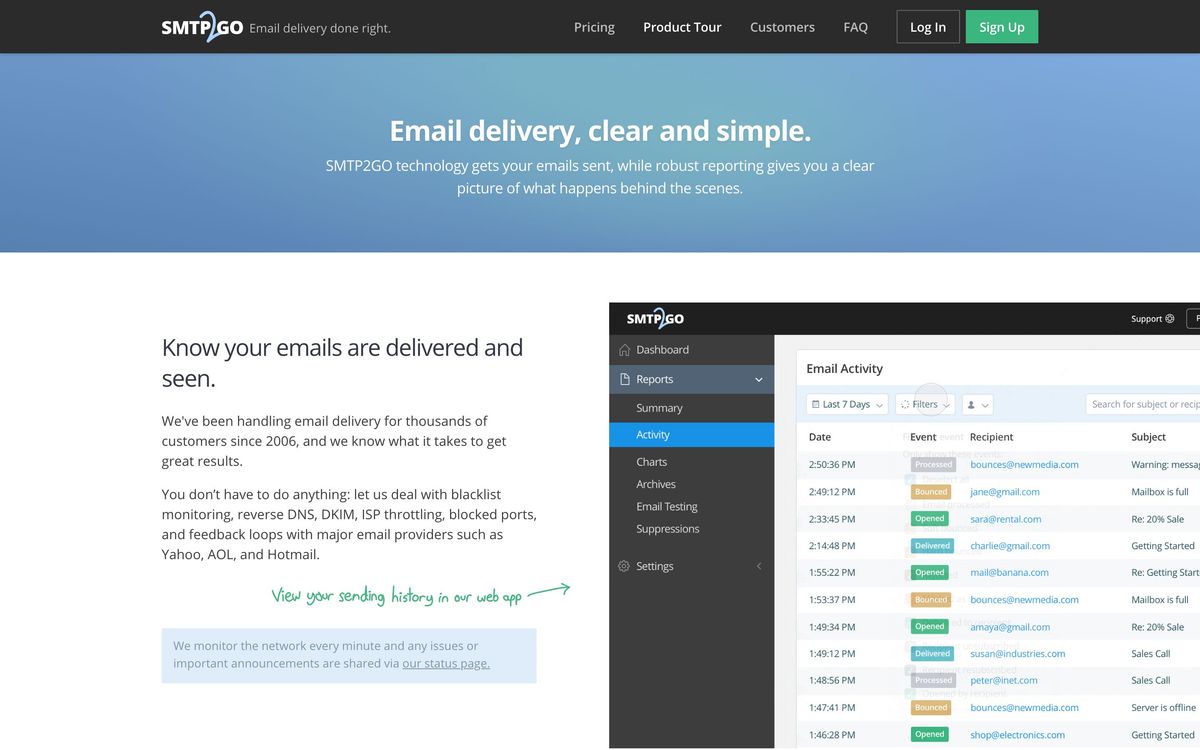
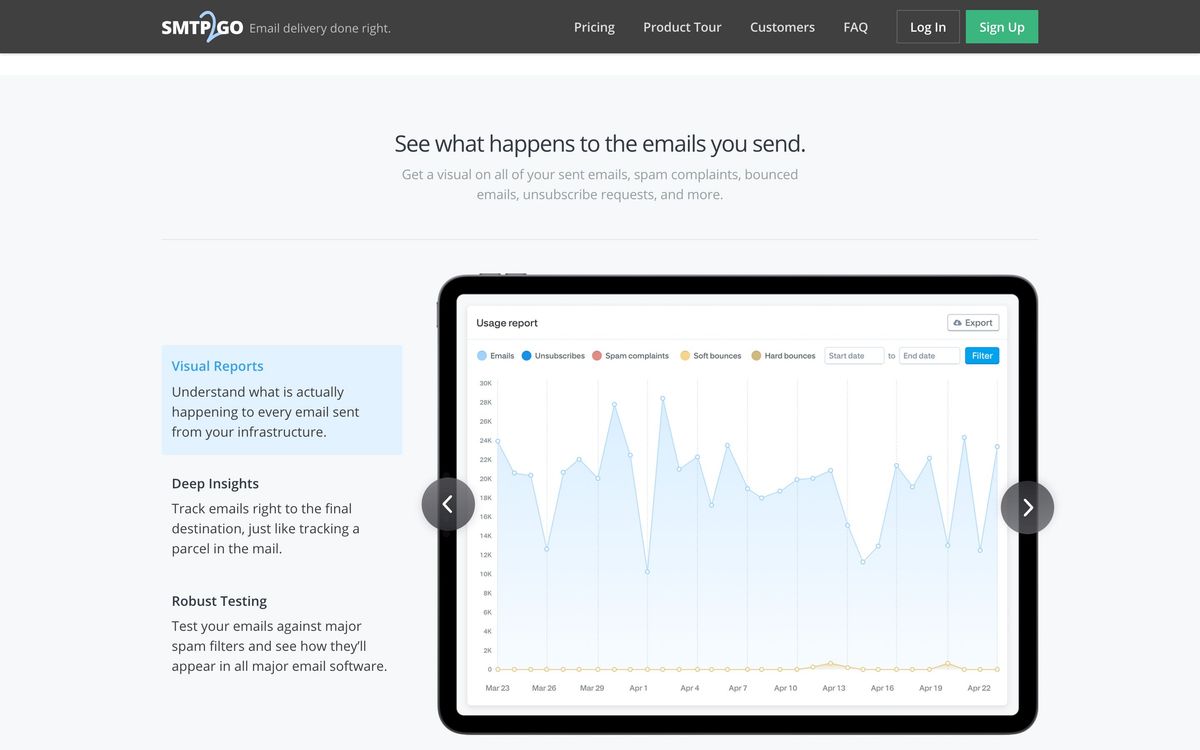
The reporting is the part regular users notice most. Every message is traceable through its lifecycle, activity logs update in real time, webhooks fire on the events you care about, and reports can be exported or scheduled. There is also inbox testing against more than forty email clients and a spam filter check, which catches the rendering and content problems that would otherwise arrive as customer complaints. What the service deliberately does not include is a campaign side: no template designer, no contact lists, no automation. It is infrastructure, and it charges infrastructure prices.
Key features
The set is small and mostly aimed at knowing what happened to a given message.
- SMTP relay plus a REST email API, with documented examples in JavaScript, Node.js, PHP, Ruby and Python
- Real-time activity logs, webhooks, data exports and scheduled reports
- Automatic SPF and DKIM setup, feedback loop handling, blacklist monitoring and spamtrap detection
- Inbox rendering tests across more than forty clients, plus spam filter scoring
- Subaccounts, unlimited API keys and a sandbox mode for staging environments
- Setup guides and plugins for WordPress, WooCommerce, Drupal, Joomla, Odoo and dozens of CRMs and mail servers
Who it's for
This is the relay for a team whose sending is real but not enormous: a SaaS product mailing receipts and password resets, an agency running mail for a handful of client sites, an internal system firing alerts. The free tier genuinely covers a small side project, and the entry paid plan covers most early-stage products without negotiation. The breadth of setup guides matters here too, because a large share of buyers are not writing an integration at all, they are pointing an existing WordPress or Odoo install at better infrastructure.
It is the wrong choice for two groups. Marketing teams wanting to design and schedule campaigns need an email service provider, not this. And senders at millions of messages a month will be negotiating a custom contract anyway, at which point the specialised high-volume providers compete on price per thousand in a way the published plans here do not reflect. Anyone who needs to investigate delivery problems months after the fact should also check the retention window before committing, because the logs do not stretch that far.
How it compares
SendGrid has the broader API surface, template management and a marketing side, but its shared pools carry a lot of unvetted senders and support below enterprise is famously thin, the opposite trade to the one SMTP2GO makes. Postmark is the quality benchmark for transactional mail, with the cleanest logs and strict separation of streams, though it costs more per message and enforces sending rules that some businesses cannot live with. Brevo bundles relay sending with a full marketing platform and suits teams that want one vendor for both. Against all three, SMTP2GO wins on support access and on the honesty of its free tier, and loses on ecosystem depth.
Verdict
SMTP2GO is unglamorous and reliable, which is what a relay should be. Deliverability tooling is included rather than sold as an add-on, the free tier is not a trap, and getting a human on chat or the phone is straightforward at a price where competitors offer a help centre. The reasons to hesitate are the short reporting retention, the awkward gap between the entry and professional plans, and the complete absence of anything marketing-facing. For small and mid-volume transactional sending it is close to the default recommendation.
Ready to try SMTP2GO?
There's a free tier, so you can test it before committing.
More developers tools like SMTP2GO
Runpod
4.5GPU cloud for AI workloads: on-demand instances, serverless inference endpoints, and multi-node clusters.
Read Runpod review →CrowdStrike
4.4Cloud-delivered endpoint protection with one lightweight agent, sold to small teams as fixed per-device bundles.
Read CrowdStrike review →NinjaOne
4.4Endpoint management and RMM platform for monitoring, patching, backing up and remotely supporting company devices.
Read NinjaOne review →Bright Data
4.3Proxy network and managed scraping APIs for collecting public web data at production scale.
Read Bright Data review →Browse AI
4.3No-code web scraping: train point-and-click robots to extract data from any site and monitor it for changes.
Read Browse AI review →BugHerd
4.3Visual feedback tool that pins client comments to the exact element on a page and turns them into tasks.
Read BugHerd review →