
SMTP.com review
SMTP relay and email API from a two-decade-old sending brand, built around deliverability not campaigns.
Best for teams pushing high transactional volume who want reputation handled for them, though the console is dated and there is no free tier to evaluate it with.
Pros
- Deliverability tooling is the product rather than a bolt-on: dedicated IPs, guided warm-up, feedback loops and automatic suppression
- RESTful JSON API with official libraries for Python, PHP, Java, C#, Node.js and Perl, plus a plain relay for apps that only need a credentials swap
- A dedicated IP is bundled from the second tier upward instead of being sold as a separate line item
- Event data is retained for up to 90 days, longer than most relays keep by default
- Assisted migration from an existing provider is offered rather than left to the customer to work out
Cons
- No free tier and no advertised trial, so a fair evaluation means paying for a month and pointing real traffic at it
- The dashboard is visibly dated and slow, and filtering logs becomes awkward once volume climbs
- Reputation Defender and Insight Engine are billed as a percentage of the plan, so the add-on cost rises with volume even though the feature does not change
SMTP.com pricing
List prices in USD per month, taken from the vendor at review time.
| Plan | Per month | What it covers |
|---|---|---|
| Essential | $25 | 50,000 emails a month, shared IP |
| Starter | $80 | 100,000 emails a month, dedicated IP |
| Growth | $300 | 500,000 emails a month, dedicated IP |
| Business | $500 | 1,000,000 emails a month, dedicated IP |
What SMTP.com actually does
SMTP.com is a sending relay. An application hands it mail over SMTP or a REST API, and the service takes responsibility for the part most teams get wrong: authentication, IP reputation, bounce handling, and suppressing addresses that keep failing. The company has been sending under the same domain since the early 2000s and now sits inside Ziff Davis's martech group alongside Campaigner and iContact. That history is closer to the actual product than any feature is. Inbox placement depends heavily on how long an IP range has been sending clean mail, and SMTP.com is selling ranges that have been doing exactly that for two decades.
What it is not is a marketing platform. There is no campaign builder, no template library, no automation canvas. You bring the application, a billing system, a storefront, an internal alerting job, and SMTP.com moves the messages. Onboarding is either a credentials change in an existing mail configuration or a short integration against the API, which ships official libraries for Python, PHP, Java, C#, Node.js and Perl. Dedicated IPs arrive from the second tier upward with a warm-up schedule, and two paid add-ons sit on top: Reputation Defender, which drops invalid addresses in real time before a send, and Insight Engine, which enriches contact records.

Key features
The list is short because the service is narrow, and the narrowness is deliberate.
- SMTP relay and a RESTful JSON email API, with official client libraries in six languages
- Dedicated IP addresses from the mid tiers, introduced on a warm-up schedule rather than switched on at full volume
- Reputation Defender, an add-on that monitors list health and suppresses hard and soft bounces automatically
- SPF, DKIM and DMARC alignment enforced on sending domains during setup
- Open, click, bounce and complaint tracking, with event data retained for up to 90 days
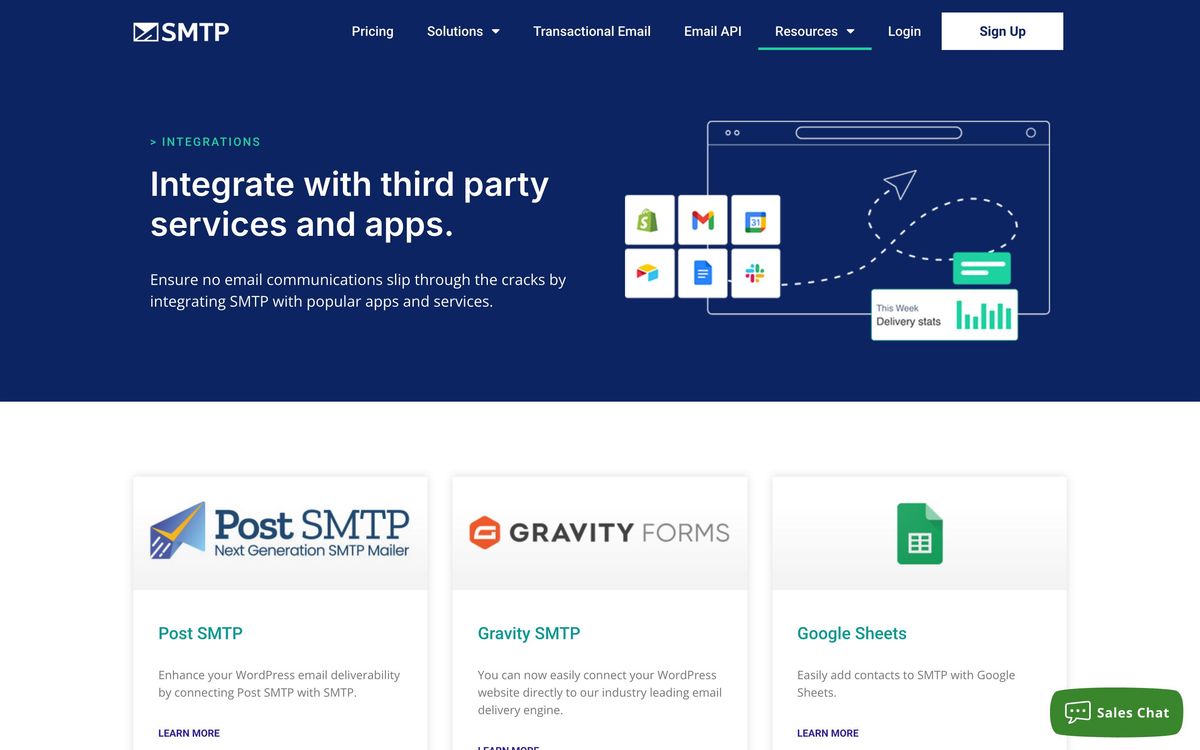
- Prebuilt connectors for WordPress, Shopify, Salesforce, HubSpot, BigCommerce, Zapier and Slack
Who it's for
The fit is a team that already has an application generating mail and a deliverability problem it does not want to staff. Receipts, password resets, shipping notices, alerting, anything where a message failing to arrive turns into a support ticket. Volumes in the tens of thousands a month and upward are where the entry plan starts to make sense.
It is a bad fit for two groups. Marketers who want to design, schedule and report on campaigns will find nothing here and should buy an email service provider instead. And small projects sending a few hundred messages a month have no reason to accept a monthly floor when SMTP2GO, Brevo and Postmark all hand out free or near-free volume at that scale. The absence of any trial compounds this: there is no way to test placement against your own traffic without committing to a paid month first, which is an odd stance for a company whose whole claim is that placement is better here.
How it compares
SendGrid is still the developer default and has the deeper API surface, template management and a genuinely free tier, but its shared pools have absorbed a lot of low-quality senders and support thins out below enterprise contracts. Postmark is stricter and faster, separates transactional from bulk streams properly, and wins clearly on log quality and response times, though it costs more per message and turns away some sending patterns outright. SMTP2GO undercuts SMTP.com badly at low volume and matches it on reporting; SMTP.com's counter-argument is IP heritage plus hands-on migration help, which lands hardest with senders who have already been burned by a reputation problem elsewhere.
Verdict
SMTP.com does one job and mostly does it well. Deliverability is not an afterthought, dedicated IPs are included rather than upsold, and the migration assistance is real rather than a support article. The caveats are equally real: the interface behaves like software that stopped being redesigned some years ago, the add-ons are priced as a share of the plan rather than by what they cost to run, and the lack of any free entry point makes honest evaluation awkward. It belongs on the shortlist for high-volume transactional senders and almost nowhere else.
Ready to try SMTP.com?
More developers tools like SMTP.com
Runpod
4.5GPU cloud for AI workloads: on-demand instances, serverless inference endpoints, and multi-node clusters.
Read Runpod review →CrowdStrike
4.4Cloud-delivered endpoint protection with one lightweight agent, sold to small teams as fixed per-device bundles.
Read CrowdStrike review →NinjaOne
4.4Endpoint management and RMM platform for monitoring, patching, backing up and remotely supporting company devices.
Read NinjaOne review →Bright Data
4.3Proxy network and managed scraping APIs for collecting public web data at production scale.
Read Bright Data review →Browse AI
4.3No-code web scraping: train point-and-click robots to extract data from any site and monitor it for changes.
Read Browse AI review →BugHerd
4.3Visual feedback tool that pins client comments to the exact element on a page and turns them into tasks.
Read BugHerd review →