
Signal House review
SMS and MMS APIs with 10DLC registration handled, aimed at teams leaving Twilio over per-message cost.
Worth a look for US A2P text volume where per-segment cost and registration speed decide the bill, though voice and RCS are still roadmap items rather than shipped products.
Pros
- Per-segment rates are published openly and fall with volume, which is rare in a market that usually hides messaging pricing behind a quote
- A2P brand and campaign registration is handled in-platform, and the carrier fees are passed through at cost rather than marked up
- Per-message telemetry shows created, queued, dequeued, sent and delivered timestamps, which makes deliverability problems diagnosable
- Agencies get per-sub-account cost control, which is the specific reason GoHighLevel shops move off the default provider
- Live human support is included on all plans, and shows up repeatedly in customer accounts of number porting
Cons
- Voice, RCS, short code and Apple Business messaging are listed as coming rather than available, so it cannot replace a full communications stack today
- The product is centred on US carrier registration and domestic delivery, which limits it for teams messaging internationally
- Rates are described as negotiable by volume and agreement, so the published numbers are a starting point rather than a committed price
Signal House pricing
List prices in USD per month, taken from the vendor at review time.
| Plan | Per month | What it covers |
|---|---|---|
| 10DLC local number | $0.25 | per number per month, from; SMS from 0.0030 per segment on volume tiers, MMS from 0.0170 |
| Toll-free number | $1 | per number per month; SMS from 0.0050 per segment, MMS from 0.0170; registration fees passed through at cost |
What Signal House actually does
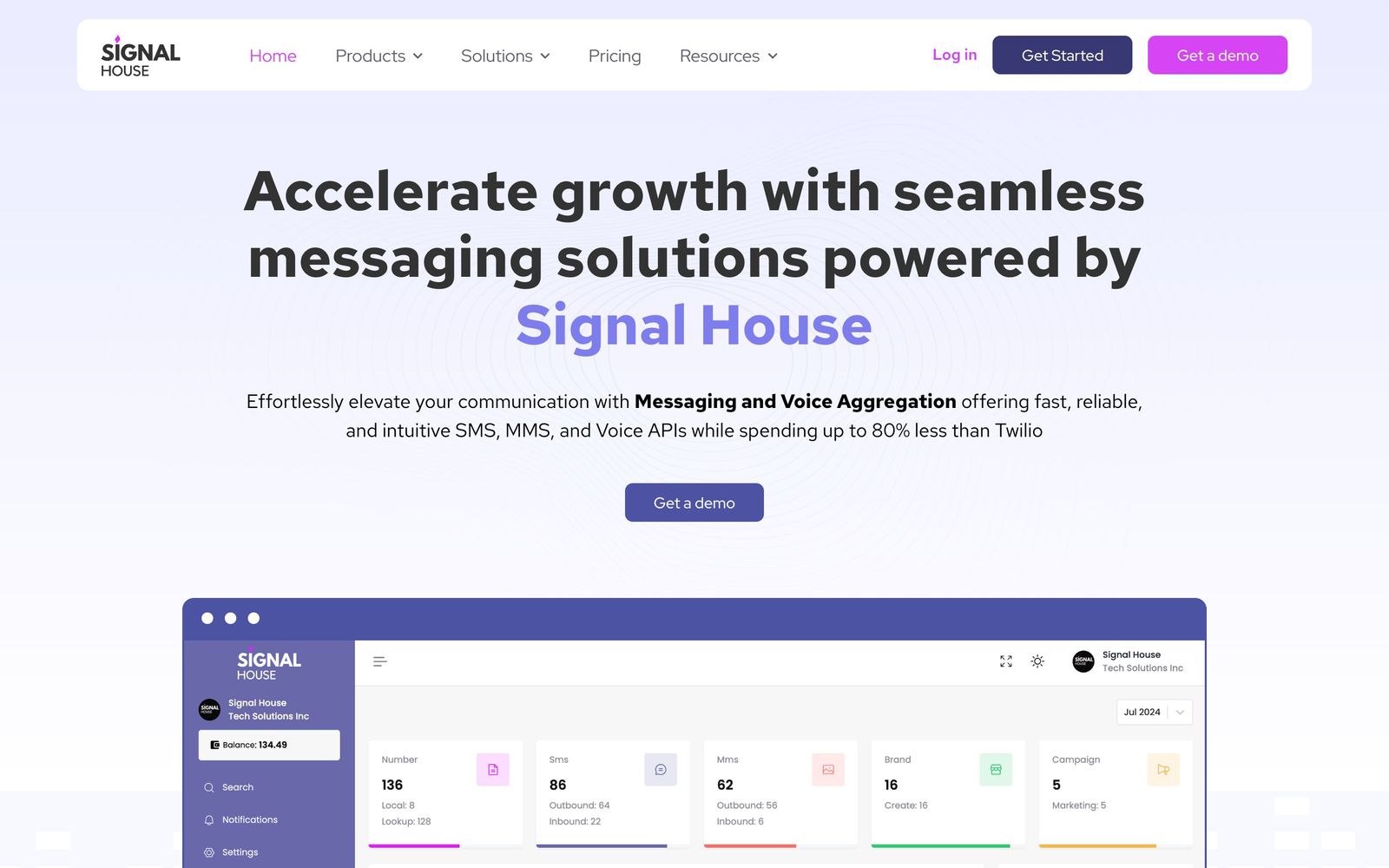
Signal House is a communications platform sold as a cheaper, simpler substitute for Twilio in one specific job: sending application-to-person text messages to US mobile numbers. It provides SMS and MMS over an API, number provisioning across 10DLC local and toll-free numbers, and a dashboard for sending and monitoring without writing code. Voice, RCS, short code and other channels sit on the roadmap rather than in the product, which matters a great deal if the goal is consolidating channels rather than moving text volume.
The company describes itself as a tier-two aggregator connected directly to carrier gateways, and most of its argument rests there: lower per-segment rates that decline as volume grows, and faster A2P brand and campaign registration, typically cleared in a couple of days rather than the drawn-out back-and-forth many teams endure. Registration fees are passed through at cost rather than marked up. The dashboard exposes timestamps for each stage of a message, from created and queued through to delivered, which is more granular telemetry than most competitors surface, and analytics can be filtered by number, brand, campaign, carrier and delivery status. Support is human and included on every plan, a point that recurs in customer accounts of number porting and campaign approval.
Key features
The product is narrow by design, and the detail is in delivery and registration.
- SMS and MMS APIs documented for dropping messaging into an existing application or CRM
- A2P 10DLC brand and campaign registration handled in-platform, with carrier fees passed through at cost
- Number provisioning for 10DLC local and toll-free numbers, priced by volume tier
- Per-message telemetry covering each stage from creation to carrier delivery
- Analytics filtered by number, brand, campaign, carrier and status, exportable into other systems
- Direct integrations with HubSpot, GoHighLevel and Shopify, plus Make for no-code automation
Who it's for
Two buyers. The first is a product team sending high volumes of transactional or notification text from its own application, where a fraction of a cent per segment compounds into real money and where 10DLC registration has been a recurring source of delay. The second is an agency running many client sub-accounts on GoHighLevel, where per-sub-account cost control is the entire problem.
It is not for teams that want one vendor for voice, video, email and chat, since the incumbents cover that spread and Signal House does not, whatever the roadmap promises. It is also a poor fit outside the US, because the product's centre of gravity is US carrier registration and domestic delivery. And anyone whose messaging is genuinely low volume will find the savings immaterial next to the switching cost of porting numbers and re-registering campaigns.
How it compares
Twilio remains the default: far wider channel coverage, a deeper ecosystem, better documentation, and a price that reflects all of it. Plivo and Telnyx occupy the same discount territory as Signal House with longer track records and broader voice products, and either is the more conservative pick for a team that needs voice today. Bandwidth sits above all of them as a carrier in its own right, which suits enterprise volume and enterprise procurement. Signal House's narrower claim, cheap US text with quick registration and a person who answers, is the reason to choose it over any of these.
Verdict
For US A2P text at volume, Signal House makes a straightforward case: published per-segment rates that undercut the incumbent, registration handled quickly and at cost, and delivery telemetry detailed enough to diagnose a problem rather than guess at it. The caution is breadth and track record. Voice and RCS are announced rather than shipped, the independent review base is thin compared with the platforms it targets, and rates are negotiable by volume, which means the published figures are an opening position. Move text volume here; do not rebuild an entire communications stack on it yet.
Ready to try Signal House?
More developers tools like Signal House
CrowdStrike
4.4Cloud-delivered endpoint protection with one lightweight agent, sold to small teams as fixed per-device bundles.
Read CrowdStrike review →NinjaOne
4.4Endpoint management and RMM platform for monitoring, patching, backing up and remotely supporting company devices.
Read NinjaOne review →Bright Data
4.3Proxy network and managed scraping APIs for collecting public web data at production scale.
Read Bright Data review →Browse AI
4.3No-code web scraping: train point-and-click robots to extract data from any site and monitor it for changes.
Read Browse AI review →BugHerd
4.3Visual feedback tool that pins client comments to the exact element on a page and turns them into tasks.
Read BugHerd review →EasyDMARC
4.3Email authentication monitoring that takes a domain from DMARC reporting to enforcement without hand-editing DNS.
Read EasyDMARC review →