
Sentaro review
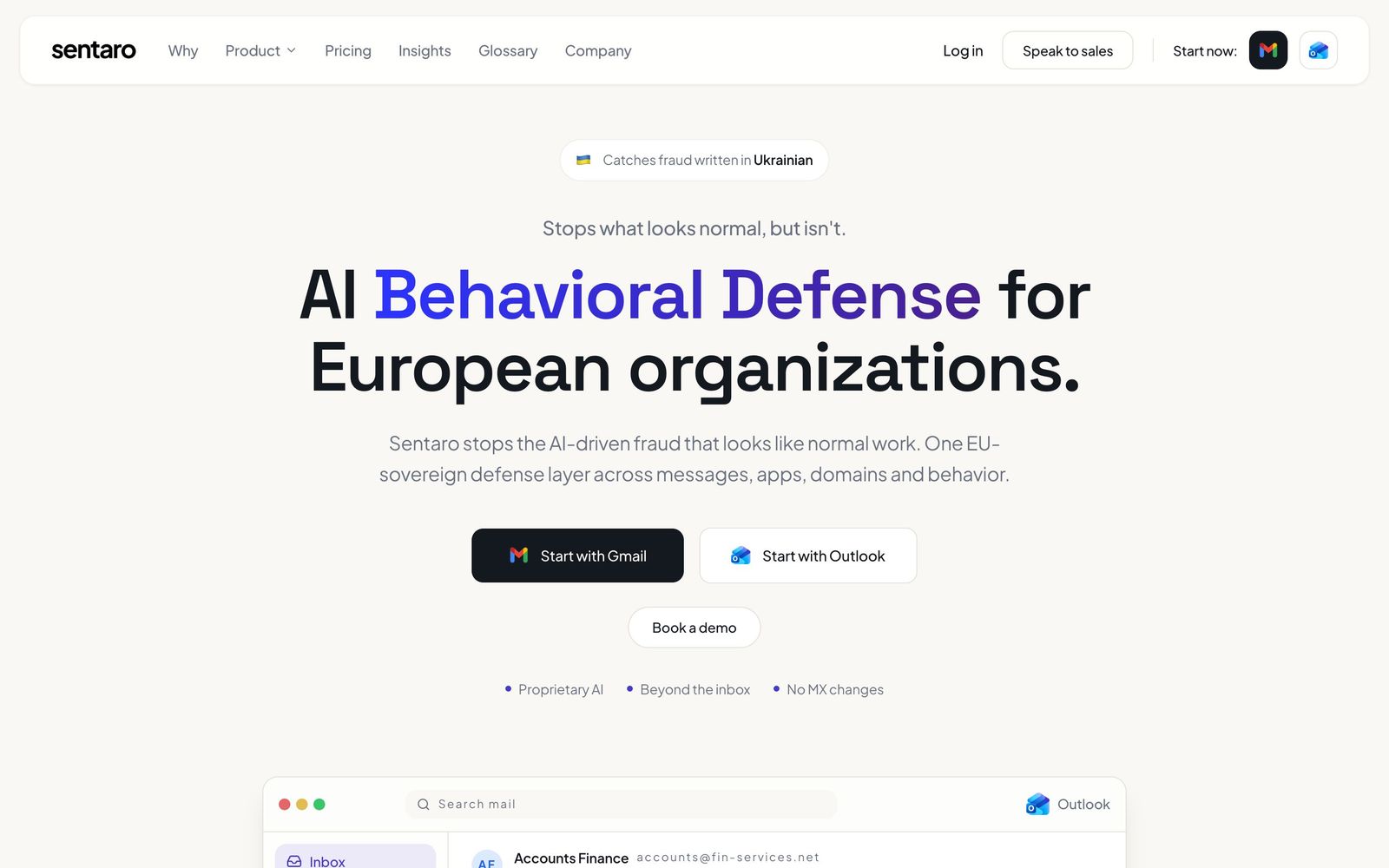
AI email security that sits inside Microsoft 365 or Google Workspace without touching mail flow or DNS.
A sensible modern layer over a mail filter that already misses impersonation and wire fraud, though it is an early-stage vendor with no published pricing and certifications still in progress.
Pros
- Connects through the mail provider's API, so there is no MX record change, no mail routing to unpick and no delivery risk during rollout
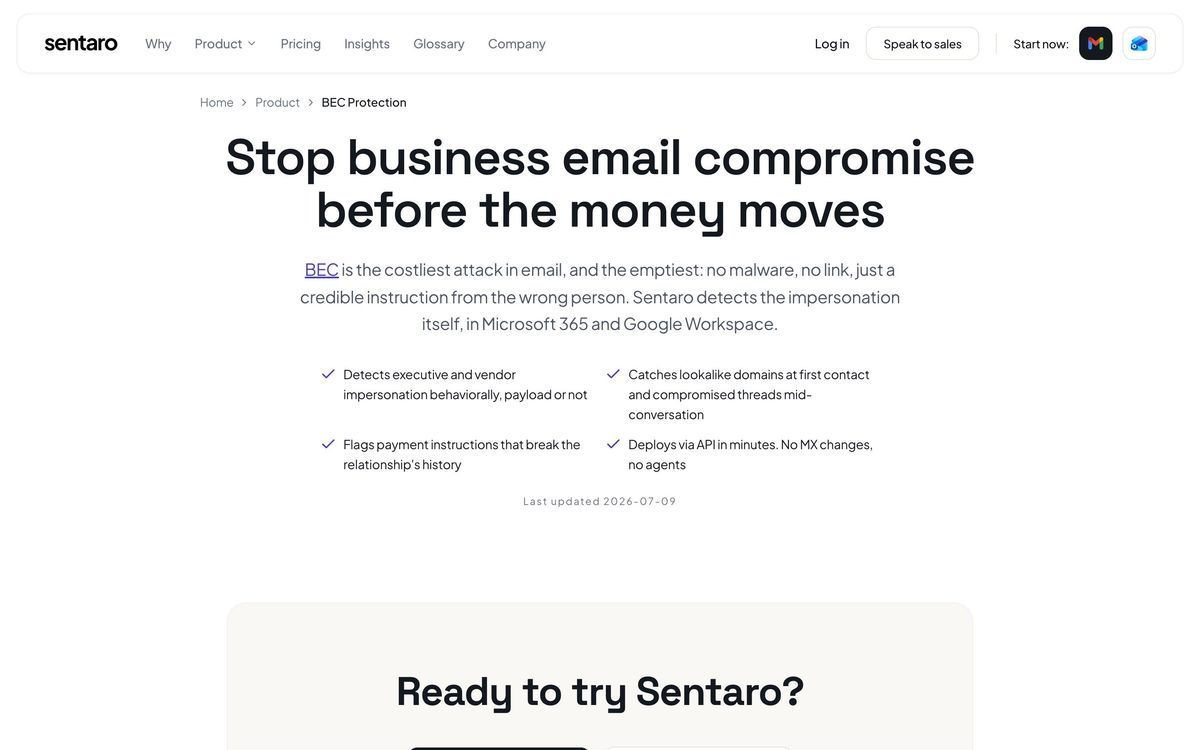
- Detection targets business email compromise and impersonation, the categories that pass gateway filters because the message carries no payload
- Shadow IT discovery surfaces the SaaS applications, AI tools and OAuth grants employees have connected to company mailboxes
- Credential leak monitoring checks breach databases for exposed and reused passwords tied to company addresses
- Only threat metadata is retained rather than message content, with short retention and no third-party data sharing
Cons
- No pricing is published, so the cost per mailbox cannot be compared against established competitors without contacting sales
- ISO 27001 and SOC 2 Type II are described as forthcoming rather than held, which is awkward for a security vendor selling to regulated buyers
- There is effectively no independent review record yet, so detection accuracy and false positive rates rest on vendor claims
What Sentaro actually does
Sentaro is an email security layer for companies that already run Microsoft 365 or Google Workspace and have discovered that the built-in filtering does not catch the attacks that matter. The category it addresses is business email compromise: a message with no attachment, no suspicious link and no malware, sent from a real account or a convincing lookalike, asking a finance clerk to change bank details on an invoice. Spam filters were designed for volume and payloads, and this kind of message contains neither, which is why it lands in the inbox.
The approach is contextual rather than signature-based. Sentaro examines sender behaviour, message content and historical communication patterns to judge whether a message is consistent with an existing relationship, then flags the ones that are not. Around that core it adds detection for AI-generated spear phishing, QR-code attacks and consent phishing, deepfake and targeted misinformation content, credential leak monitoring against breach databases, and shadow IT discovery that inventories the SaaS applications, AI tools and OAuth grants employees have connected to their mailboxes. Deployment is the practical selling point: it connects through the provider's API, so there is no DNS change, no MX record edit and no mail routing to reconfigure, and the vendor advertises setup in minutes. Infrastructure runs on Microsoft Azure behind Cloudflare, the platform is GDPR-compliant with AES-256 encryption and Google CASA certification, and it retains threat metadata rather than message content.
Key features
The capability list is focused on the threats that get past the layer beneath it.
- Context-aware analysis of sender behaviour, content and historical patterns instead of signature or reputation matching
- Business email compromise detection aimed at wire fraud and executive impersonation
- Detection for AI-generated spear phishing, QR-code attacks and OAuth consent phishing
- Deepfake and targeted misinformation identification within message content
- Credential leak monitoring against breach databases, including reused password detection
- Shadow IT discovery covering SaaS applications, AI services and OAuth grants across the mail environment
Who it's for
This is built for the company with fifty to five hundred staff, no security team, a finance function that pays invoices by email, and a mail platform whose default protections nobody has revisited since setup. The API deployment matters more than it sounds for that buyer, because it removes the one risk that stops small companies adding email security at all: nobody has to touch mail routing and hope nothing breaks. Managed service providers and IT partners are the second audience, and the tiered lifetime commission structure suggests the vendor knows it.
It is not the product for an enterprise with a security operations centre and an existing detection stack, which will want SIEM export, case management and an integration surface that is not published here. It is also premature for organisations whose procurement requires held certifications rather than planned ones, since ISO 27001 and SOC 2 Type II are still described as forthcoming.
How it compares
Abnormal Security pioneered this approach and remains the reference implementation, with far deeper behavioural modelling and enterprise pricing to match. Avanan, now part of Check Point, and Material Security both sit above Sentaro in maturity and integration depth. Ironscales and Mimecast come at the small-business end with more established review records and, in Mimecast's case, a heavier gateway model. Sentaro competes on deployment simplicity and price positioning for smaller companies rather than on detection sophistication that anyone outside the vendor has yet measured.
Verdict
The problem is real, the architecture is the right one, and the frictionless install genuinely lowers the barrier for a company that has been putting this off. That earns it consideration on a shortlist. The rating stays modest because almost everything a buyer needs to compare is missing: no published pricing, no independent detection benchmarks, no third-party review base, two certifications still pending, and no named integrations beyond the mail platforms themselves. Ask for a trial on live mail and a written detection report before treating it as a replacement for anything.
Ready to try Sentaro?
More developers tools like Sentaro
Mycroft
3.6GRC automation covering evidence collection, risk and vulnerability management across SOC 2 to FedRAMP.
Read Mycroft review →AFTRDRK
3.7Dark web surveillance that watches ransomware leak sites, stealer logs and closed forums for your name.
Read AFTRDRK review →Netlify
4.6Hosting and deployment platform with Git-based CI/CD, deploy previews, serverless functions, and AI workflows.
Read Netlify review →Pinecone
4.5Fully managed serverless vector database for similarity search, RAG, and agent memory at billion-vector scale.
Read Pinecone review →Runpod
4.5GPU cloud for AI workloads: on-demand instances, serverless inference endpoints, and multi-node clusters.
Read Runpod review →NinjaOne
4.4Endpoint management and RMM platform for monitoring, patching, backing up and remotely supporting company devices.
Read NinjaOne review →