
Heard review
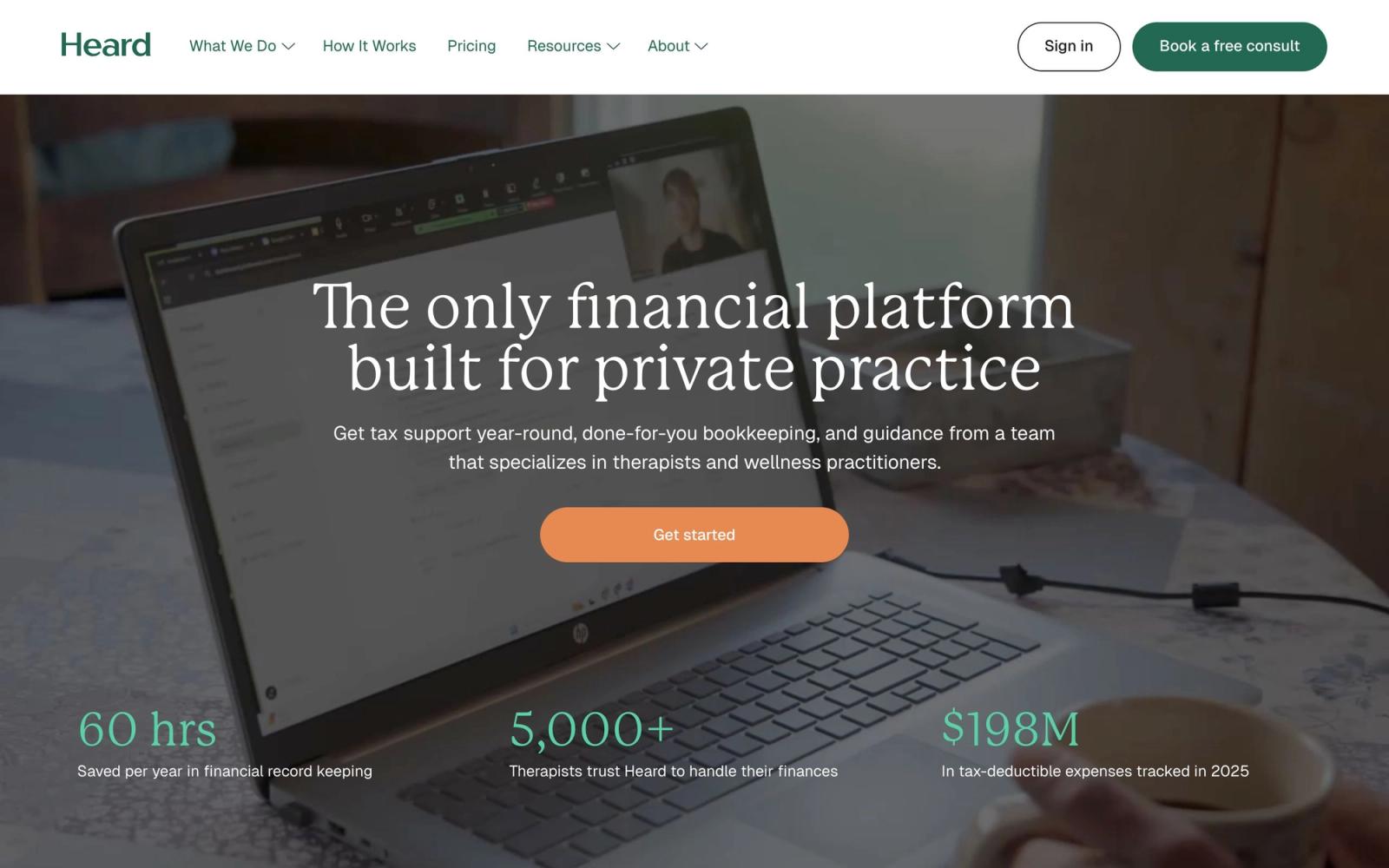
Done-for-you bookkeeping and US tax filing built only for therapists and private mental-health practices.
A genuinely good fit for solo US therapists who want bookkeeping and taxes handled, but it is niche, US-only, and not real accounting software for complex practices.
Pros
- Bookkeeping plus quarterly estimates and annual tax filing bundled into one flat monthly fee, no surprise per-return charges on most plans
- Built around therapist-specific realities (insurance reimbursements, sliding-scale, mixed personal/business spend) rather than generic small-business templates
- Flat predictable pricing that undercuts a dedicated CPA, with a dedicated bookkeeping team rather than pure software
Cons
- US-only by design (IRS filing, US bank/payroll integrations) and useless outside the US tax system
- Support is messaging-portal only with reported 24-48h response slippage and no phone line; weak for complex or multi-income-stream situations
Key features
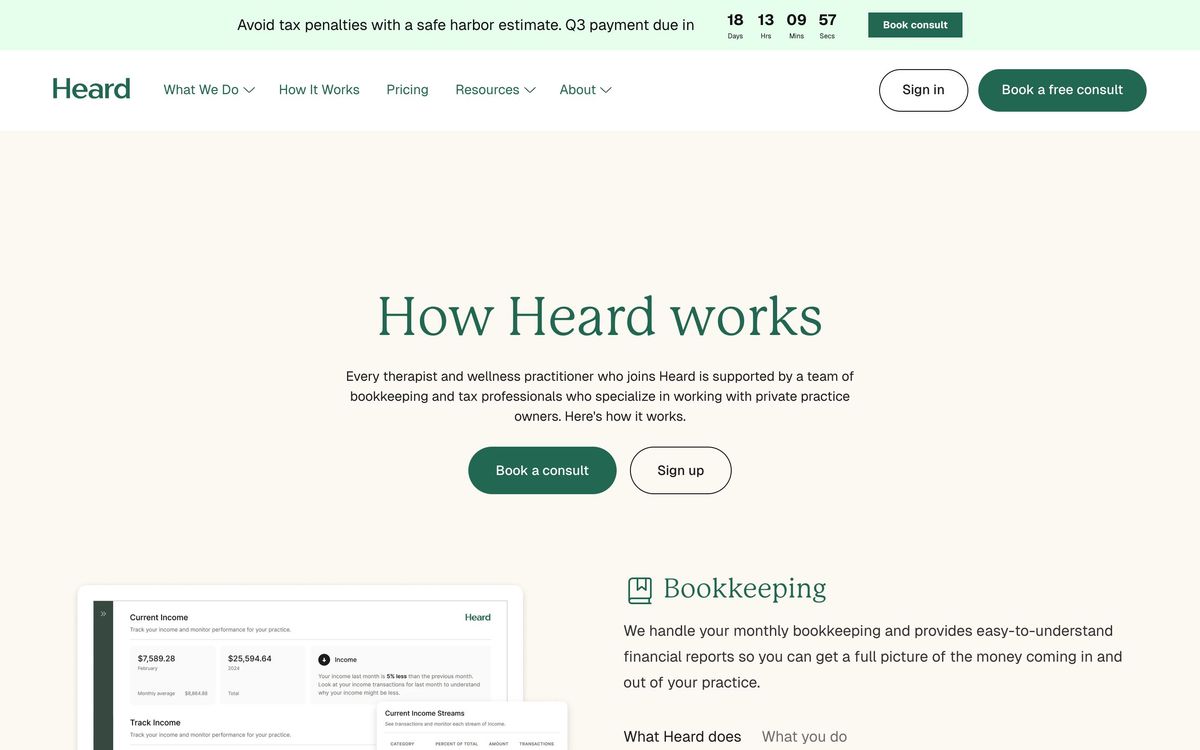
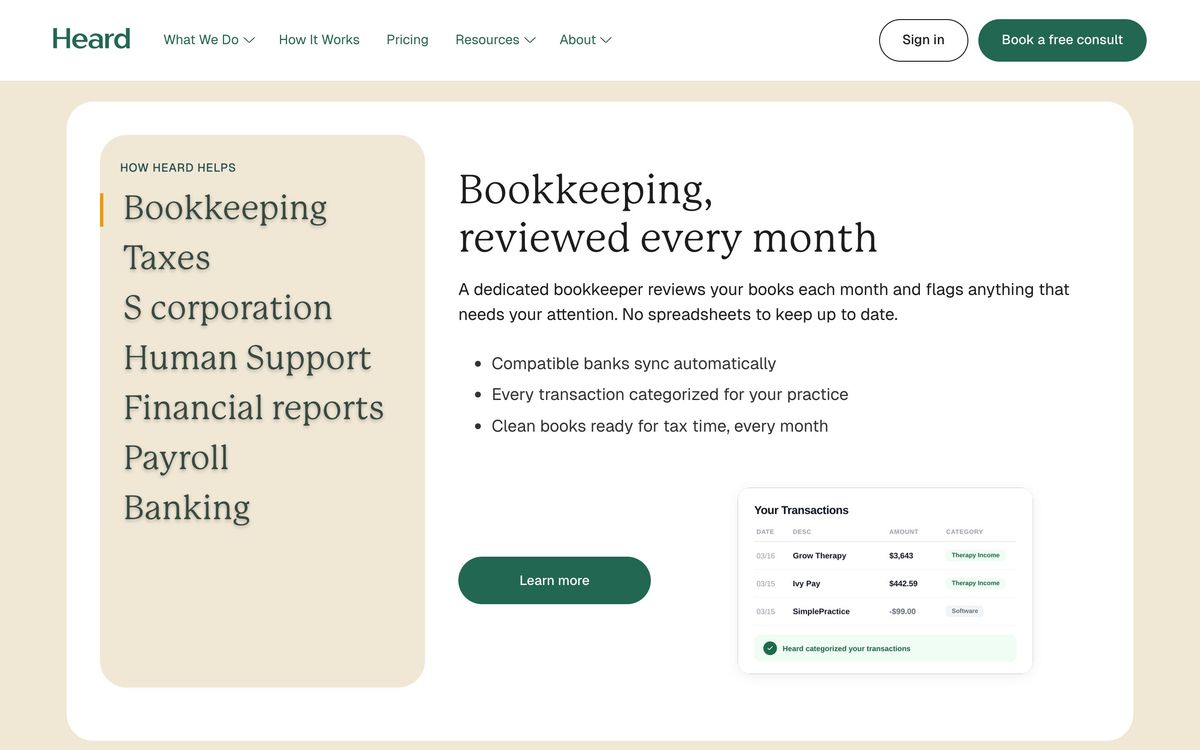
- Monthly done-for-you bookkeeping: transaction categorization and account reconciliation by a human team
- Combined quarterly tax estimates plus annual business and personal income tax filing (plan-dependent)
- S-corp compliance tooling on the top tier: payroll integration, accountable plans, reasonable-compensation support
Heard pricing
List prices in USD per month, taken from the vendor at review time.
| Plan | Per month | What it covers |
|---|---|---|
| Lite | $129 | Billed annually (~$1,548/yr). Monthly bookkeeping + quarterly estimates only; annual tax filing is a separate ~$750 fee. |
| Essential | $169 | Billed annually. Bookkeeping + quarterly and annual tax filing + personal income tax prep. Most popular; 15% off vs monthly. |
| Premium | $255 | Billed annually. Adds business return filing, S-corp compliance, accountable plans. Payroll add-on $39/mo + $6/employee/mo. |
What it is and who it's for
Heard is not general accounting software you'd put in front of a bookkeeper. It is a bundled bookkeeping-plus-tax service aimed squarely at one customer: the solo US therapist or small private mental-health practice. A human team categorizes transactions, reconciles accounts monthly, and handles quarterly estimates and year-end filing inside a purpose-built dashboard. The pitch is to take finance off a clinician's plate entirely, not to give them more knobs to turn.
Strengths
The vertical focus is the real differentiator. The platform understands insurance reimbursements, sliding-scale income, and the messy personal-vs-business spending solo practitioners actually deal with, so onboarding feels less like forcing a generic chart of accounts onto a clinical practice. Bundling bookkeeping with both quarterly and annual filing into one flat fee removes the usual sticker shock of a separate CPA invoice each spring, and a dedicated human team sits behind the automation rather than leaving you alone with a categorization bot.
Weaknesses and pricing
Support is the recurring complaint: it runs entirely through a messaging portal with no phone line, and users report responses missing the promised 24-48 hour window, which is painful near deadlines. The service is also explicitly not built for complexity, so multiple income streams, unusual structures, or joint filers who already use a personal accountant find it redundant. On price, plans run roughly $129/mo (Lite), $169/mo (Essential), and $255/mo (Premium) billed annually; watch the Lite tier, which pushes annual filing into a separate ~$750 charge, so its headline price understates real cost. Essential is the honest comparison point and beats a $300+/mo bookkeeper or $500+/mo CPA for a simple practice.
Regional note and verdict
This is a hard US-only product: it files with the IRS, integrates with US banks and Gusto payroll, and assumes the US tax calendar end to end, with no published international data-residency commitments because the audience is US clinicians. For a reader outside the US there is no usable equivalent here. For a US solo therapist with a simple tax picture it earns its fee and the niche tooling beats generic platforms; for complex returns, multiple businesses, an existing accountant, live-support needs, or any operation outside the US, look elsewhere.
Ready to try Heard?
More accountants tools like Heard
Aplos
4.0Fund accounting and donation tracking built for nonprofits and churches rather than adapted from small-business books.
Read Aplos review →Qoyod
3.8Arabic-first cloud accounting for Saudi businesses, with ZATCA e-invoicing, VAT and Zakat reporting built in.
Read Qoyod review →Dext
4.6AI receipt and invoice capture that pushes clean data into Xero, QuickBooks and Sage.
Read Dext review →Ignition
4.5Client engagement for accounting firms: proposals, engagement letters, and automated billing in one flow.
Read Ignition review →BILL
4.4Category-leading AP/AR automation for US firms, with a free Spend & Expense module bundled in.
Read BILL review →DataSnipper
4.4Excel-native AI document extraction and matching for audit and finance teams.
Read DataSnipper review →