
Qoyod review
Arabic-first cloud accounting for Saudi businesses, with ZATCA e-invoicing, VAT and Zakat reporting built in.
The pragmatic choice for a Saudi small business because ZATCA compliance is part of the product rather than a project, though tier caps on users and branches push growing companies up the price ladder quickly.
Pros
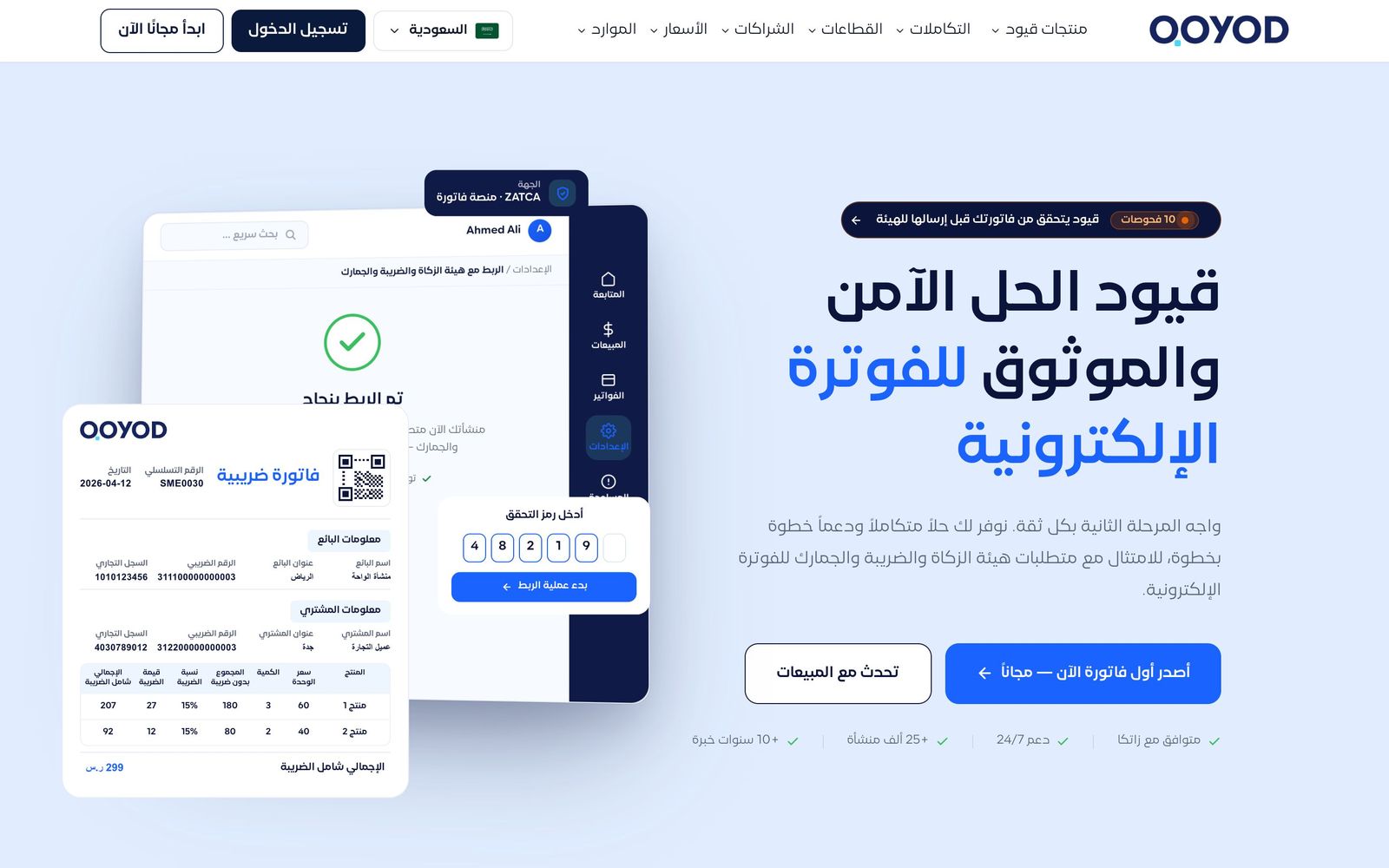
- ZATCA phase two e-invoicing is handled inside the product, signed invoices with QR codes submitted to Fatoora, with a sandbox to test against first
- The interface, invoice templates and reporting are built for Arabic and Saudi practice rather than translated after the fact
- Connects to the local commerce stack, Salla, Zid, Tabby, Moyasar and HyperPay, that international accounting tools largely ignore
- Users and branches are bundled into each plan rather than billed per seat, which keeps a small team's cost predictable
- Inventory, point of sale and manufacturing orders are available in-platform, so a retailer or small producer avoids a second system
Cons
- Each tier caps users and branches, and extra ones are charged individually, so growth means either climbing the ladder or accumulating add-ons
- The entry plan omits purchases, inventory tracking and ZATCA phase two integration, which makes it too thin for most VAT-registered trading businesses
- Coverage is regional, Saudi Arabia and Jordan, so it is no use to a practice with clients elsewhere, and the English documentation lags the Arabic
Qoyod pricing
List prices in USD per month, taken from the vendor at review time.
| Plan | Per month | What it covers |
|---|---|---|
| Basic | $138 | SAR per month, VAT included; 1 user, 1 location, ZATCA phase one |
| Pro | $207 | SAR per month, VAT included; 3 users, 3 locations, purchases, inventory, ZATCA phase two, API |
| Advanced | $379.50 | SAR per month, VAT included; 5 users, 5 locations, fixed assets, manufacturing orders, budgets |
| Point of sale add-on | $50 | SAR per POS user per month |
| Payroll add-on | $10 | SAR per employee per month |
What Qoyod actually does
Qoyod is cloud accounting written for one market rather than adapted to it. The ledger, invoicing, VAT and Zakat reporting all assume Saudi practice, the interface is Arabic first, and the part that decides most purchases is the e-invoicing engine: invoices are signed, given a QR code and submitted to ZATCA's Fatoora platform from inside the product, with a sandbox to rehearse the integration before going live. For a business that would otherwise be paying a developer to build a compliance bridge onto a foreign accounting package, that is the entire argument.
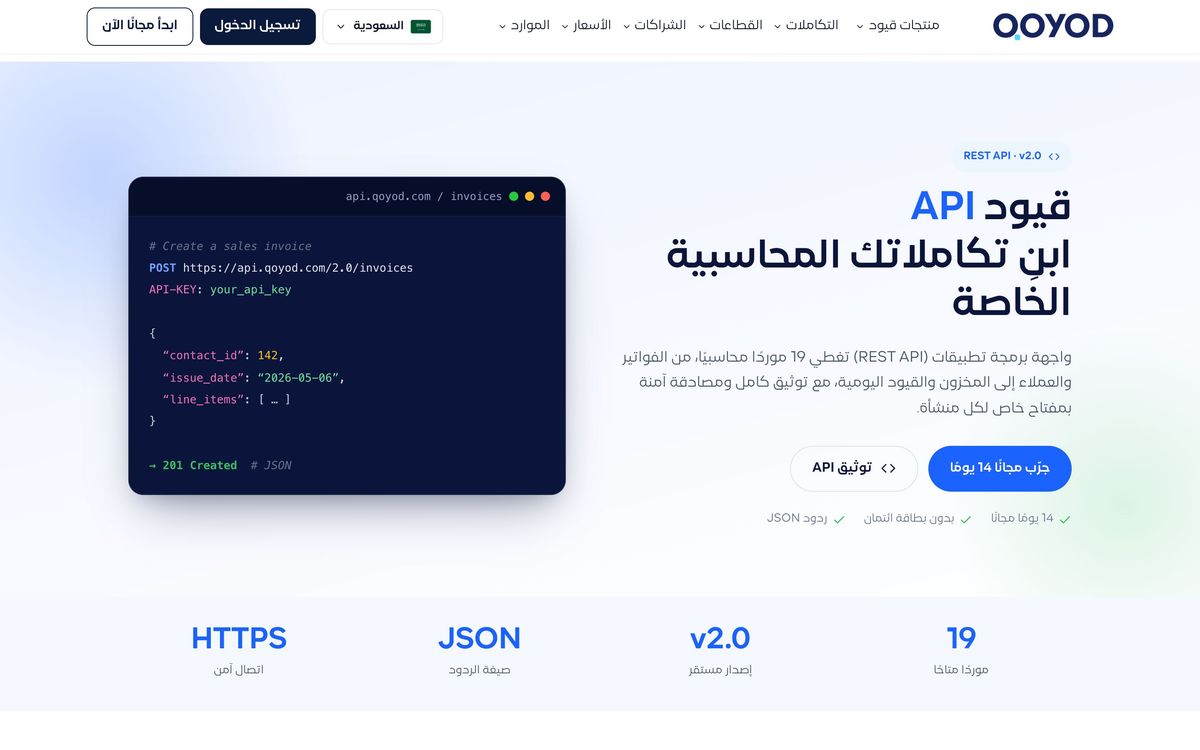
Around the ledger sits the rest of a small business system. Sales invoices, credit notes and receipts feed the accounts automatically; purchases, inventory and supplier records arrive on the middle tier; fixed assets, depreciation, manufacturing orders and budgets on the top one. A point of sale module is sold per till user and posts sales to the ledger as they happen, and payroll is a per-employee add-on. Connections cover the local commerce and payments stack, Salla, Zid, WooCommerce, Shopify, Tabby, Tamara, Moyasar and HyperPay, plus Google Sheets and an API on paid tiers. The company also sells bookkeeping and filing services performed by certified accountants, which is how many smaller clients actually use it.
Key features
The product is a conventional double-entry system with a compliance layer that carries most of its value.
- ZATCA phase two e-invoicing with digital signatures, QR codes and Fatoora submission
- Sales invoicing, credit notes, receipts and customer records
- Double-entry ledger with chart of accounts, manual journals and financial statements
- VAT and Zakat reporting, with optional bookkeeping and filing services
- Inventory tracking, purchase orders and supplier management from the middle plan
- Point of sale, billed per till user, posting sales into the accounts in real time
Who it's for
The fit is a Saudi small or mid-sized business, retail, food service, light manufacturing, professional services, that has to be ZATCA compliant and does not want a technical project to get there. It also suits accounting practices serving those clients, since the same platform covers a portfolio of small companies and the vendor sells bookkeeping capacity alongside it. A business already selling through Salla or Zid gets the strongest version of the product, because store orders reconcile without manual entry.
It is not a candidate for anyone operating outside Saudi Arabia and Jordan, and it is a weak choice for a company expecting to add staff quickly, because users and branches are counted against the plan. Groups needing consolidated multi-entity reporting, foreign currency depth or advanced management accounting will find the reporting too shallow and should be looking at a full ERP instead.
How it compares
Wafeq is the closest regional competitor, similarly focused on ZATCA compliance and generally stronger for multi-entity and multi-currency work. Zoho Books supports Saudi e-invoicing and brings a far larger surrounding ecosystem, but its local commerce and payments integrations are thinner and its Arabic experience less native. Odoo can do everything and more, at the cost of an implementation partner and continuing configuration. Qoyod's position is the practical middle: less capable than an ERP, more localised than an international suite, and cheap enough for a company with one bookkeeper.
Verdict
Qoyod earns its place by removing a specific, expensive headache. Compliant e-invoicing works out of the box, the accounting underneath is sound, and the local commerce and payment connections mean the numbers arrive without retyping. The bookkeeping and filing services attached to it make it viable even for owners who do not want to touch the ledger themselves. The caveats are structural rather than technical: the entry plan is too limited for a trading business, every tier caps users and branches so growth costs more than the headline suggests, and the product stops at the region's edge. Inside Saudi Arabia, for a company that is not growing headcount fast, it is a sensible and fairly priced choice.
Ready to try Qoyod?
More accountants tools like Qoyod
QuickBooks Online
4.2Intuit's cloud accounting platform: the most-searched ledger brand worldwide.
Read QuickBooks Online review →FreshBooks
4.1Invoicing-first accounting aimed at freelancers and service-based small businesses.
Read FreshBooks review →Heard
4.1Done-for-you bookkeeping and US tax filing built only for therapists and private mental-health practices.
Read Heard review →Sage Accounting
4.0Sage's entry-level cloud ledger for small businesses: invoicing, banking and financial reporting.
Read Sage Accounting review →Aplos
4.0Fund accounting and donation tracking built for nonprofits and churches rather than adapted from small-business books.
Read Aplos review →Quadient
3.9Accounts payable and receivable automation that plugs into NetSuite, Sage Intacct, QuickBooks and Dynamics.
Read Quadient review →