
Flatpay review
Card terminals, POS kits and online payments for European small merchants on one flat transaction rate.
The clearest card pricing a small European merchant is likely to be offered, though it trades away geographic reach and the software depth of a dedicated POS.
Pros
- One rate applies to every card type, which removes the interchange arithmetic that makes tiered card pricing impossible to compare
- No monthly subscription, so a seasonal or low-volume merchant pays only when money actually moves
- The rate steps down automatically above an annual card turnover threshold rather than requiring a renegotiation
- On-site installation, daily payouts and round-the-clock support are included rather than sold as a service tier
- The POS covers restaurant-specific work: table plans, split bills, saved orders and kitchen printer routing
Cons
- Flatpay operates in seven European countries only, so a merchant with a location outside them needs a second acquirer
- Rates are not published per market on the site; the flat percentage comes out of a sales conversation with a field representative, which makes desk comparison slow
- No published integration catalogue for accounting or ecommerce platforms, so takings mostly leave the system as reports rather than syncing to a ledger, and the POS hardware is a four-figure purchase up front
Flatpay pricing
List prices in USD per month, taken from the vendor at review time. Custom means quote-only.
| Plan | Per month | What it covers |
|---|---|---|
| Card terminal | Custom | no monthly fee; flat per-transaction rate quoted by market |
| POS Basic kit | Custom | €1,495 one-time for tablet, terminal, printer, cash drawer and stand; no monthly fee |
| POS Premium kit | Custom | €2,495 one-time for touchscreen with built-in printer, terminal, cash drawer and stand |
| Transaction rate (POS, euro markets) | Custom | 1.79% per transaction below €200,000 annual card turnover, 0.99% above |
What Flatpay actually does
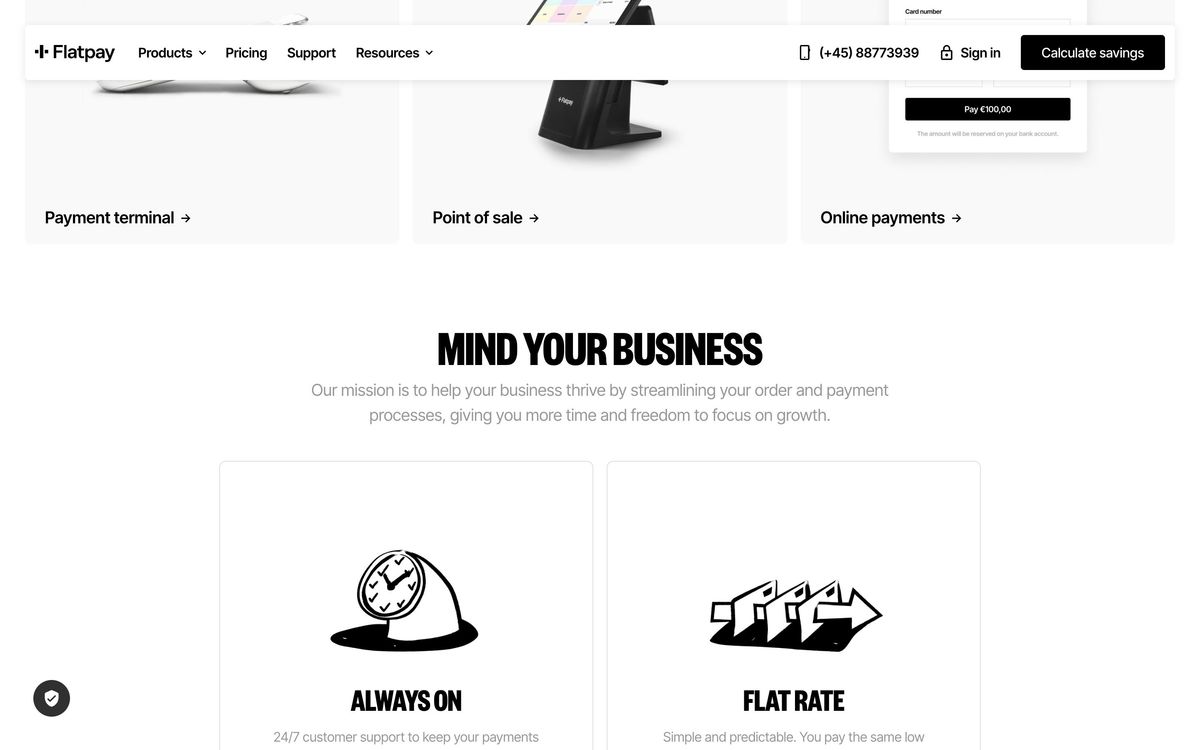
Flatpay sells card acceptance to small European merchants: a standalone payment terminal, full point-of-sale kits, and an online payments product that drops into a webshop. The pitch is not the hardware but the price sheet. Instead of the tiered card fees most acquirers quote, where debit, credit, commercial and international cards each carry a different rate and a fixed per-transaction charge sits on top, Flatpay charges one percentage on every card, with no monthly subscription and no per-transaction fee. Above a stated annual card turnover the percentage drops to a lower band automatically.
The company operates in Denmark, Germany, Finland, Italy, France, the Netherlands and the United Kingdom, and sells the way payment companies sold twenty years ago: a local representative visits the shop, runs a savings calculation against the merchant's current statement, and installs the equipment on site. Payouts land daily. For a café owner who has never been able to work out what card acceptance actually costs, that combination of one number and a person who shows up is the entire proposition.
Key features
The product line splits into hardware, the software that runs on it, and the merchant portal behind both.
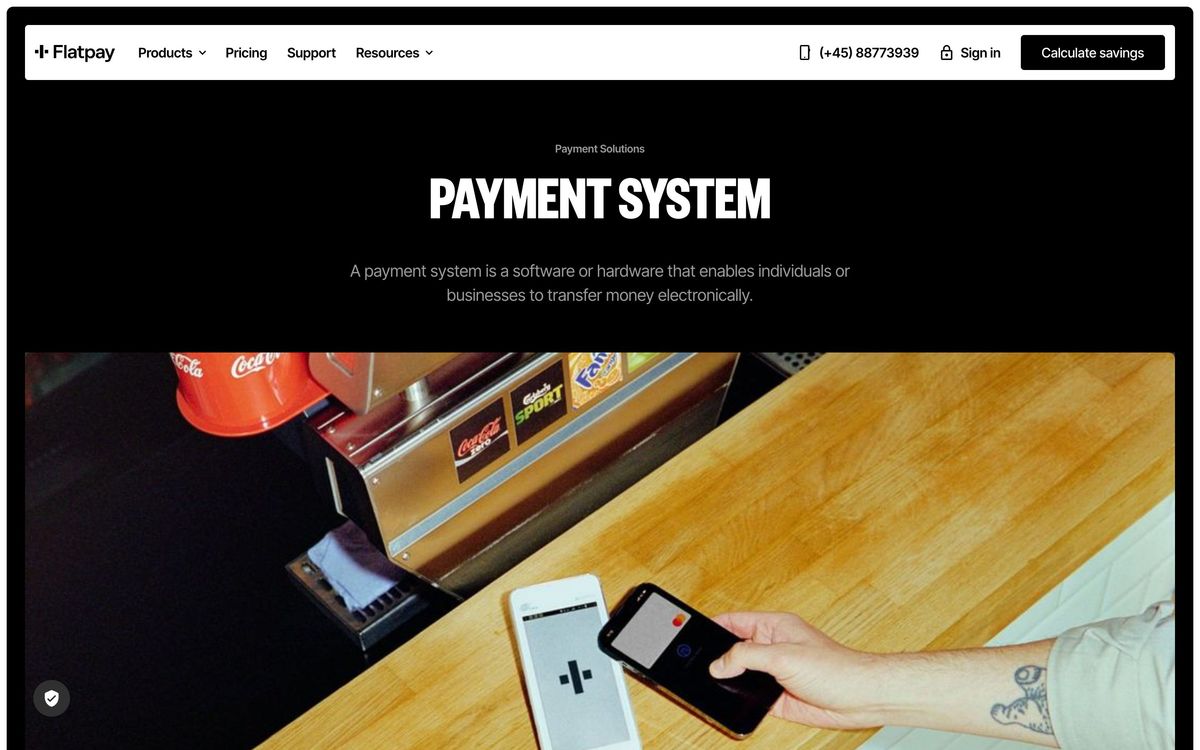
- Portable card terminal handling contactless, chip and PIN and mobile wallets
- POS kits in two configurations, one tablet-based with an external printer and one large touchscreen with the printer built in, each shipping with a cash drawer and stand
- Restaurant tooling including table management, split bills, saved orders, dine-in and takeaway separation and kitchen printer routing
- Product, category and stock control managed centrally from the merchant portal
- Real-time sales analytics with cashier reports and end-of-day reports available at the terminal
- Online payments for a webshop, with daily payouts and installation carried out on site
Who it's for
The right buyer is a single-site or few-site merchant taking most payments in person: a café, a bakery, a restaurant, a hairdresser, a small retailer. Specifically, one whose current provider bills a monthly terminal rental, a gateway fee and three different card rates, and who has been paying it for years without ever reconciling the statement. That merchant will save money and, more usefully, will be able to predict the cost of a takings day.
It is the wrong choice for a business trading outside the seven supported countries, for anyone whose volume is mostly online rather than in person, and for merchants who need the POS to feed an accounting ledger, an inventory system or an ecommerce catalogue automatically. Larger hospitality groups running multi-site stock, staff scheduling and loyalty in one system will also find this POS too plain.
How it compares
SumUp and Zettle are the obvious alternatives for the smallest merchants, both cheaper to start with and available in more countries, though their rates rise for keyed and commercial cards, which is precisely the complexity Flatpay removes. Square offers far more software around the payment, including inventory, loyalty and appointment booking, and syncs to accounting tools, but its per-transaction pricing varies by card type and its support is remote rather than a local visit. The incumbent bank acquirers still win on scale and on multi-country coverage, and lose comprehensively on legibility. Flatpay competes on a single axis and knows it.
Verdict
Judged as a payments contract rather than as software, Flatpay is a straightforwardly good deal for a small in-person merchant in one of its markets, and the flat rate across every card type is a real structural difference rather than marketing framing. Judged as a point-of-sale system, it is serviceable but ordinary, with no published integration story and hardware bought outright. The rate you are actually offered still comes from a sales conversation, so ask for the figure in writing alongside the turnover threshold, and check that every card type is covered before signing anything.
Ready to try Flatpay?
More service-businesses tools like Flatpay
Synthflow AI
4.4No-code voice AI agents for inbound and outbound calls: booking, lead qualification and support, 24/7.
Read Synthflow AI review →Bókun
4.3Booking system and OTA channel manager for tour, activity and rental operators, owned by Tripadvisor.
Read Bókun review →Boulevard
4.3Booking, point of sale and client records for salons, spas and medspas that run on appointments.
Read Boulevard review →Buddy Punch
4.3Online time clock for hourly staff, with GPS, geofencing and photo verification on every punch.
Read Buddy Punch review →Connecteam
4.3Mobile app for deskless teams: shift scheduling, GPS time clock, checklists, chat and training.
Read Connecteam review →ServiceM8
4.3Job management for trade and home service crews, metered by jobs dispatched rather than by seat.
Read ServiceM8 review →