
Coast review
Visa fleet card with per-driver and per-vehicle controls, receipt capture and accounting sync for trades fleets.
The fleet card to pick when crews buy fuel wherever they happen to be rather than at one branded network, though it is a credit product and approval is not a given.
Pros
- Runs on the Visa network, so a driver is not hunting for a branded station and the same card covers tolls, parking, parts and maintenance
- Cards can be left locked by default and unlocked from the mobile app per transaction, which kills most card-sharing fraud outright
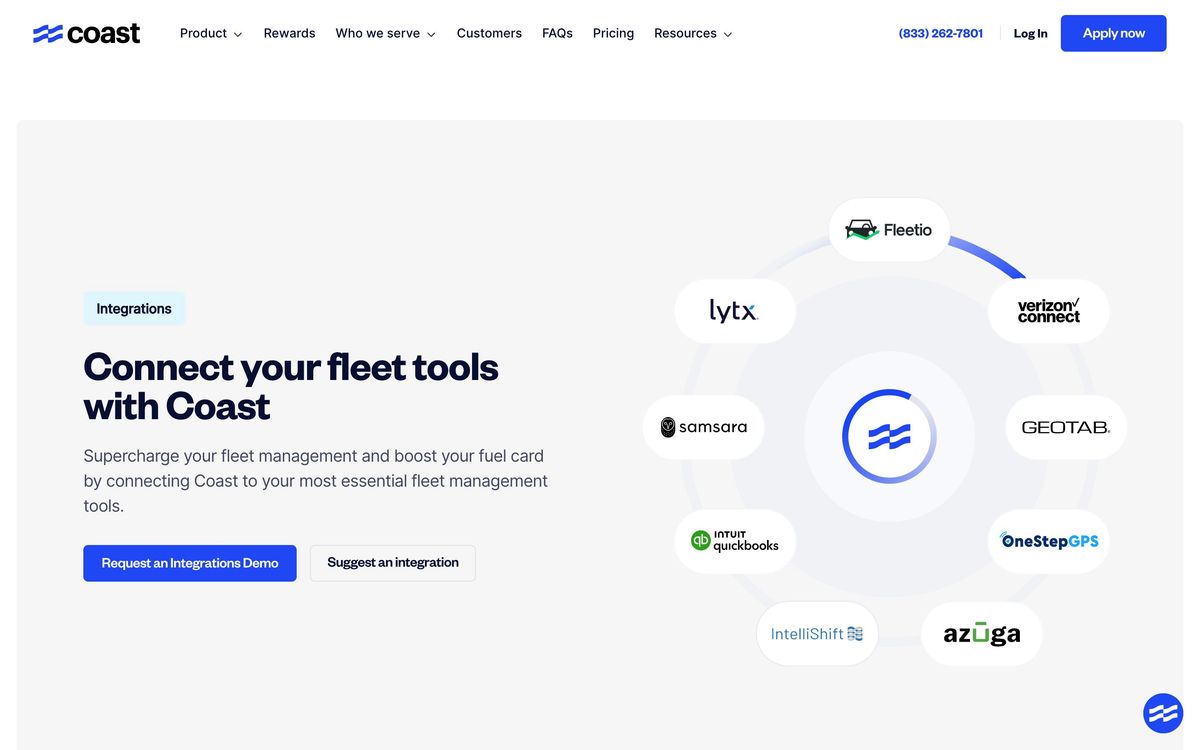
- Two-way telematics links with Samsara, Geotab, Verizon Connect and Azuga check a fill against vehicle location and tank capacity
- Transactions sync to QuickBooks, NetSuite and Sage Intacct already coded, with receipts attached, so month-end is not a shoebox exercise
- The fee schedule is unusually plain for the category: no per-gallon administration charge, no per-transaction fee and no portal or reporting fees
Cons
- It is a credit product with an underwriting step, so a young company or one with thin business credit may not be approved for the limit it wants
- Each card is tied to one person's email address and mobile number, which is awkward for shared trucks and pooled vehicles
- Some fuel stations still mishandle Visa fleet prompts, and reviewers report declines whose cause is hard to trace back to the rule that triggered them
Coast pricing
List prices in USD per month, taken from the vendor at review time.
| Plan | Per month | What it covers |
|---|---|---|
| Coast | $4 | per active user, per month; card production and standard shipping included |
| Bill Pay add-on | $99 | includes 100 ACH payments and 100 cheques a month |
What Coast actually does
Coast is a fleet fuel card issued on the Visa network with an expense platform wrapped around it. The card behaves like a normal business Visa at the pump and everywhere else, which is the point: a plumbing or landscaping crew is rarely near the one branded station a traditional fleet card accepts, and the same card also covers tolls, parking, parts, hardware runs and the occasional hotel. Coast then applies fleet-style controls on top of that generality, limits per driver, per vehicle, per day, per transaction, and merchant categories that can be blocked outright.
The security model is the part that separates it from a plain corporate card. Cards can sit locked by default and be released from the driver's phone for a single purchase. Transactions are checked against telematics: Coast pulls GPS position and tank capacity from Samsara, Geotab, Verizon Connect or Azuga and questions a fill that happened nowhere near the truck or that is larger than the tank. On the back end, spend is auto-categorised, receipts are collected from drivers by prompt, and the coded transactions push into QuickBooks Online or Desktop, NetSuite or Sage Intacct, with fuel and maintenance data also flowing to Fleetio and WhipAround for cost-per-vehicle tracking.
Key features
The product is a card, a control layer and an accounting pipe:
- Visa fleet card with rules set per driver and per vehicle, including daily and per-transaction caps
- Default-locked cards with mobile authorisation and merchant category blocking
- Telematics-fed fraud checks that compare a fill against vehicle location and tank size
- Receipt capture and automatic coding across fuel, field and office purchases
- Discounts at a large network of partner stations plus cashback on non-fuel spend
- Optional bill pay module for ACH runs and printed cheques alongside card spend
Who it's for
Coast fits the trades: HVAC, plumbing, solar, roofing, landscaping, general contracting and small transport operations, typically running somewhere between a handful and a few hundred vehicles. The common thread is drivers who fuel opportunistically rather than at a fixed network, and an office manager who currently reconciles fuel receipts by hand. The controls and the telematics checks pay for themselves fastest in fleets that suspect card sharing but cannot prove it.
It suits two groups less well. Long-haul trucking operations that need in-network diesel pricing, weigh-station services and over-the-road discounts will still find the traditional trucking cards better matched. And because this is credit rather than a prepaid product, a newly formed company or one with a thin file may be approved for a limit smaller than its weekly fuel bill, which turns the card into a constraint rather than a tool.
How it compares
AtoB is the closest competitor and plays the same universal-acceptance card, with a stronger pull among owner-operators and small trucking fleets; Coast is generally the tidier product for trades businesses that also buy parts and materials. WEX and Fuelman remain the incumbents, with deeper station-level fuel data and negotiated network pricing, but their acceptance footprint and their fee schedules are the reason people leave. Ramp and Brex handle office spend far more elegantly and integrate with more of the finance stack, yet neither offers vehicle-level rules or telematics fraud checks, so a fleet ends up running two systems. Coast's argument is that one card can serve both purposes for a company whose spend is mostly fuel and field purchases.
Verdict
Coast has done the unglamorous work well: acceptance anywhere Visa reaches, controls that map onto how a crew actually spends, fraud checks grounded in vehicle data rather than guesswork, and a clean push into the accounting system. The fee schedule is refreshingly free of the nuisance charges the legacy fleet cards still levy. The caveats are the ones that come with a credit product and a general-purpose network: underwriting decides the limit, cards are bound to individual people rather than to trucks, some stations still fumble the Visa fleet prompt, and support is not there at three in the morning. For a trades fleet tired of chasing paper receipts, it remains the strongest option in its class.
Ready to try Coast?
More service-businesses tools like Coast
Synthflow AI
4.4No-code voice AI agents for inbound and outbound calls: booking, lead qualification and support, 24/7.
Read Synthflow AI review →Bókun
4.3Booking system and OTA channel manager for tour, activity and rental operators, owned by Tripadvisor.
Read Bókun review →Boulevard
4.3Booking, point of sale and client records for salons, spas and medspas that run on appointments.
Read Boulevard review →Buddy Punch
4.3Online time clock for hourly staff, with GPS, geofencing and photo verification on every punch.
Read Buddy Punch review →Connecteam
4.3Mobile app for deskless teams: shift scheduling, GPS time clock, checklists, chat and training.
Read Connecteam review →ServiceM8
4.3Job management for trade and home service crews, metered by jobs dispatched rather than by seat.
Read ServiceM8 review →