
800.com review
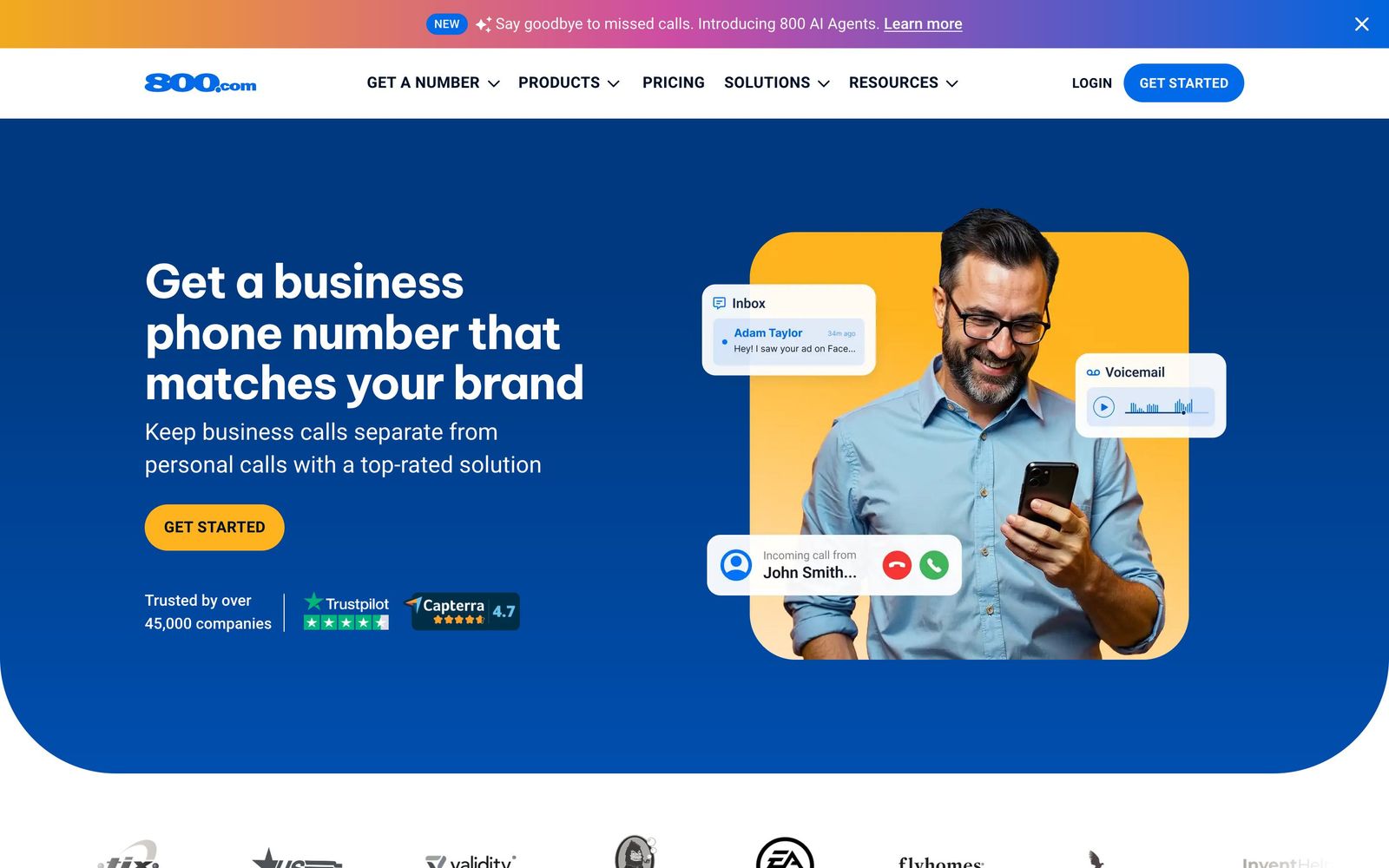
Toll-free, local and vanity business numbers with call forwarding, texting and call tracking in one account.
A straightforward way to put a memorable business number in front of customers without a phone system, though it is not a full communications platform and stops at the US and Canadian borders.
Pros
- Toll-free, local and vanity numbers can be bought and pointed at an existing mobile or landline within minutes
- Calls forward sequentially or simultaneously across devices, so a small team can share one published number
- Call recording and voicemail transcription are included on every plan rather than sold as add-ons
- Dynamic number insertion on the top tier attributes inbound calls to the campaign that produced them
- No setup fee or contract, with a thirty-day money-back window instead of a trial
Cons
- Service covers the United States and Canada only, which rules it out for anyone taking international calls
- It is a number and forwarding service, not a unified communications platform: no video meetings, no team messaging, and a limited mobile app
- The top tier costs several times the mid tier yet includes a metered minute allowance where the cheaper plan has unlimited minutes
800.com pricing
List prices in USD per month, taken from the vendor at review time.
| Plan | Per month | What it covers |
|---|---|---|
| Startup | $23 | 1 business number, 1,000 minutes and 120 SMS a month; overage $0.06 |
| Small Business | $59 | 3 numbers, unlimited minutes under fair use and 500 SMS a month |
| Complete | $119 | 5 numbers, 1,000 minutes, 1,000 SMS, AI receptionist and dynamic number insertion |
What 800.com actually does
800.com sells business phone numbers and the routing that sits behind them. A customer searches for a toll-free, local or vanity number, buys it, and points it at whatever device already rings: a mobile, a landline, a colleague's phone, or the provider's own desktop and mobile applications. There is no hardware, no PBX to configure, and no requirement to move an existing phone service. That narrow scope is the product. For a contractor, a clinic, a law practice or a franchise that wants a memorable published number and a clean separation between business and personal calls, the setup takes minutes rather than a project.
Behind the number sits a modest but coherent feature set. Calls can ring several devices in sequence or all at once, be screened before they are answered, or be routed through an auto attendant with extensions. Recordings and voicemail transcriptions are kept against each number, and analytics show which numbers and campaigns produce calls. Two-way texting and SMS campaigns run from the same account, which matters for service businesses that confirm appointments by text. The upper tier adds call tracking with dynamic number insertion for advertising attribution and AI answering that qualifies leads and books appointments. Integrations reach Salesforce, HubSpot, Slack, Zapier and Looker, enough to push call records into a CRM.
Key features
The capability list stays close to numbers, routing and measurement:
- Toll-free, local and vanity number search, purchase and porting
- Sequential or simultaneous call forwarding with call screening
- Auto attendant, extensions and recorded business greetings
- Call recording and voicemail transcription retained per number
- Two-way SMS with campaign sending and a contact list
- Call analytics and tracking, with dynamic number insertion on the top plan
Who it's for
The right buyer already has phones that work and wants a business identity in front of them: a growing service business that publishes one number on vans, invoices and a website, a marketer who needs separate tracking numbers per campaign, or an owner who is tired of customers calling a personal mobile. Multi-number call tracking is the strongest use case, because attribution data flows into the CRM and the cost per number is modest.
It is the wrong purchase for anyone who wants to replace a phone system. There is no video conferencing, no internal team messaging and no contact centre queueing, and the mobile application is thinner than the ones shipped by full communications vendors. Businesses that take calls from outside the United States and Canada are excluded outright. Larger teams that need call queues, supervisor tooling or detailed agent reporting will exhaust the analytics quickly.
How it compares
Grasshopper is the closest analogue, similarly focused on numbers and forwarding for small businesses, and comparable on both simplicity and limits. RingCentral and Nextiva sell a genuine phone system with video, messaging, queues and desk phone support, at a higher per-user price and with a real implementation to do; they win the moment the requirement is a company phone system rather than a number. CallRail is the better tool if the point is purely marketing attribution, with deeper call tracking and reporting, and no ambition to be the phone line. 800.com sits between the two, adding measurement to a plain number.
Verdict
800.com does a small job cleanly, and the value is highest for businesses that publish a number widely and want to know which advertisement produced each call. The rating reflects that focus and the quick setup, discounted for its North American limits, the absence of the collaboration features buyers increasingly expect from a business phone provider, and a top tier whose price is hard to justify against a mid tier with unlimited minutes. Firms wanting one memorable number will be satisfied; firms wanting a phone system should shop elsewhere.
Ready to try 800.com?
More service-businesses tools like 800.com
Aircall
4.1Cloud phone system with a shared call inbox and automatic CRM logging, for support and inside-sales teams.
Read Aircall review →Textline
4.1Shared inbox for business texting, with HIPAA-grade controls for support, logistics and clinic teams.
Read Textline review →Calilio
4.0AI-powered cloud phone system with a unified callbox and virtual numbers from 100+ countries.
Read Calilio review →Nextiva
3.9Cloud phone system that extends into a contact centre with shared inboxes, chat and AI call handling.
Read Nextiva review →Ruby
3.8Live virtual receptionists and managed website chat answering for small businesses around the clock.
Read Ruby review →Unitel Voice
3.8A virtual phone system that puts a business number, auto attendant and shared voicemail on phones a team already owns.
Read Unitel Voice review →