
Pagecloud review
Drag-and-drop website builder with popups, forms and cookie-free analytics for small business sites.
A capable and unusually flexible builder for small business sites and landing pages, though the ecosystem around it is a fraction of Squarespace's or Wix's and e-commerce costs extra on top of the plan.
Pros
- The editor allows genuine layout control rather than forcing content into fixed template slots
- Popups, banners and lead capture forms are built in, so no separate conversion tool is needed for a simple site
- Analytics are cookie-free and GDPR-friendly, covering visits, clicks, form submissions and broken links
- SEO basics are exposed properly: meta titles and descriptions, heading hierarchy, redirects and broken link detection
- Hosting, SSL, unlimited blogging and a Semrush keyword research integration come with the plan
Cons
- E-commerce is an add-on charged in addition to the site plan rather than a feature of the higher tiers
- There is no real app marketplace, so extending a site means embedding third-party tools such as Calendly or Eventbrite
- The template and section library is far smaller than Squarespace's or Wix's, which leaves more of the design work starting from a blank page
What Pagecloud actually does
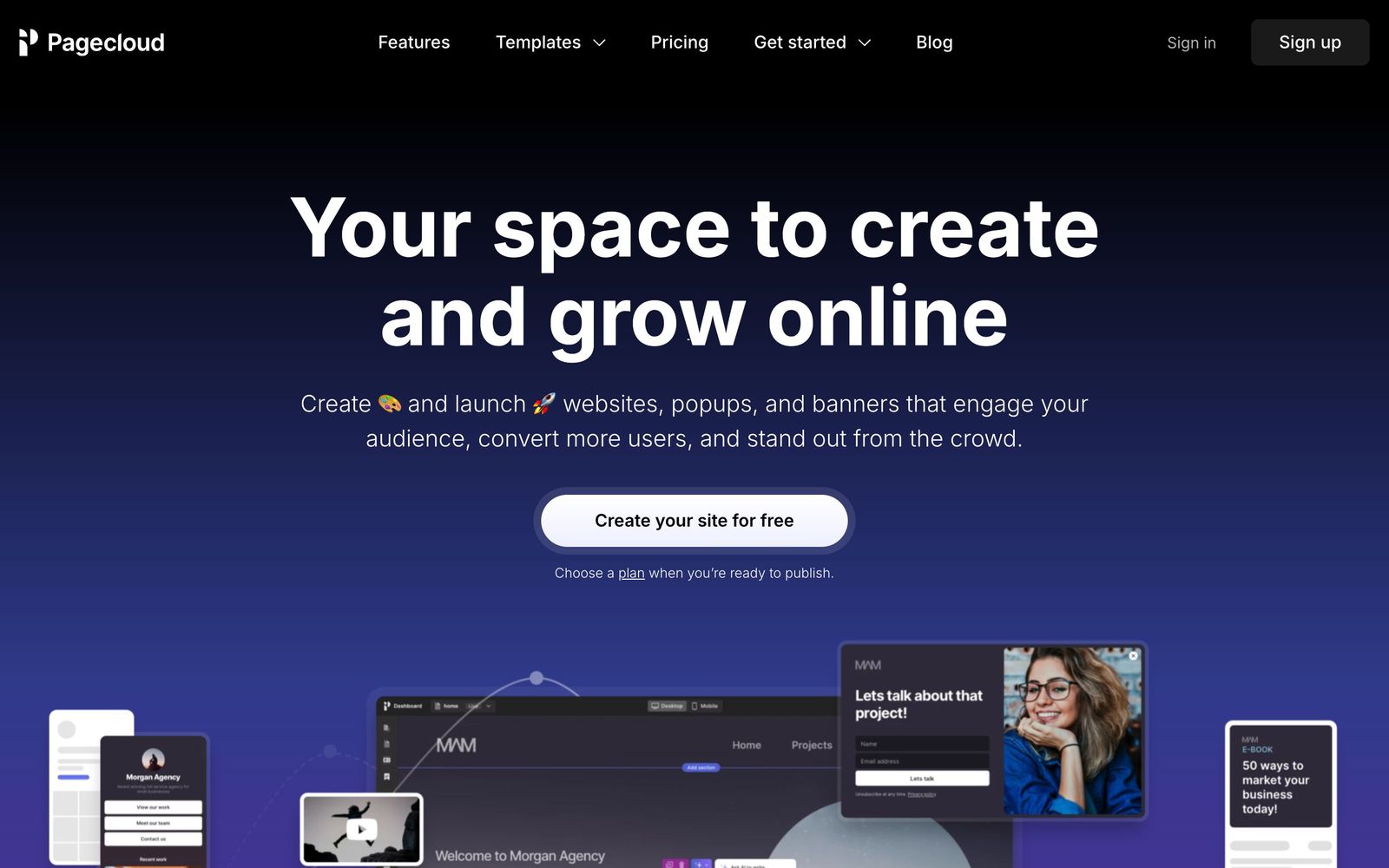
Pagecloud is a hosted website builder aimed at people who want their site to look the way they imagined rather than the way a template decided. The editor works by direct manipulation: elements are dragged into place, styled with colours and fonts pulled from a brand palette, and animated if wanted, all without writing code. Sites can start from a template across categories like business, photography, restaurants and nonprofits, and grow by dropping in pre-built sections. Hosting, SSL and a custom domain connection come with the subscription.
What distinguishes it from the obvious competitors is how much conversion tooling is included rather than sold separately. Popups appear as modals, slide-ins or exit-intent overlays, promotional banners can be scheduled, and custom forms collect leads into the same dashboard. Analytics are first-party and cookie-free, reporting visits, clicks, form submissions and broken links without dropping a consent banner on visitors. There is a blog with unlimited posts, an AI writing assistant for drafting copy, a Semrush integration for keyword research, and a storefront that can be added to any plan for selling products and syncing to Instagram, TikTok, Amazon, Facebook and eBay.
Key features
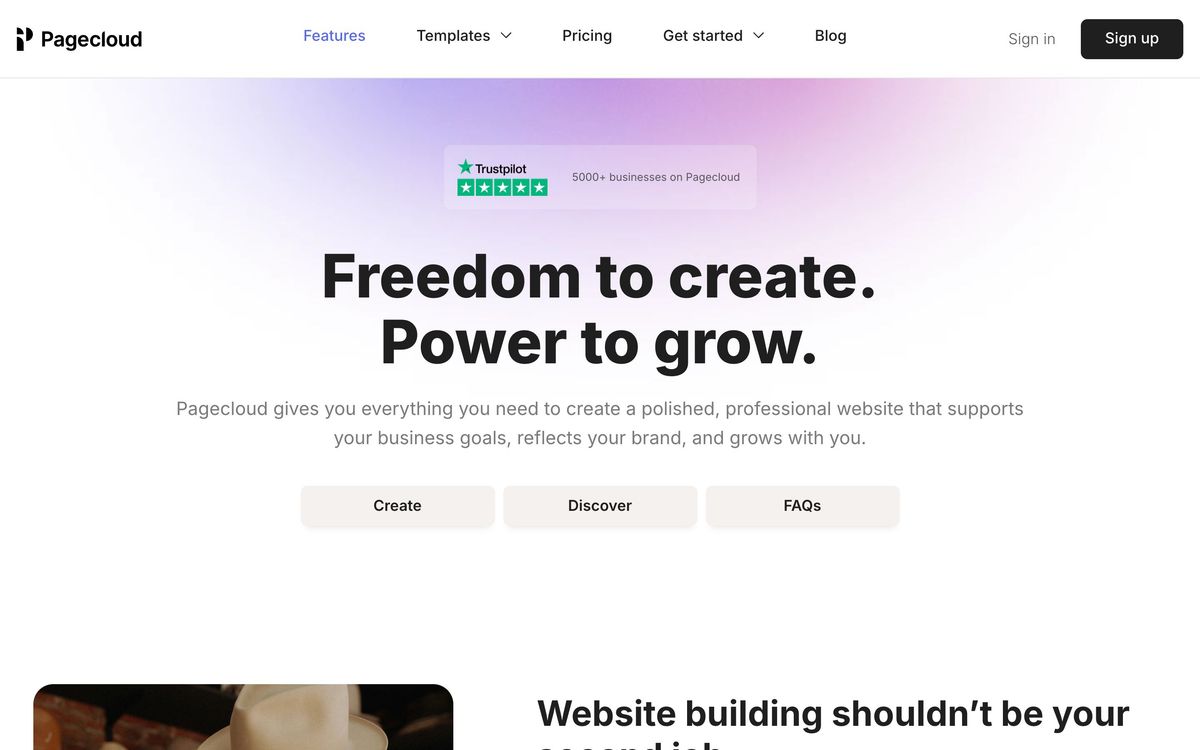
The feature set is broader than the price suggests, but its centre of gravity is design and lead capture.
- Visual editor with drag-and-drop placement, custom fonts, animations and brand colour management
- Popups and banners in several formats with display rules, built in rather than bolted on
- Custom lead capture forms with submissions stored in the dashboard
- Cookie-free analytics with custom event tracking and broken link detection
- SEO controls for meta tags, heading hierarchy and redirects
- Optional e-commerce storefront with inventory and multi-channel selling
Who it's for
Pagecloud suits the small business owner, freelancer or small agency that wants an attractive marketing site with a working lead form and a promotional popup, and does not want the site to look like every other template on the internet. Agencies get a dedicated plan structure and a collaboration layer, which makes it plausible as a way to hand simple sites to clients without teaching them a content management system.
It is not the right foundation for a business whose growth plan depends on a plugin ecosystem. WordPress exists precisely for that, and Shopify exists for anyone whose site is fundamentally a store. Pagecloud also asks more of the person building the site than a rigid template product does: the freedom that makes it appealing is the same freedom that lets an inexperienced builder produce something visually inconsistent across breakpoints.
How it compares
Squarespace wins on template quality, a mature ecosystem and brand recognition with clients, and loses on layout freedom, since its structure resists designs that step outside the grid. Wix offers comparable drag-and-drop freedom and a much larger app market, but carries more product surface than most small sites need and a heavier page as a result. Webflow is far more capable for anyone willing to learn box models and CSS concepts, and far too much for someone who simply wants a five-page site by Friday. Pagecloud is the middle option: more design freedom than Squarespace, less complexity than Webflow, a smaller ecosystem than either.
Verdict
Pagecloud is a competent builder that does more than its profile suggests, and the inclusion of popups, forms and privacy-friendly analytics means a small business can run a marketing site without stacking three subscriptions. The design freedom is real and the SEO controls are honest rather than decorative. The caveats are ecosystem and commercial structure. There is no marketplace of apps to grow into, extensions rely on embedding other people's tools, and selling products means paying for the storefront on top of the site plan. For a straightforward brochure-and-leads site it holds up well; for anything with ambitions to become a platform, start somewhere with more room.
Ready to try Pagecloud?
More marketers tools like Pagecloud
Ploy
3.5AI site builder that also identifies visitors, writes SEO pages and reports on paid campaigns.
Read Ploy review →RGE Studio
4.1Drag-and-drop email and landing page builder that exports into whichever platform you already send from.
Read RGE Studio review →Outgrow
4.0Builder for calculators, quizzes and assessments that qualify a visitor before asking for an email.
Read Outgrow review →Instapage
3.9Landing page builder for paid traffic, with server-side A/B testing and ad-to-page matching.
Read Instapage review →Leadpages
3.9Landing pages, pop-ups and opt-in forms with unlimited traffic on every plan and Stripe checkout built in.
Read Leadpages review →AWeber
3.8Long-running email marketing platform for newsletters, autoresponders and sign-up forms, with a usable free tier.
Read AWeber review →