
Landingi review
Landing page platform with 400+ templates, AI page generation, built-in event tracking, and bulk page updates.
Best at managing large portfolios of landing pages cheaply with Smart Sections and programmatic generation; it lacks the AI traffic-routing optimization that Unbounce offers.
Pros
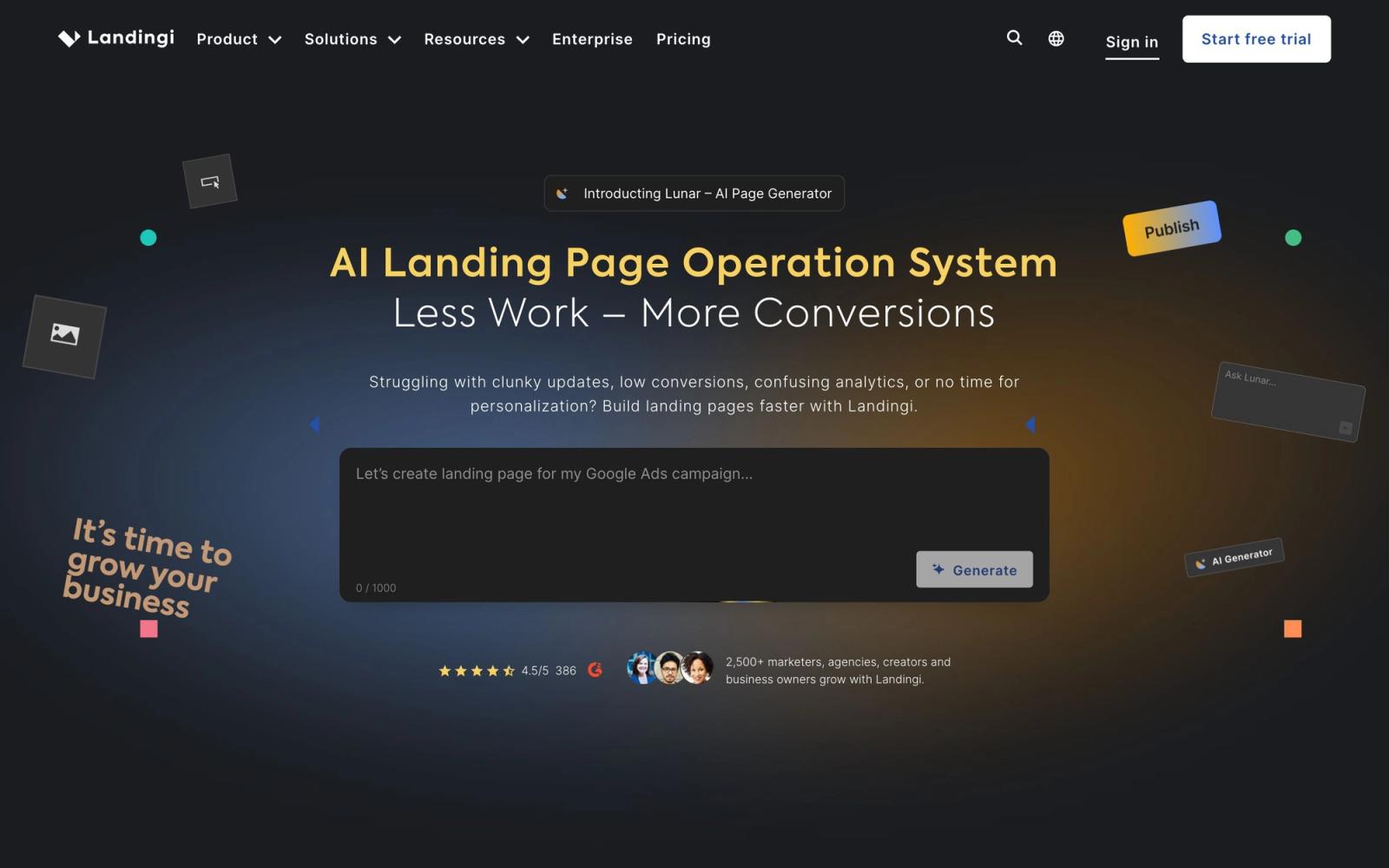
- 400+ templates plus Lunar, an AI generator that drafts launch-ready pages from a short description
- Smart Sections update a shared block across many pages at once: a real time-saver for agencies
- EventTracker records clicks, scrolls, and form activity without wiring up external analytics
- Programmatic pages generate hundreds of variants from one master layout and dynamic data
- A genuine free plan exists, so you can publish before paying
Cons
- No AI traffic routing equivalent to Unbounce's Smart Traffic; optimization is manual A/B testing
- A/B testing and some automation features are reserved for higher tiers
- The editor's fine-grained control takes longer to learn than simpler builders
Landingi is a Poland-born landing page platform that has grown into one of the more complete alternatives to Unbounce and Instapage. Its 2026 pitch is automation: not just building a landing page, but generating pages with AI, tracking visitor behavior natively, and updating hundreds of pages at once. This Landingi review covers what the platform does well for conversion-focused marketers, where the editor shows its limits, and who should pick it over the bigger names in the landing page builder category.
What Landingi actually does
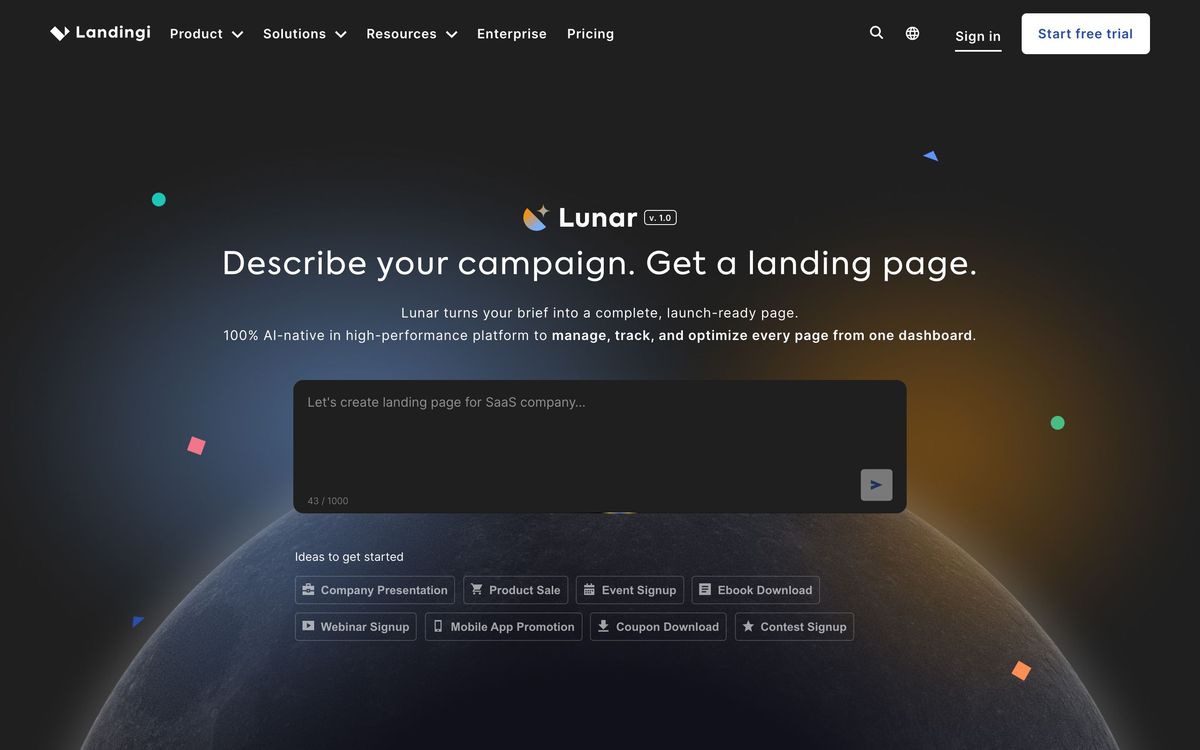
Landingi gives you a pixel-level drag-and-drop editor and a library of more than 400 templates for landing pages, popups, and microsites. The AI layer, called Lunar, can draft a launch-ready page from a brief text description, which is useful for getting past the blank-canvas stage even if you end up rewriting most of the copy.
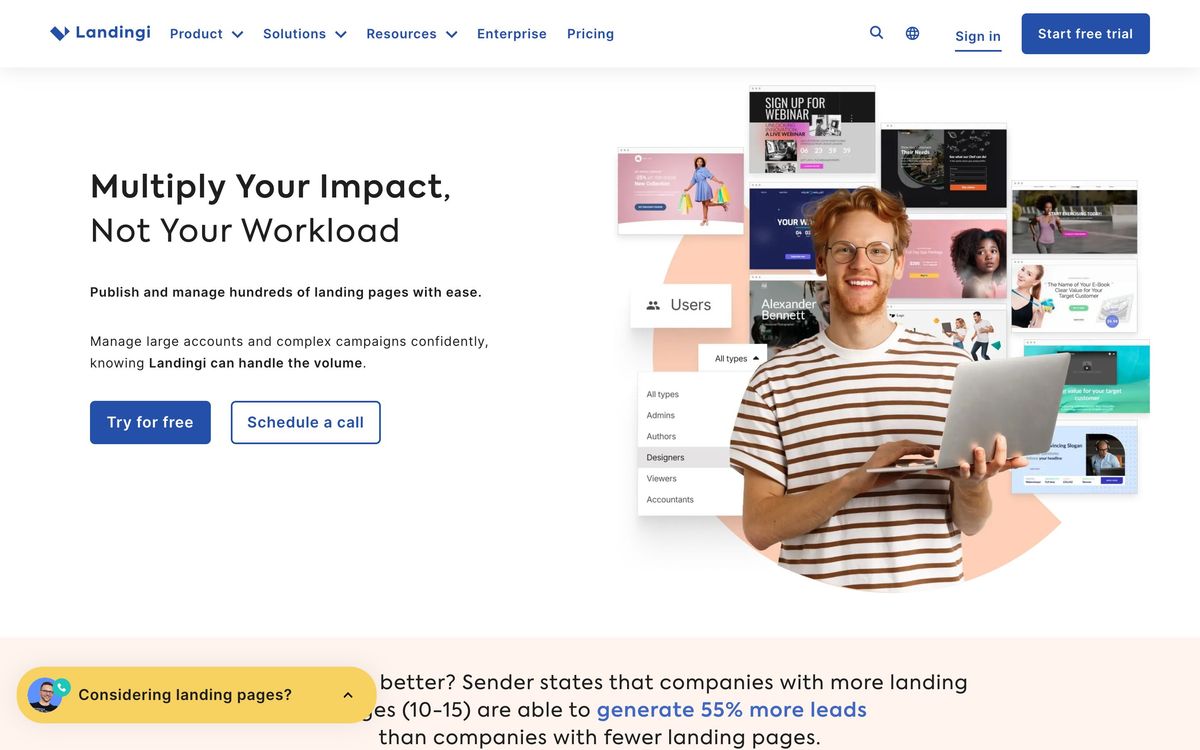
Where Landingi gets genuinely interesting is portfolio management. Smart Sections let you define a shared block (a header, a pricing section, a footer) and update it across every page that uses it in one action. Programmatic pages take that further: one master layout plus a data file can generate hundreds of localized or keyword-specific pages. Add automatic translation into 35 languages and you have a platform clearly aimed at people who run many pages, not one or two. EventTracker, the built-in behavior analytics, records clicks, scroll depth, and form interactions without any external tag setup, and classic A/B testing is available for optimization. Infrastructure basics like automated SSL and reCAPTCHA-verified lead forms are handled for you, and around 170 integrations cover the usual CRM, email, and analytics stack.
Key features
- Drag-and-drop editor with 400+ templates for pages, popups, and microsites
- Lunar AI page generator that produces a working draft from a short brief
- Smart Sections for updating shared blocks across many pages simultaneously
- Programmatic page generation from a master layout and dynamic data
- EventTracker built-in behavior analytics (clicks, scrolls, form activity)
- Automatic translation into 35 languages and ~170 integrations
Who it's for
Landingi suits agencies and in-house marketers who maintain dozens or hundreds of landing pages: localized campaigns, per-keyword PPC pages, multi-client rosters. The free plan also makes it one of the few serious builders a bootstrapped marketer can start on without a card. Solo users who need one beautiful page and heavy AI-driven conversion optimization are less of a match; the platform's strengths are scale and workflow, not algorithmic traffic routing.
How it compares
Against Unbounce, the trade is clear: Unbounce has Smart Traffic, an AI system that routes visitors to the best-converting variant, while Landingi counters with bulk-management features, more templates, and a friendlier entry point including a free plan. Instapage is the other frequent comparison; it focuses on enterprise ad-to-page personalization and collaboration and is positioned well upmarket of Landingi. If your bottleneck is producing and maintaining many pages, Landingi wins on workflow. If your bottleneck is squeezing conversion rate from one high-traffic page, Unbounce's optimization stack is stronger.
Verdict
Landingi is a quietly capable landing page platform that prioritizes the unglamorous parts of the job: shipping many pages, keeping them consistent, and knowing what visitors do on them. The AI generator is a useful accelerant rather than a gimmick, and EventTracker removes a whole category of analytics setup. The honest cons are the absence of automated traffic optimization and the gating of A/B testing behind higher tiers. For agencies and portfolio marketers comparing the best landing page builders of 2026, Landingi deserves a serious look, especially if you want to start free and scale up only when the page count demands it.
Ready to try Landingi?
There's a free tier, so you can test it before committing.
More marketers tools like Landingi
Webflow
4.3Visual builder that writes real HTML and CSS, with a CMS marketing teams can edit without developers.
Read Webflow review →RGE Studio
4.1Drag-and-drop email and landing page builder that exports into whichever platform you already send from.
Read RGE Studio review →Outgrow
4.0Builder for calculators, quizzes and assessments that qualify a visitor before asking for an email.
Read Outgrow review →Instapage
3.9Landing page builder for paid traffic, with server-side A/B testing and ad-to-page matching.
Read Instapage review →Leadpages
3.9Landing pages, pop-ups and opt-in forms with unlimited traffic on every plan and Stripe checkout built in.
Read Leadpages review →AWeber
3.8Long-running email marketing platform for newsletters, autoresponders and sign-up forms, with a usable free tier.
Read AWeber review →