
Tie review
Identity resolution for consumer stores: puts a name and contact on anonymous website visitors.
A capable way for a US consumer brand to turn anonymous store traffic into addressable profiles, though it is contractually and legally inflexible: annual commitments, credit-based billing, and no honest use on EU or UK visitors.
Pros
- Identified shoppers flow directly into Klaviyo, Attentive and Postscript flows, so the data lands in the tools that already send the messages
- Shopify integration ties browsing and purchase behaviour to the resolved profile rather than leaving two disconnected records
- Resolved identities can be pushed to Meta Ads and Google Ads as custom audiences and used for closed-loop ad measurement
- Email warming capacity is bundled into every tier, which matters because a sudden influx of cold identified addresses is exactly what wrecks deliverability
- Pricing is published on the site, which is rare in a category that usually hides behind a demo request
Cons
- Every plan is an annual contract with the credit pool granted upfront, so a brand that finds the match rate disappointing in month two is committed for the year
- The product identifies people who never submitted a form, which makes it unusable for EU and UK traffic under GDPR and increasingly awkward under US state privacy laws that require clear disclosure and an opt-out
- Billing is per credit against traffic rather than against results, so a spike of unqualified visitors consumes budget without producing buyers
Tie pricing
List prices in USD per month, taken from the vendor at review time.
| Plan | Per month | What it covers |
|---|---|---|
| Starter | $375 | billed annually, 300,000 credits a year; $499 billed monthly |
| Growth | $1,125 | billed annually, 1.2 million credits a year; $1,499 billed monthly |
| Enterprise | $1,875 | billed annually, 3 million credits a year; $2,499 billed monthly |
What Tie actually does
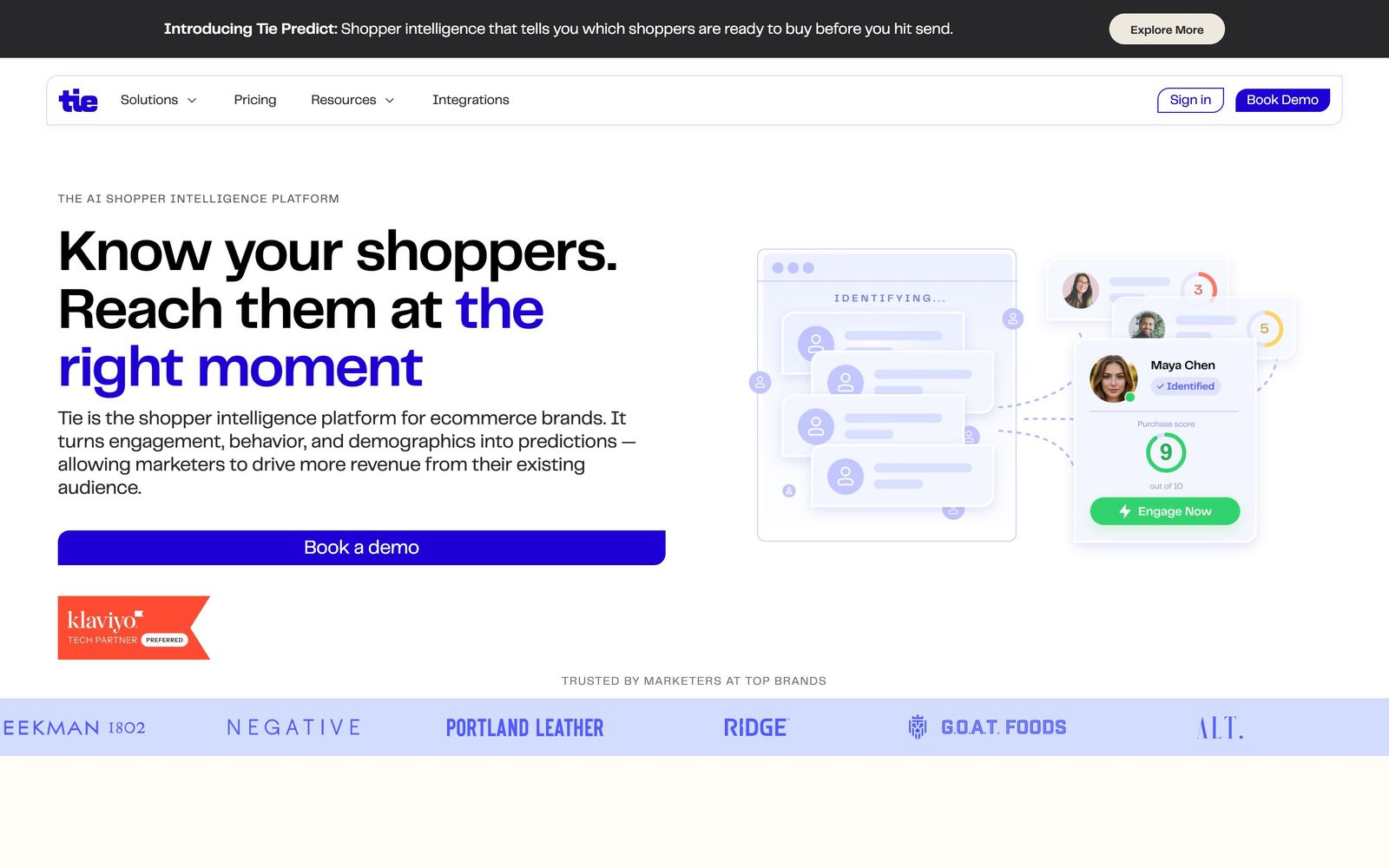
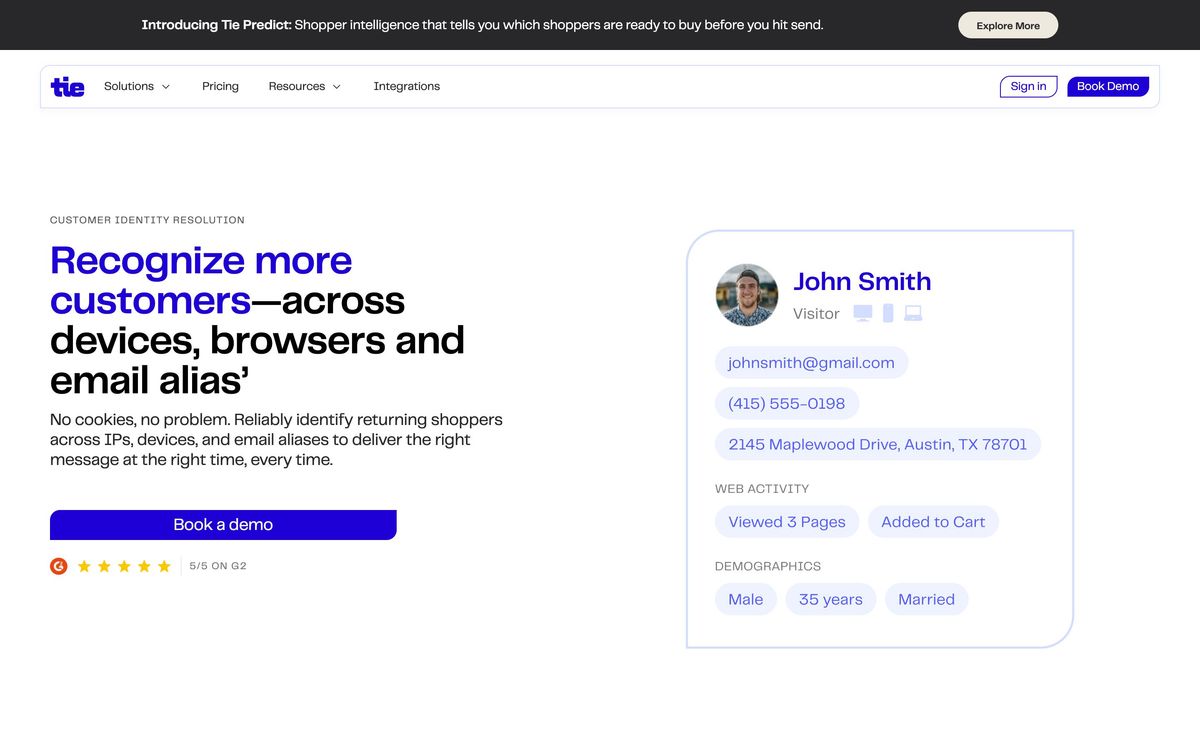
Tie, which traded until recently as Revenue Roll, resolves the identity of people browsing a consumer store. A pixel on the site observes behaviour, and the platform matches that behaviour against a large consumer data set to return a name, contact details and demographic attributes for a share of visitors who never filled in a form or logged in. The company describes the result as one view of every shopper, known or anonymous, and reports drawing on hundreds of millions of US shopper records assembled from a thousand-plus data sources.
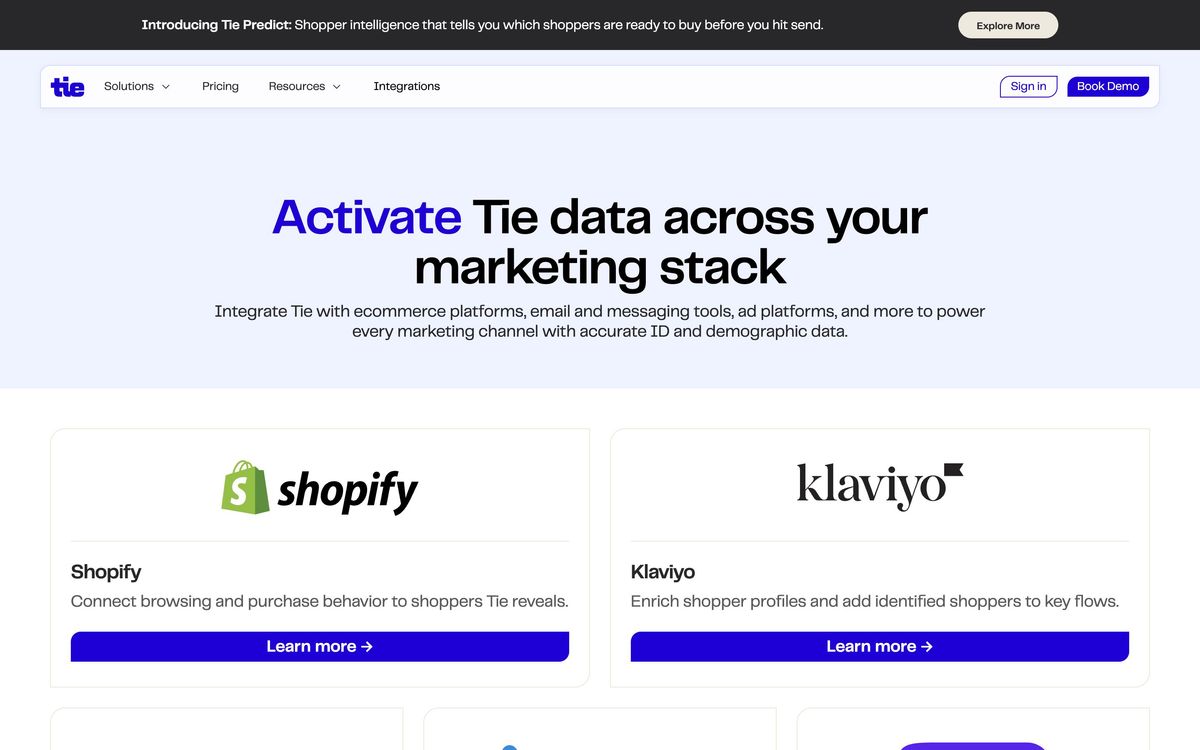
The output is not meant to be looked at. It is meant to be piped somewhere: into Klaviyo or Attentive or Postscript so a browse-abandonment flow has somebody to send to, into Meta and Google as custom audiences, into Shopify so that browsing and purchase history attach to a single profile. Around that core sits a deliverability layer, inbox placement help and email warming capacity sized by plan, which exists because sending to a pile of freshly identified addresses is a fast way to damage a sending domain. A newer module, Tie Predict, scores which identified shoppers look ready to buy.
Key features
Everything here is in service of one transaction: anonymous traffic in, addressable profiles out.
- Persistent identity resolution across sessions and devices, surviving cookie expiry and cleared browsers
- Real-time enrichment returning demographic and behavioural attributes alongside contact details
- AI shopper segmentation and purchase-intent scoring through Tie Predict
- Native sync to Klaviyo, Attentive and Postscript flows, and to Shopify for behaviour and order history
- Custom audience building and ad performance tracking in Meta Ads and Google Ads
- Inbox placement and email warming capacity, scaled by tier, for ramping sends to newly identified contacts
Who it's for
This is built for a US direct-to-consumer brand with real traffic and a mature email programme, one already running Klaviyo flows that convert, where the constraint is list size rather than message quality. At that shape, identifying a slice of otherwise anonymous browsers has obvious arithmetic behind it, and the credit pools are sized for stores doing serious volume.
It should be avoided by anyone selling into Europe or the UK. Identifying a visitor who has given no consent is not a configuration option under GDPR, and no amount of contractual language changes that. It is also the wrong purchase for a small store: the entry tier costs more per month than many businesses make from email in total, the commitment is annual, and the credit model bills traffic rather than outcomes. Brands in regulated categories, or those whose customers would react badly to being recognised without introducing themselves, should think hard about the reputational side.
How it compares
Retention.com is the best-known competitor and does broadly the same job with a similar Klaviyo-first posture and comparable privacy questions. Opensend, which Tie names on its own comparison pages, competes on price and tends to be chosen by smaller stores. Wunderkind operates further up market as a managed performance-marketing partner rather than a self-serve tool, taking on execution as well as identification and charging accordingly. Tie's edge over the cheaper end is the enrichment depth and the ad-platform sync; its edge over Wunderkind is that the brand keeps control of its own messaging.
Verdict
The engineering is sound and the integrations are the right ones, which is why the platform sells. The reservations are not about whether it works but about the terms and the terrain: an annual contract with credits granted upfront removes the ability to test cheaply, billing scales with traffic rather than results, and the core capability simply cannot be used on European visitors. A US store with heavy traffic and a working email programme will likely see a return. Everyone else should treat the category itself as the decision, not the vendor.
Ready to try Tie?
More ecommerce tools like Tie
soona
4.4Creative-for-commerce platform: studio photo and video, UGC creators, AI editing tools and listing insights.
Read soona review →DataHawk
4.3Enterprise-grade Amazon and Walmart analytics: SKU-level dashboards, anomaly alerts and AI diagnostics.
Read DataHawk review →Gorgias
4.3Ecommerce help desk where order data and refunds live inside the conversation, with an AI agent priced per resolution.
Read Gorgias review →Teikametrics
4.3AI marketplace optimization for Amazon, Walmart and TikTok Shop: ads automation, listings and forecasting.
Read Teikametrics review →AfterSell by Rokt
4.2Adds one-click upsells to the cart, checkout and thank-you pages of a Shopify store.
Read AfterSell by Rokt review →AliDrop
4.2Dropshipping app importing AliExpress, Alibaba and Temu products into Shopify with automated fulfillment.
Read AliDrop review →