
Drip review
Ecommerce email and onsite marketing that segments on real order history rather than list membership.
A good fit for a single-store DTC brand that wants purchase-aware automation without tier gating, though the per-contact price climbs hard past a few thousand subscribers.
Pros
- Every paid account gets the full feature set; price moves only with contact count, so there is no tier gate on automation or segmentation
- Two-way store sync pulls historical orders, the product catalog and customer records, so segments can be built on lifetime value or specific SKUs
- The onsite suite (popups, slide-ins, sticky bars, quizzes) is included rather than sold as an add-on, which removes a second vendor
- Around 50 prebuilt ecommerce workflows shorten the first week of setup for abandoned cart, welcome and win-back sequences
- Revenue attribution ties individual campaigns and workflows back to orders instead of stopping at opens and clicks
Cons
- Cost scales steeply with list size: the same feature set costs roughly four times more at 10,000 contacts than at 2,500, which punishes stores that build large low-intent lists
- Contact search works on email address rather than name, which slows down manual lookups in support or sales contexts
- Reporting is fixed rather than configurable, and split testing is limited to one element per test, so multivariate subject-and-content experiments are out of reach
Drip pricing
List prices in USD per month, taken from the vendor at review time. Custom means quote-only.
| Plan | Per month | What it covers |
|---|---|---|
| Drip | $39 | up to 2,500 people; all features included, price rises with contact count |
| Trial | Custom | 14 days, up to 2,500 contacts with a send cap; no free-forever plan |
What Drip actually does
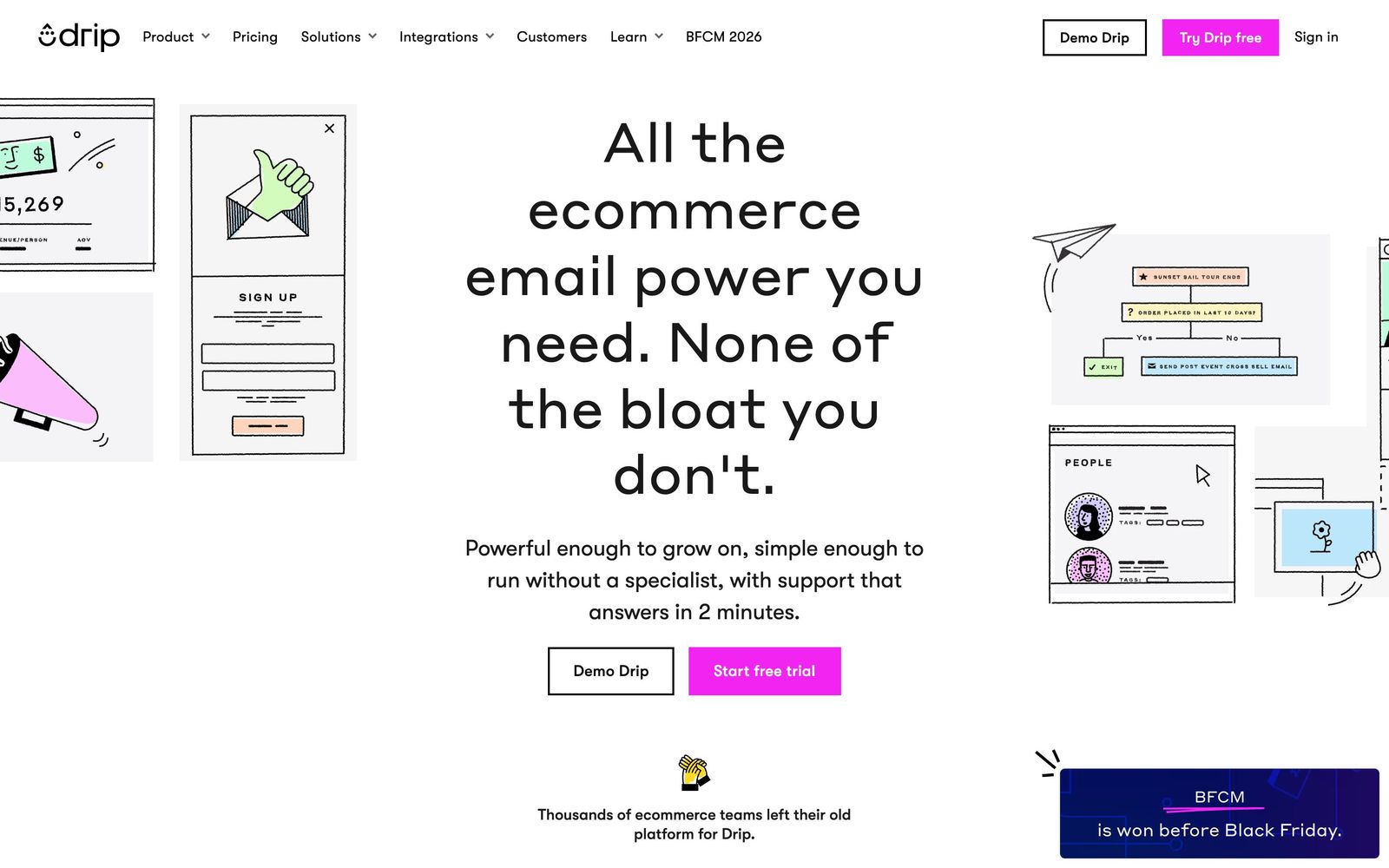
Drip is an email and onsite marketing platform built for ecommerce stores rather than for general business marketing. It connects to a storefront, pulls the full customer list, order history and product catalog, and keeps them in sync from then on. That purchase data is the raw material for everything else: segments are written against what someone bought, when, and for how much, and workflows fire on store events rather than on list membership alone. Day to day the work happens in a visual workflow canvas, a welcome series, a browse-abandonment sequence, a post-purchase follow-up, with roughly fifty prebuilt templates as starting points.
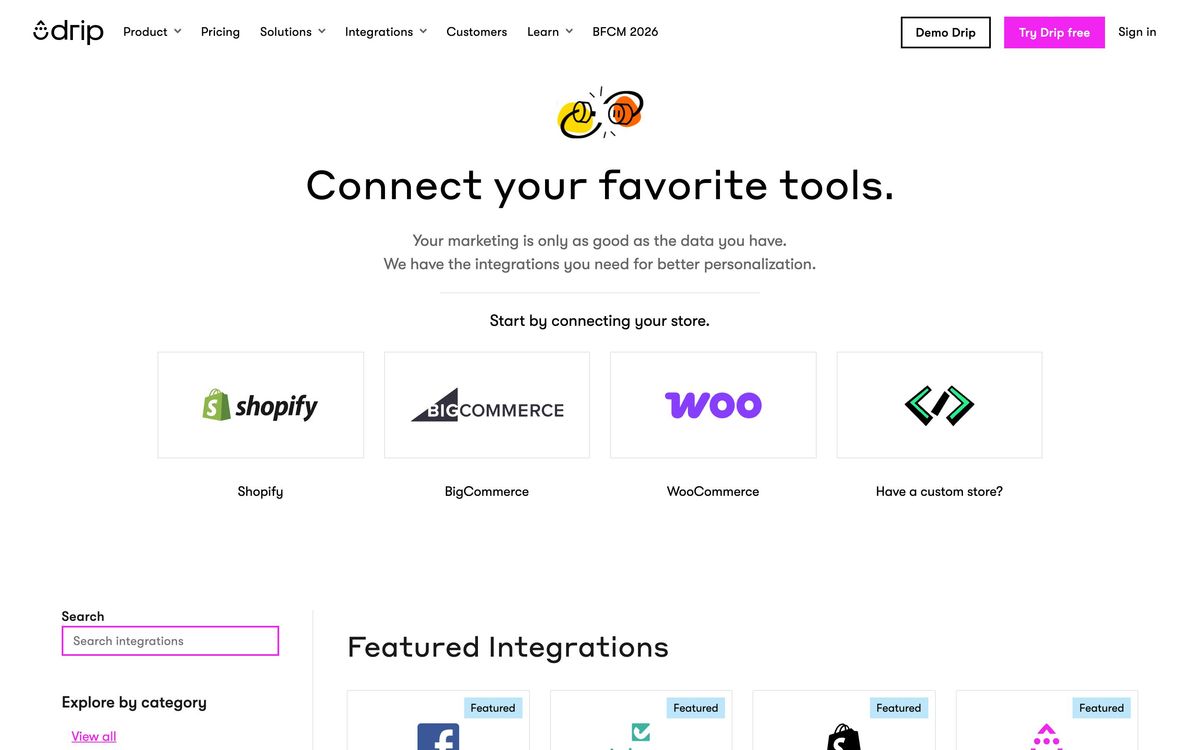
The other half of the product runs on the storefront itself. Drip ships popups, slide-ins, sticky bars, quizzes and spin-to-win forms that collect addresses and feed the same subscriber database. This part came from Sleeknote, which Drip acquired and folded in, and it is noticeably more capable than the popup builders bundled into most email tools. Delivery is a hosted service plus a script on the store and a native app for Shopify, WooCommerce, BigCommerce and Magento. There is no feature gating between paid plans: every account gets the whole product, and the invoice moves only with the number of contacts.
Key features
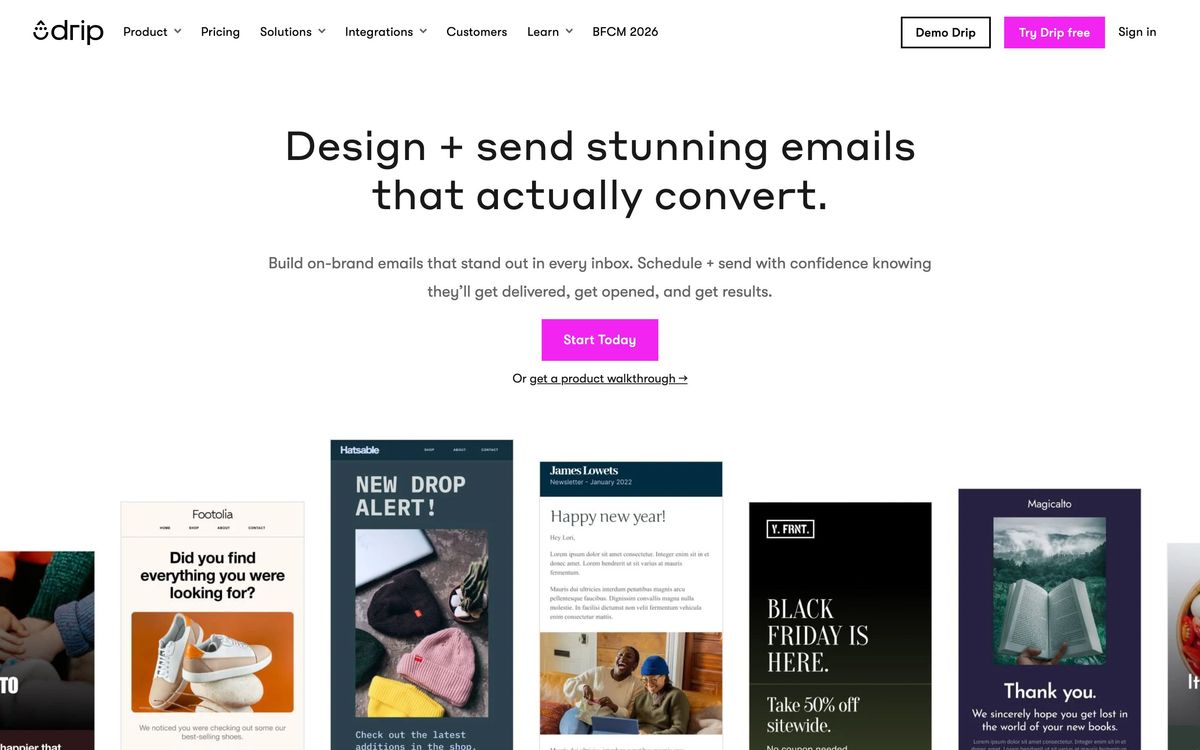
The product splits cleanly between what happens in the inbox and what happens on the storefront.
- Visual workflow builder with about fifty prebuilt ecommerce automations covering cart abandonment, welcome, win-back and post-purchase
- Dynamic segments that read order history, product tags, lifetime value and onsite behaviour, and recalculate as data changes
- Onsite forms including popups, slide-ins, sticky bars, quizzes and spin-to-win, with trigger rules per page and per visitor type
- Native two-way sync with Shopify, WooCommerce, BigCommerce and Magento that imports historical orders on setup
- Revenue attribution that reports orders generated per campaign and per workflow rather than stopping at open and click rates
- Open API, unlimited sub-accounts and unlimited email sends included on every paid plan
Who it's for
The natural buyer is a direct-to-consumer store with steady order volume and one or two people responsible for retention. The store data is already good, the list is moderate, and the goal is to stop sending the same broadcast to everyone. For that shape of team the flat feature set matters: nobody has to argue for an upgrade to get segmentation or automation, and the onsite forms remove a second subscription.
It is a poor fit in two situations. Agencies and businesses selling services will find the whole model awkward, because the segmentation logic assumes orders, carts and products exist. And brands with very large lists should price the alternative carefully: because cost tracks contacts rather than sends, a list padded with dormant subscribers gets expensive quickly, and the usual remedy is aggressive list pruning. There is also no free plan, only a two-week trial, so evaluation happens on a clock.
How it compares
Klaviyo is the direct rival and the more common default on Shopify; it has deeper predictive analytics and a larger partner ecosystem, but it charges for both contacts and SMS volume and gates some reporting behind higher tiers. Omnisend undercuts both on price and bundles SMS and push in the same plan, though its automation branching is simpler and its onsite forms are thinner. ActiveCampaign is stronger for businesses that need a CRM and sales pipeline alongside email, but its ecommerce data model is bolted on rather than native, and building purchase-based segments there takes more work. Mailchimp remains cheaper at small volumes and worse at almost everything ecommerce-specific.
Verdict
Drip earns its place by refusing to sell features twice: the automation, the segmentation and the onsite forms all arrive on the entry plan, and the store sync is genuinely native rather than a nightly export. Reviewers consistently praise the workflow builder and consistently criticise two things, fixed reporting and the price curve, and both criticisms hold up. The main caveat is arithmetic rather than product: past roughly ten thousand contacts, the value case against Klaviyo and Omnisend gets harder to make, so the tool rewards brands that keep their list clean and their sending purposeful.
Ready to try Drip?
More ecommerce tools like Drip
Quartile
4.4Cross-channel retail media platform managing Amazon, Walmart, Instacart, Google and Meta ads with ML bidding.
Read Quartile review →soona
4.4Creative-for-commerce platform: studio photo and video, UGC creators, AI editing tools and listing insights.
Read soona review →DataHawk
4.3Enterprise-grade Amazon and Walmart analytics: SKU-level dashboards, anomaly alerts and AI diagnostics.
Read DataHawk review →Gorgias
4.3Ecommerce help desk where order data and refunds live inside the conversation, with an AI agent priced per resolution.
Read Gorgias review →Teikametrics
4.3AI marketplace optimization for Amazon, Walmart and TikTok Shop: ads automation, listings and forecasting.
Read Teikametrics review →AfterSell by Rokt
4.2Adds one-click upsells to the cart, checkout and thank-you pages of a Shopify store.
Read AfterSell by Rokt review →