
Notify Me review
Shopify app that captures demand on sold-out products with restock alerts, pre-orders and wishlists.
The most complete way to stop losing sold-out traffic on Shopify, though the plan limits are hard caps and the useful Klaviyo sync sits on the upper tiers.

Pros
- Four demand-capture mechanics, restock alerts, pre-orders, wishlists and low-stock badges, in one app instead of four subscriptions and four theme edits
- Notifications go out by email, SMS, push and WhatsApp, so a merchant is not restricted to the channel the customer ignores
- Wishlists work for shoppers who are not logged in, which is most of them, and expose what people wanted but did not buy
- Pre-orders support partial payment and discounts, turning an out-of-stock listing into revenue rather than a bounce
- The free tier is permanent rather than a trial, enough for a small store to see whether restock demand is real
Cons
- Notification and wishlist allowances are hard monthly caps: exceed them and the feature stops until the next cycle or an upgrade
- The Klaviyo sync, the integration most established stores actually want, is limited to the top two plans
- SMS and WhatsApp are billed separately by country on top of the subscription, so the headline plan price is not the real cost for stores that lean on those channels
Notify Me pricing
List prices in USD per month, taken from the vendor at review time. Custom means quote-only.
| Plan | Per month | What it covers |
|---|---|---|
| Lite | Custom | 10 notifications a month, 5 pre-orders and 50 wishlist actions lifetime |
| Kickstart | $9.90 | 500 notifications; Basic Shopify stores in their first year only |
| Starter | $19.90 | 500 notifications, 500 pre-orders, 2,000 wishlist items |
| Standard | $39.90 | 1,500 notifications, 1,500 pre-orders, 10,000 wishlist items |
| Rocket | $69.90 | 5,000 notifications, 10,000 pre-orders, adds the Klaviyo integration |
What Notify Me actually does
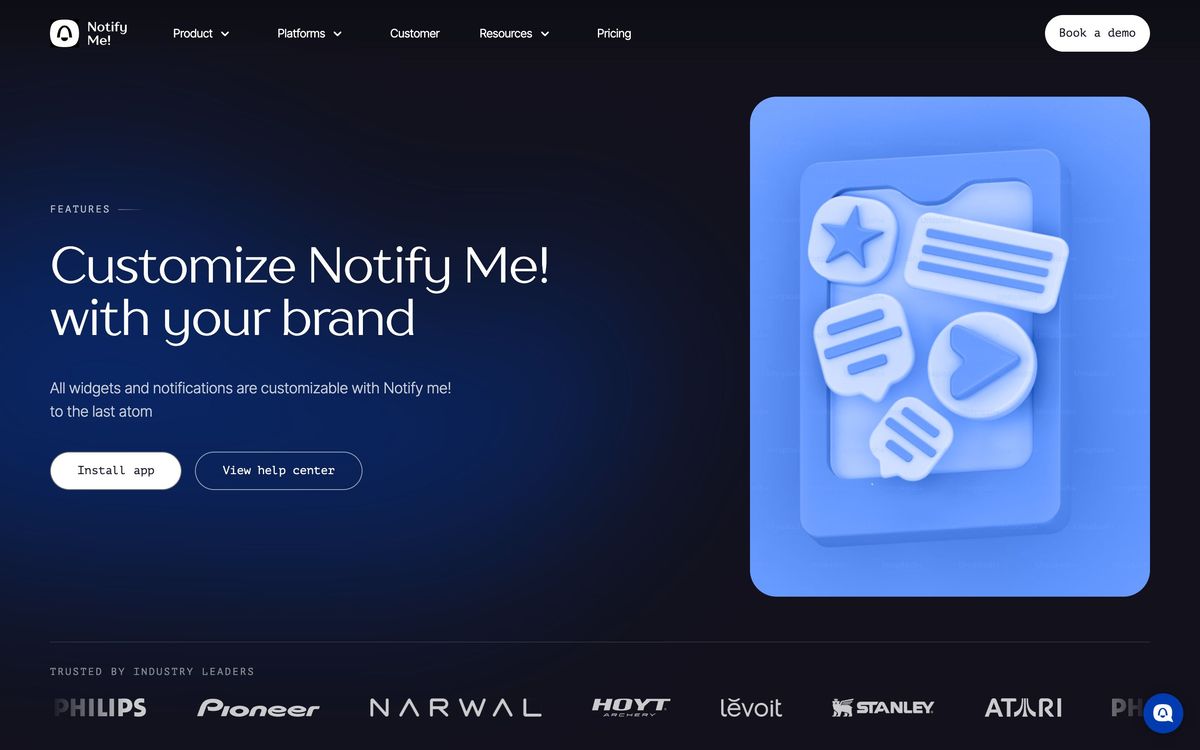
Notify Me is a Shopify app that addresses one leak: traffic arriving at a product that cannot be bought. Instead of a sold-out button, the product page offers to take the shopper's contact details, and when inventory returns the app sends a notification with a direct link back to the item. Around that core it adds three related mechanics, pre-orders for stock that has not landed, wishlists for products someone wants but is not ready to buy, and low-stock badges that show how few units remain.
The delivery side is deliberately broad. Alerts can go by email, SMS, push notification or WhatsApp, with the messaging channels billed on usage at country rates rather than bundled into the subscription. Collected contacts can sync into Klaviyo, Mailchimp or Omnisend on the higher plans, so a restock signup becomes a marketable subscriber rather than a dead end. Installation is a Shopify app install with theme placement handled by the app, and billing runs through the Shopify invoice. The vendor reports use by more than thirty-five thousand stores, and the app holds a rating close to five stars across several thousand Shopify reviews.
Key features
The four mechanics share one contact list and one notification queue:
- Back-in-stock alerts fired by inventory returning, with a notify button in place of the sold-out state
- Pre-orders supporting partial payment, discounts and per-variant availability dates
- Wishlists that work for guests as well as account holders, including price-drop alerts
- Low-stock badges showing remaining units on the product page
- Email, SMS, push and WhatsApp delivery from a single queue
- Contact sync into Klaviyo, Mailchimp and Omnisend on the upper tiers
Who it's for
The merchants who gain most are those whose bestsellers sell out: apparel brands with limited runs, supplement and beauty stores waiting on production, anyone whose supply chain is slower than demand. For them the wishlist and restock data is also a demand-planning signal, showing which variants people asked for before the next order is placed. The free tier is small but real, so a store can measure the size of the leak before paying to fix it.
Stores that rarely run out of stock will get little from the restock half and should judge the app on wishlists and pre-orders alone, which is a narrower case than the pricing assumes. The plan structure also punishes spiky demand, because the notification allowance is a hard monthly cap rather than an overage: a single viral restock can exhaust a tier mid-month and pause sending until the next cycle. And because this is a Shopify app, none of it helps a merchant on another platform.
How it compares
Back in Stock by Swym and Restock Rocket cover the alert use case with similar competence, and Swym has a longer track record on wishlists; neither bundles pre-orders as thoroughly. Dedicated pre-order apps such as PreProduct or Amai handle deposits and staged payments in more depth, but do nothing about restock demand. Klaviyo itself sends back-in-stock emails perfectly well, and a store already paying for Klaviyo should weigh that native flow against another subscription, though Klaviyo will not run pre-orders, wishlists or stock badges. Notify Me's argument is consolidation: one app, one contact list, four mechanics that all deal with inventory a shopper cannot buy today.
Verdict
As a bundle this is well judged. Each of the four features exists elsewhere, but running them separately means four apps, four theme integrations and four contact lists that never reconcile. The channel spread is unusually wide for the category, and the wishlist data is more useful for buying decisions than merchants expect. The caveats are commercial rather than technical: allowances are hard caps, the messaging channels are metered on top of the plan, and the Klaviyo sync that serious stores depend on is reserved for the more expensive tiers, which is where the real cost of the app tends to settle.
Ready to try Notify Me?
There's a free tier, so you can test it before committing.
More ecommerce tools like Notify Me
Tie
3.7Identity resolution for consumer stores: puts a name and contact on anonymous website visitors.
Read Tie review →Quartile
4.4Cross-channel retail media platform managing Amazon, Walmart, Instacart, Google and Meta ads with ML bidding.
Read Quartile review →soona
4.4Creative-for-commerce platform: studio photo and video, UGC creators, AI editing tools and listing insights.
Read soona review →DataHawk
4.3Enterprise-grade Amazon and Walmart analytics: SKU-level dashboards, anomaly alerts and AI diagnostics.
Read DataHawk review →Gorgias
4.3Ecommerce help desk where order data and refunds live inside the conversation, with an AI agent priced per resolution.
Read Gorgias review →Teikametrics
4.3AI marketplace optimization for Amazon, Walmart and TikTok Shop: ads automation, listings and forecasting.
Read Teikametrics review →