
PushOwl review
Web push, email and SMS campaigns for Shopify stores, with unlimited subscribers on every plan.
The cheapest way to add a recoverable marketing channel to a Shopify store, though attribution stays murky and the whole thing is bound to Shopify.
Pros
- Web push subscribers are collected with a single browser permission click, so a store starts recovering carts without asking for an email address
- Subscriber counts are unlimited on every plan including the free one, and the metered resource is messages sent rather than list size
- Abandoned cart, back-in-stock, price drop and browse abandonment flows ship as presets rather than as blank automation canvases
- Now part of Brevo, so email, SMS and pop-ups sit in the same app instead of being wired to a separate platform
- Installation is a Shopify app install with no theme editing or developer time
Cons
- Shopify only, with no support for WooCommerce, BigCommerce or Magento, so a replatform means replacing the channel entirely
- SMS credits are not bundled into the standard plans and are bought separately, which makes the advertised bundle less complete than it appears
- Push is easy enough to send that stores over-message, and the reporting does not clearly separate incremental revenue from customers who were going to buy anyway
PushOwl pricing
List prices in USD per month, taken from the vendor at review time. Custom means quote-only.
| Plan | Per month | What it covers |
|---|---|---|
| Basic Bundle | Custom | 500 web push and 500 emails a month, unlimited subscribers |
| Plus Bundle | $19 | 10,000 web push a month, adds cart abandonment and pop-ups |
| Power Bundle | $79 | 25,000 web push a month, adds segmentation and smart delivery |
What PushOwl actually does
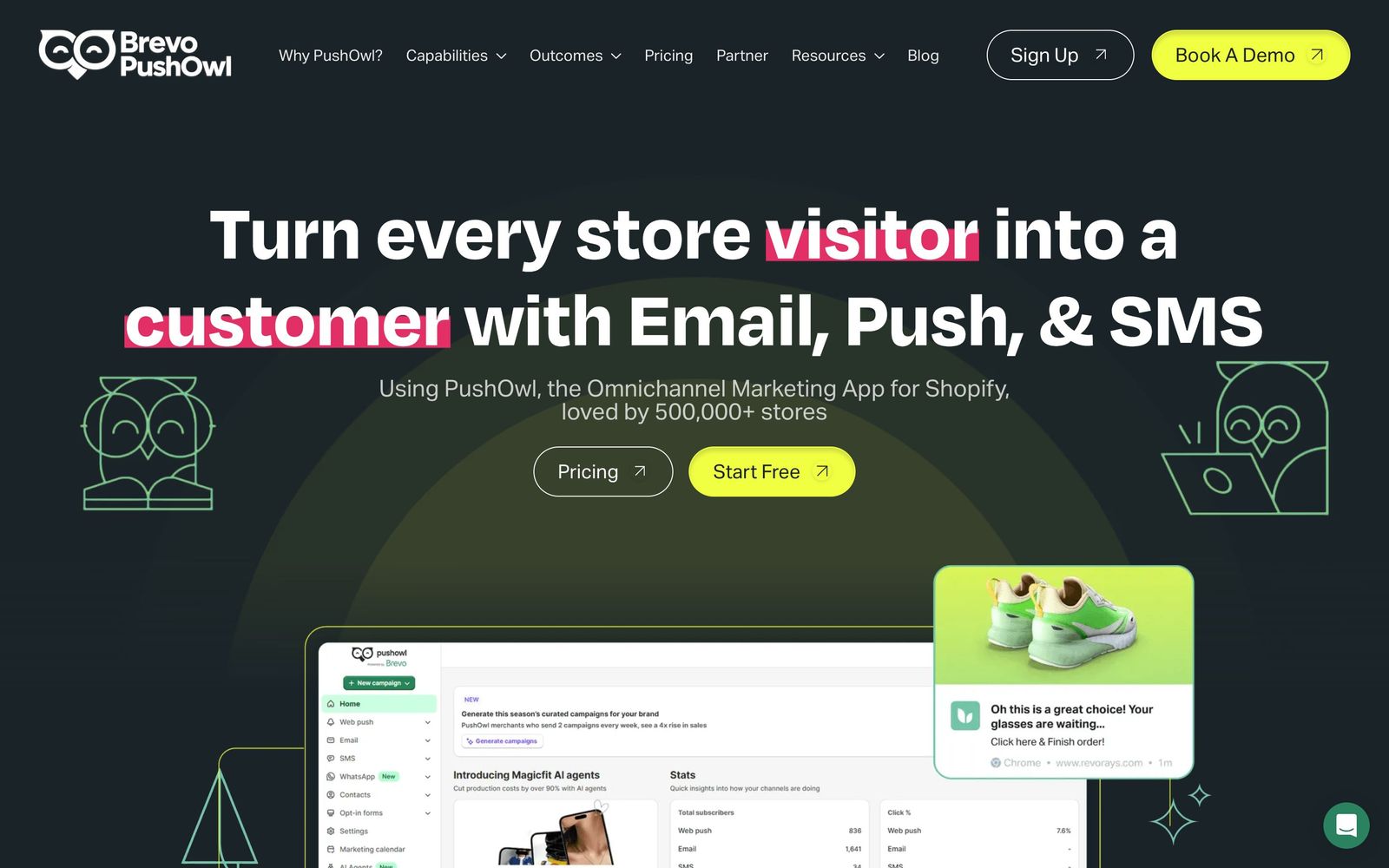
PushOwl adds a marketing channel most Shopify stores ignore. When a visitor lands, the browser asks whether the site may send notifications; if they accept, the store can message them later on the desktop or phone screen without ever holding an email address. That single detail is the reason the app exists. Push subscribers accumulate far faster than email subscribers because the ask is one click rather than a form, and they can be reached the day a cart is abandoned or the hour a sold-out product returns to stock.
Since joining Brevo, the app has widened from push alone into a small multichannel suite. Email campaigns and pop-ups now run inside the same interface, SMS and WhatsApp are available for markets where browser push adoption is weak, and the automations most stores actually want arrive as presets: abandoned cart, checkout alert, back-in-stock reminder, price drop, browse abandonment, flash sale. Everything is scoped to Shopify, installed as an app, and metered on messages sent rather than on subscribers held, which is a meaningfully different bargain from the way email platforms price.
Key features
The automations do most of the work, and the channel mix is the rest.
- Web push opt-in from a browser prompt, requiring no email address or form fill
- Abandoned cart, checkout alert, back-in-stock and price drop flows as configurable presets
- Email campaigns, newsletters and pop-ups powered by Brevo in the same app
- SMS and WhatsApp channels for regions where browser push is less established
- Behavioural segmentation and smart delivery timing on the upper plan
- Revenue reporting per channel and per automation, with unlimited subscribers on every tier
Who it's for
This is aimed at the small and mid-sized Shopify merchant who has traffic but not much of a list. A store doing a few thousand sessions a month can build a push audience in weeks and start recovering carts on the free plan, which is a genuinely low-risk way to test whether the channel does anything for that catalogue. Back-in-stock alerts are the standout use case for anyone selling limited runs, sizes or seasonal inventory, because the demand signal already exists and the message arrives instantly.
It suits larger senders less well. A store already running heavy email volume through Klaviyo will find the email side thinner than what it left, and message overage charges bite once volume climbs. Anyone not on Shopify cannot use it at all. The other limit is judgement rather than software: push is fast to send and easy to overuse, and the app does relatively little to stop a merchant training subscribers to switch notifications off.
How it compares
Klaviyo is the serious answer for Shopify lifecycle marketing, with far deeper segmentation, reporting and attribution, at a price that scales with list size and a learning curve to match. Firepush and Vibetrace cover similar multichannel ground for smaller stores and are worth a look, though neither has the install base or the Shopify App Store track record. Aftership and Back in Stock apps beat PushOwl on the single restock use case with tighter inventory hooks. PushOwl's position is the cheap, fast middle: more automation than a single-purpose app, less machinery and less cost than a full lifecycle platform.
Verdict
For a Shopify store without a large email list, PushOwl is close to free money, a channel that costs nothing to test, collects subscribers passively, and reliably recovers some proportion of carts that would otherwise be lost. The Brevo acquisition made it more complete rather than more complicated. Two things keep the rating honest: the reporting does not draw a clear line between recovered revenue and revenue that was arriving anyway, which makes the return harder to defend internally than the dashboard implies, and the whole product is welded to Shopify.
Ready to try PushOwl?
There's a free tier, so you can test it before committing.
More ecommerce tools like PushOwl
Quartile
4.4Cross-channel retail media platform managing Amazon, Walmart, Instacart, Google and Meta ads with ML bidding.
Read Quartile review →soona
4.4Creative-for-commerce platform: studio photo and video, UGC creators, AI editing tools and listing insights.
Read soona review →DataHawk
4.3Enterprise-grade Amazon and Walmart analytics: SKU-level dashboards, anomaly alerts and AI diagnostics.
Read DataHawk review →Gorgias
4.3Ecommerce help desk where order data and refunds live inside the conversation, with an AI agent priced per resolution.
Read Gorgias review →Teikametrics
4.3AI marketplace optimization for Amazon, Walmart and TikTok Shop: ads automation, listings and forecasting.
Read Teikametrics review →AfterSell by Rokt
4.2Adds one-click upsells to the cart, checkout and thank-you pages of a Shopify store.
Read AfterSell by Rokt review →