
Marketing 360 review
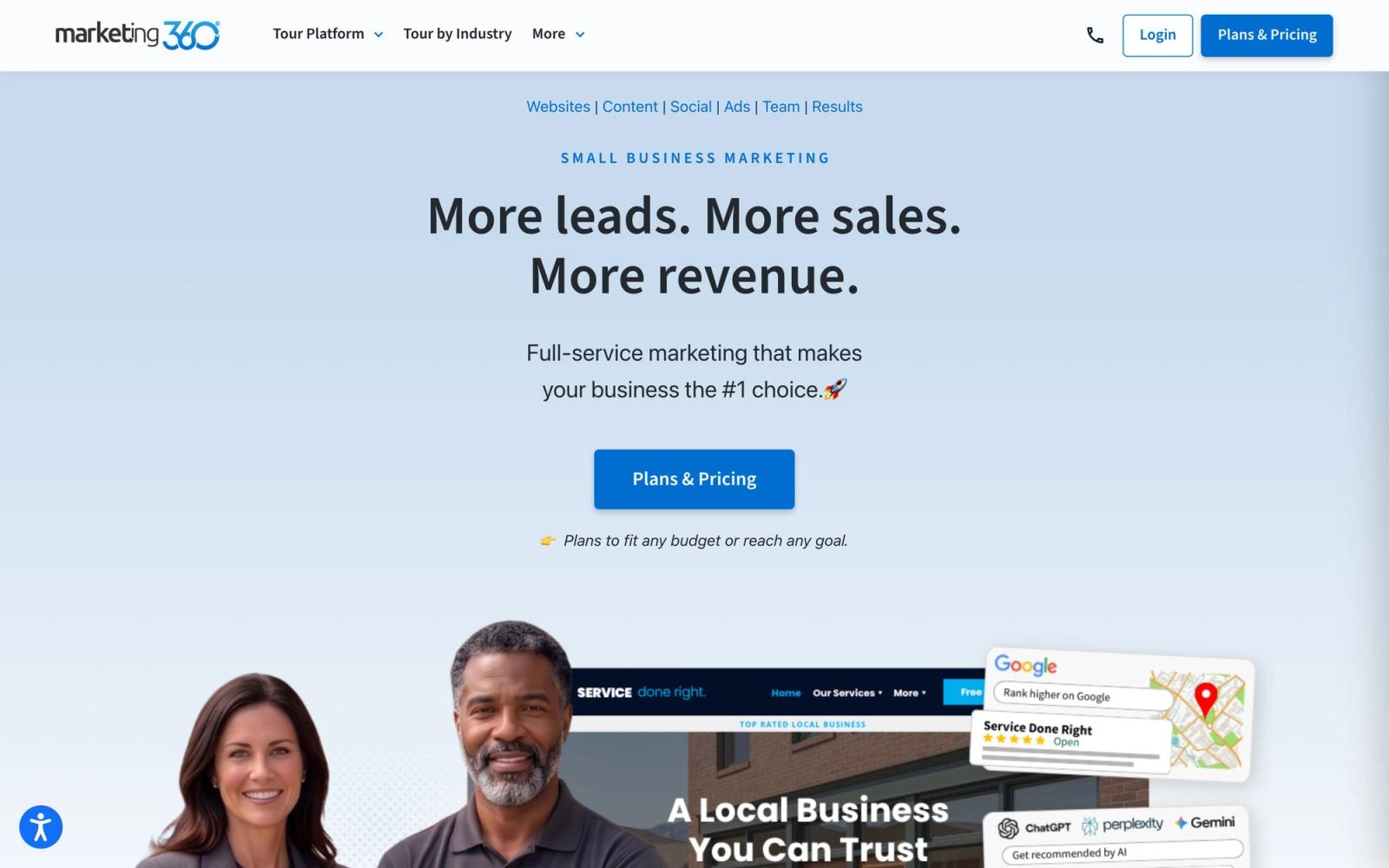
All-in-one marketing platform for small local businesses, sold with a marketing manager attached.
A reasonable fit for an owner-operator who wants one vendor to run the website, ads and follow-up, though the closed platform and unpublished pricing make it hard to leave or to budget for.
Pros
- Website, CRM, email, social scheduling, ads, forms and reviews sit in one login instead of five subscriptions
- Every account gets a named marketing lead who plans and executes rather than only answering support tickets
- Reporting pulls ad spend, form fills and CRM activity into one view, which most stitched-together small-business stacks never manage
- Vertical-specific setups exist for contractors, home services, medical practices and retail rather than one generic template
- Payment processing and appointment scheduling are built in, so quote-to-paid stays inside the same record
Cons
- Pricing is not published anywhere and requires a sales call, which makes comparison against a DIY stack impossible before committing
- Reviewers repeatedly report extra charges beyond the quoted monthly fee, particularly for design and website work
- The website, CRM and email all live inside a proprietary platform, so leaving means rebuilding rather than exporting
What Marketing 360 actually does
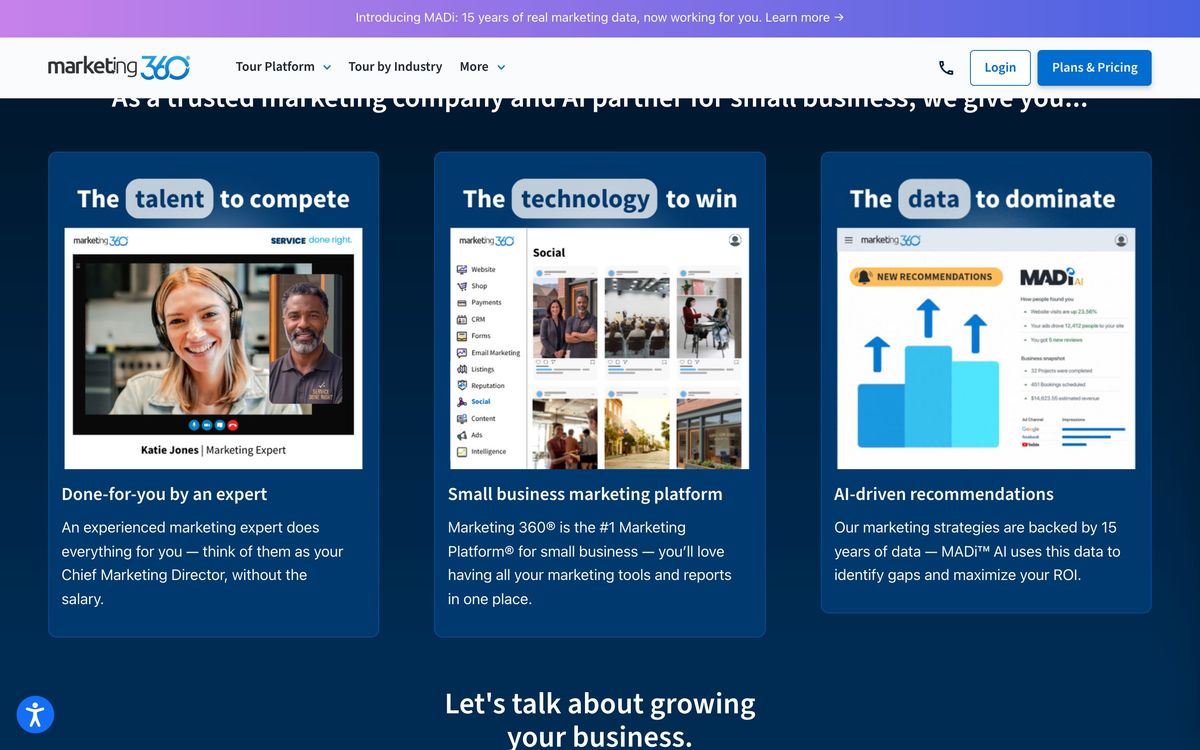
Marketing 360 is a marketing platform for small businesses that arrives with people attached. The software side is a set of modules under one login: a website builder with ecommerce, a CRM, email marketing, social scheduling, forms, content and SEO tools, paid advertising management for Google and Facebook, local listings maintenance, reputation and review management, payment processing, appointment scheduling and a reporting layer with an AI assistant summarising performance. A mobile app carries the CRM and messaging.
The services side is what actually distinguishes it. Each account is assigned a named marketing lead who functions as an outsourced marketing director: they build the plan, run the ad campaigns, commission the design work and report on results. This is not a self-serve tool that happens to offer support. The company positions itself for small businesses that do not want to learn marketing software at all, and the split between what the subscription covers and what is billed as a service - website design in particular - is negotiated per account rather than listed. Typical customers are contractors, home services firms, medical and dental practices, salons, retailers and franchise locations.
Key features
The modules are proprietary and built to work together rather than to integrate outward.
- Hosted website builder with design service and an ecommerce option
- CRM holding contacts, pipeline stages and automated follow-up sequences
- Managed Google and Facebook advertising with spend and conversion reporting in the same dashboard
- Email marketing, social scheduling and content publishing in one calendar
- Review generation, reputation monitoring and local listings maintenance
- Payment processing and appointment scheduling tied to the same customer record
Who it's for
This suits an owner-operator running a local service business with no marketing employee and no appetite to become one - the roofer, the dentist, the salon owner whose current arrangement is a neglected website, an unmanaged Google Business Profile and a shoebox of leads. For that buyer, having one vendor answer for the website, the ad spend and the follow-up is worth paying for, and the assigned marketing lead is the actual product. Capterra reviewers in exactly that position rate it highly and stay for years.
It is a poor fit for anyone with in-house marketing skill, anyone who wants to own their website outside a vendor platform, and anyone whose ad budget is small enough that a management layer eats the returns. Businesses that already run their own campaigns will find the modules shallower than the specialist tools they replace. And any buyer who needs to compare costs on a spreadsheet before signing will be frustrated: there is nothing to compare until a sales call has happened.
How it compares
Thryv is the closest analogue - the same bundle of website, CRM, reviews, scheduling and payments aimed at the same local operator - and publishes more about what it costs, though it leans less on assigned human strategists. HubSpot's starter tiers give a far stronger CRM and marketing automation engine with an open integration ecosystem, but there is no one to run the campaigns, which is the whole point of Marketing 360 for this buyer. A local agency plus off-the-shelf tools - a hosted site, an email platform, a review tool - usually costs less and keeps the assets portable, at the price of managing three vendors instead of one. Marketing 360 wins on single-throat-to-choke simplicity and loses on portability and price transparency.
Verdict
The satisfaction scores are real and the model works for the buyer it targets: a small local business that wants marketing to stop being their problem. The modules are competent, the reporting is more coherent than a stitched-together stack, and the assigned marketing lead is a genuine differentiator rather than a support upsell. The caveat is the commercial shape, not the software. Nothing is published, extra charges surface after the quote, and because the website and customer records live inside a proprietary system, the cost of changing your mind later is high. Worth a conversation, but go into it asking exactly what is included, what is billed separately, and what happens to the website on the way out.
Ready to try Marketing 360?
More service-businesses tools like Marketing 360
NiceJob
4.0Automated review requests, referrals and social proof widgets for local service businesses.
Read NiceJob review →Keap
3.6CRM, follow-up automation, email and text marketing sold to small service businesses as one platform.
Read Keap review →Thryv
3.6All-in-one CRM, booking, invoicing and local marketing for small service businesses that run on one system.
Read Thryv review →UENI
3.6A done-for-you website with bookings and payments, built by UENI's team in about a week and hosted on its own platform.
Read UENI review →StampEzee
3.5Branded digital stamp cards and repeat-visit campaigns for cafes, salons and small retail chains.
Read StampEzee review →Tradify
4.6Job management app for tradespeople covering quoting, scheduling, invoicing and payments in one place.
Read Tradify review →