
NiceJob review
Automated review requests, referrals and social proof widgets for local service businesses.
A dependable way to turn finished jobs into public reviews without anyone remembering to ask, though its value drops sharply if your field software is not on the short native integration list.

Pros
- Review invitations fire from job completion, so the request does not depend on a technician remembering
- Referral and repeat-booking campaigns run against the same customer list as the review requests
- Social proof widgets place recent reviews on the company website without developer involvement
- AI drafted replies cover the review responses most owners quietly skip
- Reviewers consistently describe setup measured in minutes rather than an implementation project
Cons
- Native integrations are narrow: outside Jobber, Housecall Pro and QuickBooks, most trade CRMs need Zapier or manual sending
- The website product is a separate subscription with its own setup fee rather than part of the reputation plans
- Nothing here improves the underlying service, so a business with a quality problem simply collects the evidence faster
NiceJob pricing
List prices in USD per month, taken from the vendor at review time.
| Plan | Per month | What it covers |
|---|---|---|
| Reviews | $75 | review automation, monitoring and widgets |
| Pro | $125 | adds referrals, booking reminders and AI review replies |
| Sites | $99 | done-for-you website, $199 setup fee |
What NiceJob actually does
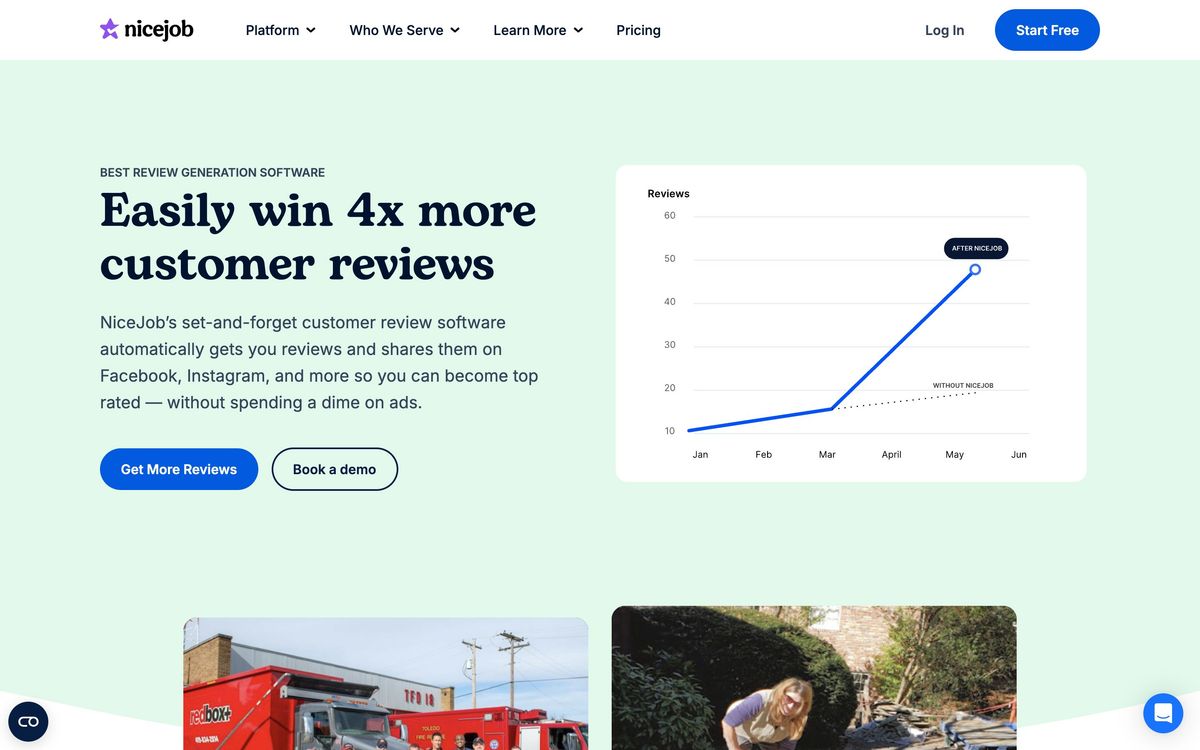
NiceJob is reputation software for local service businesses. It watches for a signal that a job has finished, usually a completed job or a paid invoice in the field service or accounting system, then sends the customer a review invitation by email and text, follows up if nothing happens, and routes the person to whichever review site the business wants to grow. That single loop is the product's reason to exist, and it works because it removes the human step that normally fails: nobody has to remember to ask at the end of a long day.
The rest of the platform extends that loop outward. Reviews collected are monitored and can be answered with AI drafted replies. Widgets push recent reviews and live customer activity onto the company website as social proof. Referral campaigns invite past customers to pass the business on, booking reminders chase dormant customers back, and NPS surveys collect the feedback too blunt to publish. There is also a separate website service, sold on its own subscription with a setup fee, where NiceJob builds and maintains the site rather than handing over a builder.
Key features
What the subscription actually buys:
- Automated review invitations by email and SMS triggered on job completion
- Review monitoring across Google, Facebook and industry sites
- AI drafted replies to incoming reviews
- Referral campaigns with tracked invitations and rewards
- Website widgets showing recent reviews and customer activity
- NPS surveys and sentiment reporting for feedback that should stay private
Who it's for
The business that gains most is a home or local service operator doing steady residential volume, where reviews are the main ranking and trust signal and where the crew will never chase them manually. Cleaning companies, landscapers, HVAC and plumbing shops, pest control, dental and wellness clinics all fit the shape. It also works for a marketing agency managing several such clients, because accounts can be added one at a time rather than bought in blocks.
It is a weak purchase in two situations. If the field software is not one of the handful with a native connection, every job either passes through an automation layer or gets sent by hand, and the automation that justifies the price is gone. And if the business already runs a broader customer engagement platform with review requests built in, NiceJob duplicates a feature that is already paid for. Franchises and multi-location operators can use it, but should confirm how reporting rolls up across locations before standardising on it, since the product is shaped around a single business rather than a group.
How it compares
Podium and Birdeye are the obvious alternatives, and both are considerably larger products: messaging inboxes, webchat, payments and, in Birdeye's case, listings management across dozens of directories. They cost more and take longer to configure. Broadly sits closer to NiceJob in scope and price and competes directly for the same trades. NiceJob's argument is narrowness done well, at a price a two-truck operation can justify, with an interface an owner can configure without a specialist.
Verdict
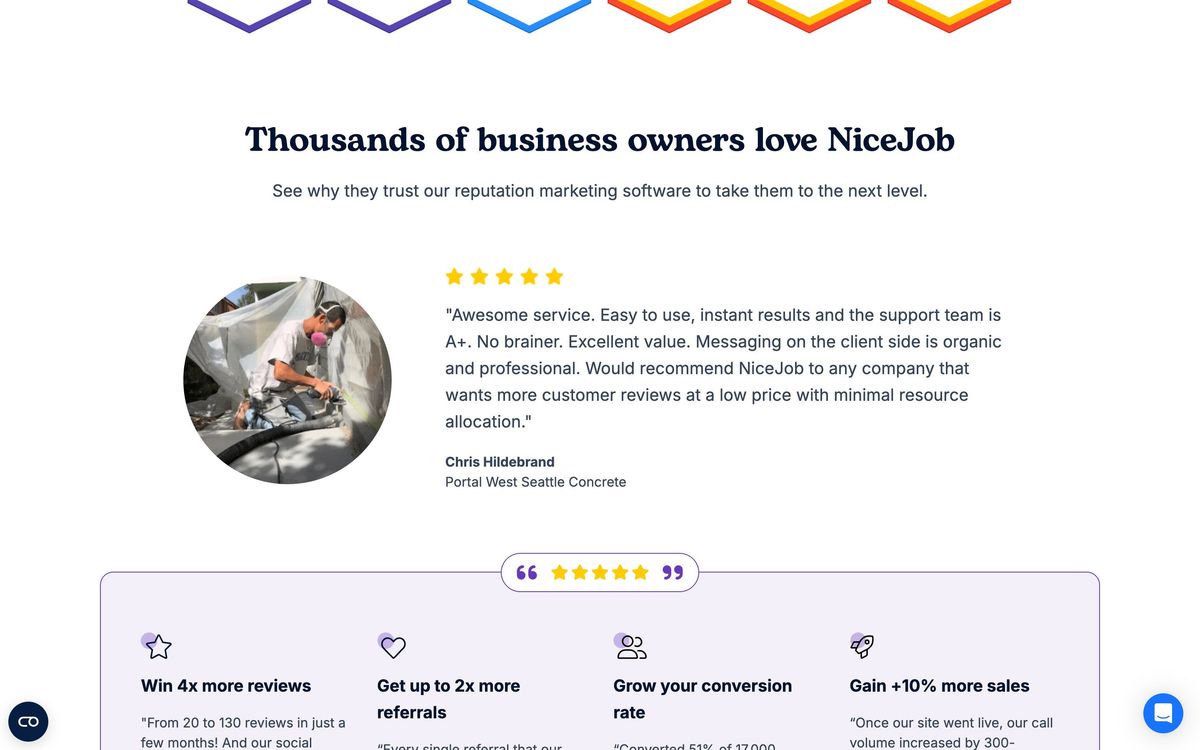
NiceJob does one job properly, and its review scores across the main directories reflect customers who saw review volume move within weeks. The interface is plain, the setup is short, and the automation holds up. The caveat is dependency: everything rests on a clean trigger arriving from the field or accounting system, and the native integration list is short enough that plenty of businesses will be building automation bridges or sending manually. Confirm the connection to your existing system before buying, because that detail decides whether this is automation or another task.
Ready to try NiceJob?
More service-businesses tools like NiceJob
Marketing 360
3.7All-in-one marketing platform for small local businesses, sold with a marketing manager attached.
Read Marketing 360 review →Thryv
3.6All-in-one CRM, booking, invoicing and local marketing for small service businesses that run on one system.
Read Thryv review →UENI
3.6A done-for-you website with bookings and payments, built by UENI's team in about a week and hosted on its own platform.
Read UENI review →StampEzee
3.5Branded digital stamp cards and repeat-visit campaigns for cafes, salons and small retail chains.
Read StampEzee review →Tradify
4.6Job management app for tradespeople covering quoting, scheduling, invoicing and payments in one place.
Read Tradify review →Weave
4.5All-in-one phone, texting, scheduling and payments platform for dental, vet and optometry practices.
Read Weave review →