
Surfer SEO review
SERP-driven content editor that scores drafts against ranking pages and now tracks brand mentions in AI answers.
Still the sharpest on-page content editor for teams briefing writers at volume, though the score is easy to game and the plan limits have tightened while prices climbed.

Pros
- The Content Editor turns a SERP into a concrete brief, terms, headings, length band, that a freelance writer can follow without an SEO call
- Auto-Optimize and the audit flag decayed pages and specific missing sections, which makes refresh work schedulable rather than instinctive
- The AI Tracker reports visibility across Google AI Overviews, ChatGPT, Gemini, Claude and Perplexity, so AI mentions and classic rankings live in one account
- Topical maps and cannibalisation reports turn a keyword list into a publishable cluster plan with internal links suggested
- The Chrome extension and Google Docs integration keep writers in the document they already use rather than in another editor
Cons
- The content score is gameable: mechanically inserting suggested terms lifts the number without improving the article, and following it literally produces stilted prose
- Document allowances have been cut and repackaged more than once while list prices rose, so renewal quotes often surprise long-standing users
- AI-generated drafts and the in-editor assistant still invent statistics and citations, so nothing ships without a fact-check pass
Surfer SEO pricing
List prices in USD per month, taken from the vendor at review time.
| Plan | Per month | What it covers |
|---|---|---|
| Discovery | $49 | per month, billed yearly; 120 documents, 1 workspace |
| Standard | $99 | per month, billed yearly; 360 documents, weekly AI prompt tracking |
| Pro | $182 | per month, billed yearly; 5 workspaces, internal linking, daily AI prompt tracking |
| AI Search Analytics add-on | $158 | per month, billed yearly; standalone AI prompt tracking |
What Surfer SEO actually does
Surfer takes a target keyword, reads the pages currently ranking for it, and turns that reading into a brief: which terms appear and how often, roughly how long the piece runs, what headings the winners use, what questions they answer. You write inside its editor, or in Google Docs and WordPress through the extension, and a score moves as the draft covers more of the model. The practical value is not the number itself but the fact that a brief becomes something a freelance writer can execute without a strategy call.
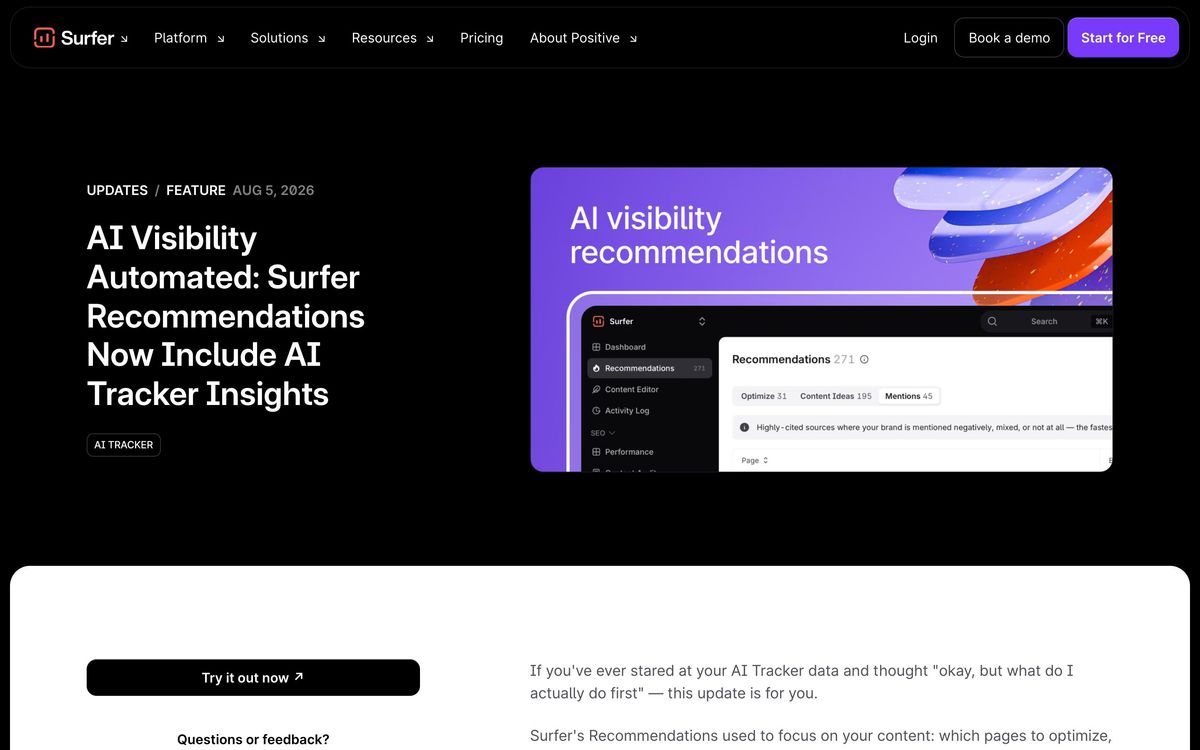
Around that core the company has built the rest of a content workflow. Surfer AI drafts a full article to the same brief and can be fed brand knowledge so the voice is not generic. The Content Audit scans published pages and points at the ones losing ground, with specific additions rather than a vague warning. Topical Map converts a seed topic into a cluster of planned pieces. The newest layer is the AI Tracker, which watches whether a brand is mentioned in Google AI Overviews, ChatGPT, Gemini, Claude and Perplexity for a set of prompts, an admission that a growing share of the traffic Surfer was built to win is now answered without a click.
Key features
Most of what teams use daily sits in two modules; the rest is planning and monitoring.
- Content Editor with live scoring against ranking pages, term suggestions and a structure outline
- Surfer AI article generation against a brief, with brand knowledge and plagiarism checking
- Content Audit that identifies decayed pages and proposes specific edits
- Topical Map for cluster planning, with internal linking and cannibalisation reports on higher tiers
- AI Tracker for brand and competitor visibility across the major AI answer engines
- Integrations with WordPress, Google Docs, Contentful, Jasper, ChatGPT and Zapier, plus API access at the top
Who it's for
Surfer suits a content team or agency shipping several optimised pieces a month into competitive results, where the bottleneck is briefing and editorial consistency rather than ideas. It works well where writers are external: the brief carries the requirements, and the editor gives an editor something objective to check against. Agencies get further value from workspaces, since client accounts stay separated with their own brand knowledge.
It is not for a solo blogger publishing occasionally, the entry plan's document allowance costs more per article than the article is likely to earn early on. It is also a bad fit for teams that write from genuine expertise in a narrow field, where the ranking pages are shallow and matching them means writing worse. Treat the score as a checklist, not a target, or the tool will actively degrade the work.
How it compares
Clearscope is the closest rival on brief quality and reads as the more restrained of the two: cleaner term recommendations, a higher price, and no article generation. Frase is cheaper and faster for question research, but its optimisation model is coarser. MarketMuse works at the level of site-wide topic authority rather than the single page, which suits strategists more than writers. For the AI-visibility half, dedicated trackers such as Profound and Peec go deeper on prompt-level analysis; Surfer's advantage is having it beside the editor where the fix gets made.
Verdict
Surfer remains the most useful on-page tool for teams that produce content at a pace, and adding AI answer tracking to the same account is a sensible response to where search is going. The reservations are real, though. The score invites gaming, and a writer who chases it without judgement produces mechanical copy that Google has become good at recognising. Document limits and packaging have moved against long-standing customers more than once, so check what the plan actually includes at renewal rather than assuming last year's terms.
Ready to try Surfer SEO?
More marketers tools like Surfer SEO
Tidio
4.5AI customer service platform with Lyro AI agent, live chat, ticketing, and automations for 300K+ businesses
Read Tidio review →Vista Social
4.5Social media management covering publishing, inbox, listening, reviews, and reporting across 11+ networks.
Read Vista Social review →Unbounce
4.4Landing page builder with AI traffic routing (Smart Traffic), A/B testing, popups, and sticky bars.
Read Unbounce review →ActiveCampaign
4.3Email marketing and automation platform with a built-in CRM, contact scoring, and SMS and WhatsApp sending.
Read ActiveCampaign review →AgencyAnalytics
4.3Client reporting for marketing agencies: 85+ connectors, white-label dashboards and scheduled reports.
Read AgencyAnalytics review →Bouncer
4.3Email verification and deliverability testing that strips invalid addresses before a send hurts your domain.
Read Bouncer review →