
Nexcess review
Managed WordPress, WooCommerce and Magento hosting with auto-scaling, staging and store-specific tooling.
One of the stronger managed hosts for WooCommerce and Magento stores, though support has thinned since the Liquid Web consolidation and the control panel assumes some server literacy.

Pros
- Auto-scaling PHP workers absorb traffic spikes without a manual plan change, which matters on a sale day
- Staging environments, daily backups with one-click restore and automatic core and plugin updates come with every plan
- Application-layer expertise on the support side, so a WooCommerce question does not land in a generic infrastructure queue
- Visual regression testing and a plugin performance monitor catch update breakage before customers do
- Supports platforms most managed hosts ignore, including Magento, Craft CMS, ExpressionEngine and Sylius
Cons
- Long-standing customers report that support quality dropped after the Liquid Web consolidation, with more chat and less named human ownership
- The control panel is aimed at people comfortable with hosting concepts and is rougher than the dashboards at WP Engine or Kinsta
- No free domain, and entry plans start at a single site with modest storage, so agency work moves up the ladder quickly
What Nexcess actually does
Nexcess is a managed hosting company, now part of Liquid Web, that specialises in the application rather than the server. You do not get a bare box and a root password. You get an environment already tuned for the platform you are running, with caching layers configured, PHP workers sized, SSL issued, backups scheduled and updates applied on a cadence you can control. The company has been in this business since the late 1990s and its reputation was built on ecommerce, particularly Magento, before WooCommerce became the volume product.
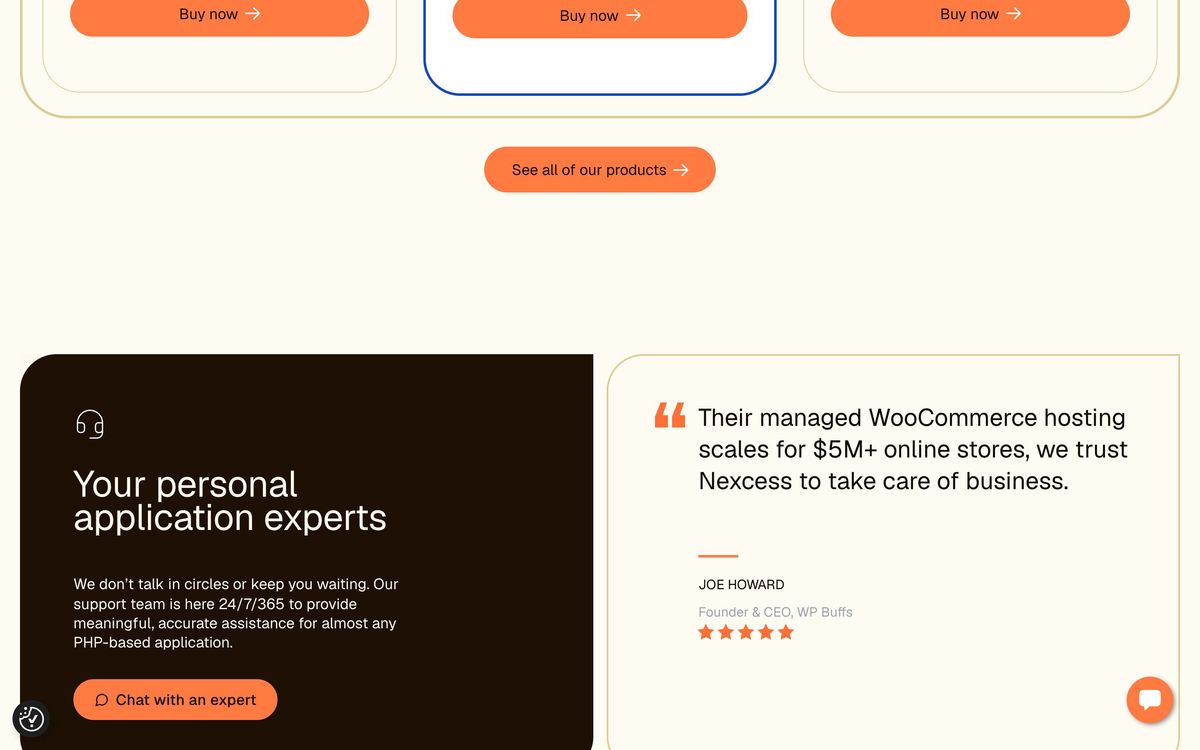
The platform side covers WordPress, WooCommerce, Magento, Drupal, Craft CMS, ExpressionEngine, Sylius and Shopware, which is broader than most managed hosts bother with. Plans are structured by number of installs, storage and bandwidth, with auto-scaling PHP workers so a traffic spike does not require an emergency upgrade. Around that sit the operational tools: one-click staging, daily backups with restore, a proprietary CDN, a plugin performance monitor that flags which addition slowed the site, and visual regression testing that screenshots pages before and after an update so a broken layout is caught before a customer finds it. Support is available around the clock and is staffed by people who know the applications, not only the infrastructure.
Key features
What is included rather than sold separately:
- Auto-scaling PHP workers with burst headroom defined per plan
- One-click development and staging environments per site
- Daily automatic backups with one-click restore
- Multi-layer caching, free SSL and a proprietary content delivery network
- Automatic core and plugin updates, with visual regression testing to catch breakage
- Plugin performance monitoring that attributes slowdowns to specific additions
Who it's for
Nexcess fits a store or a small agency portfolio where downtime has a direct cost and nobody on the team wants to be the sysadmin. A WooCommerce shop running seasonal peaks gets the most out of it, because auto-scaling and the store-specific caching are the parts that genuinely differ from commodity hosting. Agencies managing ten to fifty client sites are the other natural buyer, since staging, regression testing and update automation remove the most tedious part of a maintenance retainer.
It is a poor fit for a first personal blog or a brochure site with no traffic. The pricing and the tooling both assume the site earns money, and someone learning WordPress will find the control panel unhelpfully technical compared with a beginner-focused host. It is also not the right answer for a team that wants root access and custom infrastructure, since the value here is precisely that the environment is managed and opinionated.
How it compares
WP Engine and Kinsta are the obvious comparisons and both have friendlier dashboards, more polished onboarding and stronger brand pull with agencies; Nexcess typically undercuts them at the entry tier and beats both on Magento, which neither seriously supports. Cloudways offers more infrastructure choice and lower prices but leaves more of the operational work with you. SiteGround is cheaper still and adequate for content sites, but it is not built for a high-traffic store. The honest summary is that Nexcess wins on ecommerce depth and platform breadth, and loses on interface polish.
Verdict
Nexcess is a credible choice for stores and agency portfolios that need managed hosting with real ecommerce tuning, and the operational tooling around updates and staging is better than the price suggests. Two caveats keep the rating where it is. Reviews are noticeably split, with strong Trustpilot scores sitting next to a much weaker G2 average, and a recurring theme among long-term customers is that support became more transactional after the Liquid Web consolidation. Test the support channel during your first month, while switching is still cheap.
Ready to try Nexcess?
More developers tools like Nexcess
Ultahost
3.3Budget shared, WordPress and VPS hosting on NVMe storage with cPanel, domains and a 30-day money-back guarantee.
Read Ultahost review →Pinecone
4.5Fully managed serverless vector database for similarity search, RAG, and agent memory at billion-vector scale.
Read Pinecone review →Runpod
4.5GPU cloud for AI workloads: on-demand instances, serverless inference endpoints, and multi-node clusters.
Read Runpod review →CrowdStrike
4.4Cloud-delivered endpoint protection with one lightweight agent, sold to small teams as fixed per-device bundles.
Read CrowdStrike review →NinjaOne
4.4Endpoint management and RMM platform for monitoring, patching, backing up and remotely supporting company devices.
Read NinjaOne review →Bright Data
4.3Proxy network and managed scraping APIs for collecting public web data at production scale.
Read Bright Data review →