
Shopmonkey review
Cloud shop management for auto repair: estimates, work orders, inspections, parts and payments in one workflow.
The most complete cloud shop management system for independent auto repair, though reporting is shallow and the flat monthly fee is steep for a two-bay shop.
Pros
- Estimate, inspection, work order, invoice and payment all live on one record, so nothing is retyped between stages
- Digital vehicle inspections with photos and video sent by text, which is the single clearest driver of approved upsells
- Two-way SMS and email threading keeps customer approvals attached to the job rather than in a technician's phone
- Native payments, including in-person card readers and pay-by-link, with buy-now-pay-later options at the counter
- Multi-location tier consolidates scheduling and reporting for franchises without separate logins per shop
Cons
- Reporting is the weakest area: reviewers repeatedly say custom reports are limited and shop profitability is hard to isolate
- Parts costing needs manual correction - catalogue pricing skews to OEM, and reconciling a parts invoice against a job is fiddly
- Inventory, purchase orders, time clock and QuickBooks sync are withheld from the entry plan, so most shops are pushed to the middle tier
Shopmonkey pricing
List prices in USD per month, taken from the vendor at review time. Custom means quote-only.
| Plan | Per month | What it covers |
|---|---|---|
| Basic | $239 | flat, 3 users included; $215/mo billed annually; extra users $20/mo |
| Clever | $399 | flat, 4 users; adds inventory, purchase orders, time clock, QuickBooks Online |
| Genius | $499 | flat, 5 users; adds MOTOR data, Google Reviews manager, advanced reporting |
| Multi-Shop | Custom | custom pricing for franchises and multi-location operators |
What Shopmonkey actually does
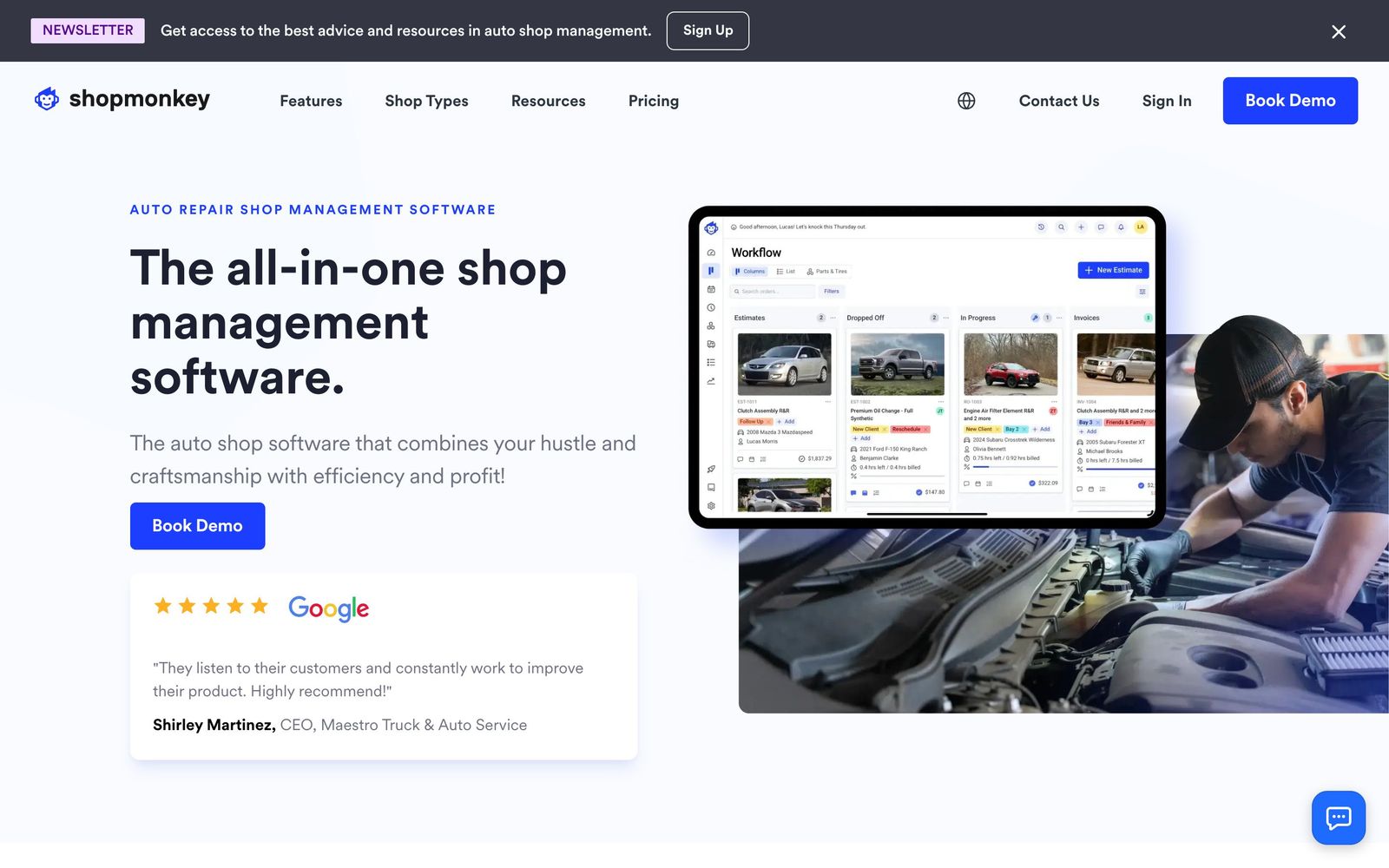
Shopmonkey is a cloud shop management system for automotive service businesses: independent repair shops, tire stores, quick lube bays, heavy-duty truck shops, and detail and wrap outfits. It replaces the stack most shops accumulate - a legacy DOS-era management program, a texting app, a separate inspection tool, a card terminal, a spreadsheet for parts - with a single record per vehicle that moves from estimate to inspection to work order to paid invoice without anyone retyping a VIN.
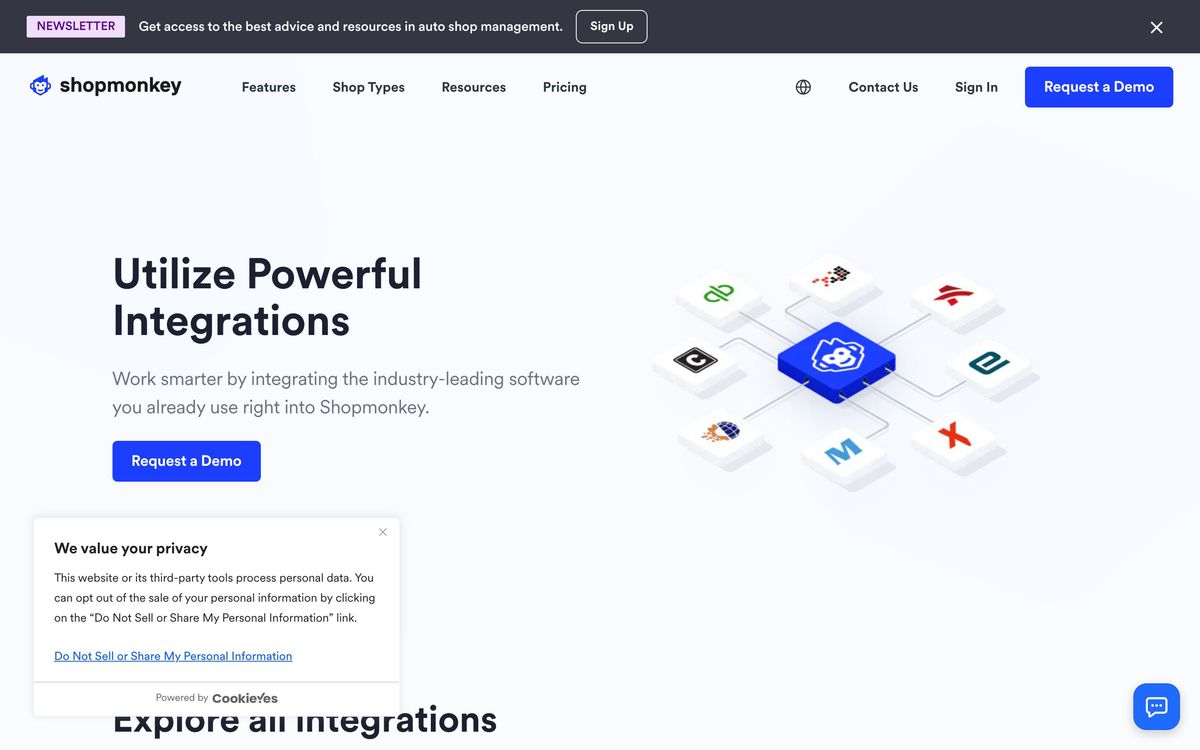
It runs in the browser with companion iOS and Android apps, so a technician can shoot inspection photos at the bay and a service advisor can send the estimate from the counter a minute later. Customer messaging is two-way and threaded to the job. Payments are native, covering pay-by-link, in-person readers and financing offers. Accounting either stays inside Shopmonkey's own bookkeeping or syncs to QuickBooks Online on the mid tier and above. The company reports use across more than eight thousand shops in North America. Outside accounting, the integration list is narrow and specific to the trade: parts and tyre catalogues through PartsTech, Nexpart, WORLDPAC and Epicor, vehicle history through CARFAX, repair data through ALLDATA and MOTOR. Most of what a shop needs is built in, which shortens setup and limits anyone with an unusual stack.
Key features
What a shop uses on an average Tuesday:
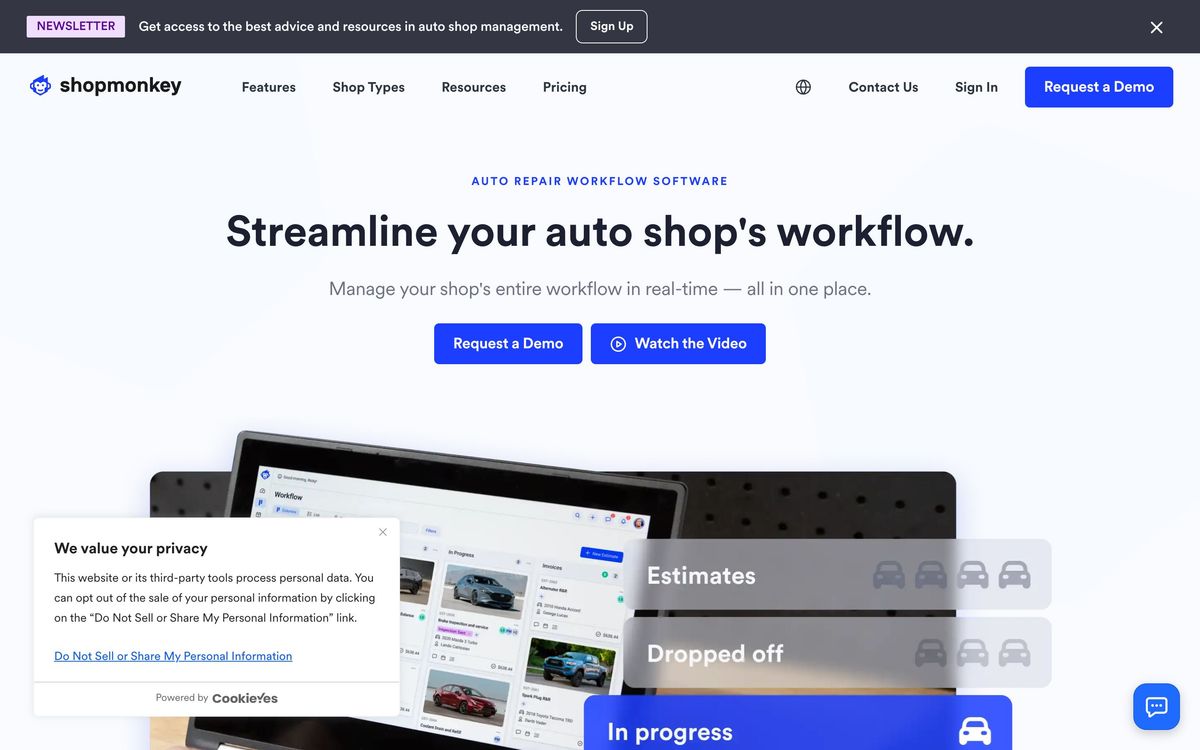
- Workflow board tracking every vehicle from check-in to pickup, with technician assignment and status
- Digital vehicle inspections with photos and video, delivered by text for one-tap approval
- Estimates and invoices with parts lookup, ordering and reusable canned service jobs
- Two-way SMS and email conversations attached to the job record
- Integrated card payments, in-shop readers, and automated appointment reminders
- Inventory, purchase orders and a time clock on the mid tier; MOTOR labour times, review requests and coupons on the top tier
Who it's for
The sweet spot is an independent shop of roughly three to fifteen people that has outgrown paper tickets and wants approvals to happen on a customer's phone rather than over voicemail. Shops that live on upsells - inspections that find worn brakes, tyres, filters - get the most from it, because the photo-based inspection is what turns a phone call into an approved line item. Multi-location owners are served by a dedicated tier that consolidates scheduling and reporting.
It is a poor fit for a one-person mobile mechanic, where the flat monthly fee is heavy relative to ticket volume and a lightweight invoicing app would do. It is also a poor fit for shops that need serious financial analysis: owners who want granular profitability by service, technician or vehicle class consistently report having to export data and rebuild the numbers elsewhere. Heavy-duty and fleet shops should test the parts catalogue against their real supplier list before signing, because coverage outside light-duty passenger work is thinner.
How it compares
Tekmetric is the closest rival and the usual head-to-head: it is stronger on reporting and profitability metrics, which is exactly where Shopmonkey is weakest, but its interface is denser and it leans harder on integrations for parts and marketing. Mitchell 1 Manager SE carries far deeper repair and labour data through decades of OEM information, and shops doing complex diagnostic work often keep it for that reason, though its interface and cloud story feel dated next to either newer product. AutoLeap is the third contender, close to Shopmonkey in look and feel and aggressive on price, but younger and thinner on multi-location. Shopmonkey wins on breadth in a single subscription and on the customer-facing experience; it loses to Tekmetric on analytics and to Mitchell on repair data depth.
Verdict
This is a well-built, genuinely all-in-one shop management system, and the inspection-to-approval loop earns its keep in most shops within a month. The rating stops short of the top of the range for two concrete reasons: reporting is thin enough that owners chasing profitability end up in spreadsheets anyway, and parts costing needs manual attention often enough to be a daily irritation rather than an edge case. Shops should also note that the features most of them assume are standard - inventory, purchase orders, accounting sync - are not on the entry plan, so the real cost is usually the middle tier.
Ready to try Shopmonkey?
More service-businesses tools like Shopmonkey
VEA
3.4Business management for solo operators: customers, work orders, scheduling, invoicing and accounting in one place.
Read VEA review →Guesty
4.1Runs short-term rental operations: channel sync, guest messaging, cleaning tasks, payments and owner reporting.
Read Guesty review →Housecall Pro
4.1Job management for home-service trades: scheduling, dispatch, estimates, invoicing and card payments in one app.
Read Housecall Pro review →MyCase
4.0Practice management for small law firms, built around the client portal and getting invoices paid.
Read MyCase review →Contractor Foreman
3.9All-in-one construction management for small contractors: estimates, job costing, schedules and field time cards.
Read Contractor Foreman review →Weave
4.5All-in-one phone, texting, scheduling and payments platform for dental, vet and optometry practices.
Read Weave review →