
Wati review
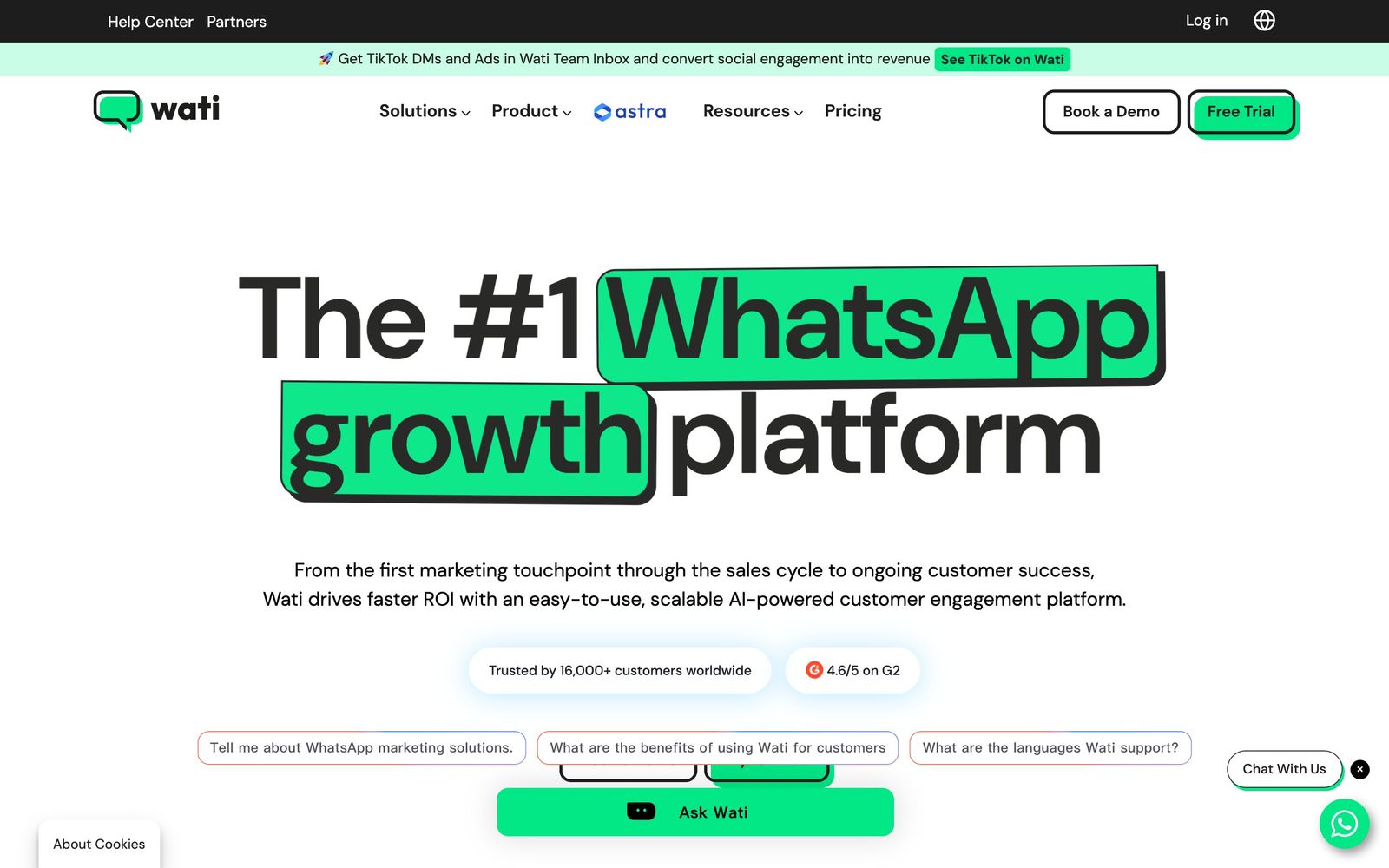
WhatsApp Business API platform with a shared team inbox, broadcast campaigns and a no-code chatbot builder.
A practical way for a small team to run sales and support on WhatsApp at scale, though the real monthly cost is the subscription plus Meta's conversation fees plus Wati's markup on them.
Pros
- Official WhatsApp Business API access, including verification, is handled as part of onboarding rather than left to the buyer.
- A shared inbox assigns WhatsApp threads to named agents with routing, notes and canned replies instead of one phone passed around.
- Broadcast campaigns run against segmented lists with template management and delivery reporting.
- The no-code flow builder covers order status, FAQs and lead qualification without developer time.
- The AI support agent deflects a meaningful share of repeat questions before a human sees the thread.
Cons
- Three billing layers, the subscription plus Meta's per-conversation fee plus Wati's markup on that fee, make monthly cost hard to forecast.
- Agent seats are capped per tier and priced per user, so a support team that grows past a handful of people jumps tiers quickly.
- Analytics are shallow, and reviewers repeatedly cite slow support responses and friction when cancelling a subscription.
Wati pricing
List prices in USD per month, taken from the vendor at review time.
| Plan | Per month | What it covers |
|---|---|---|
| Growth | $29 | 3 users, 1 channel, 15,000 broadcasts a month |
| Pro | $99 | 5 users, unlimited broadcasts, 5 integrations including HubSpot |
| Business | $249 | 5 users, unlimited integrations, dedicated account manager |
What Wati actually does
Wati is a front end for the WhatsApp Business API. Meta does not sell that API to businesses directly in a usable form; a solution provider handles the account setup, phone number verification, message template approval and the interface people actually work in. Wati is one of the larger providers, and its product is built around three things: a shared inbox, broadcast campaigns and automation.
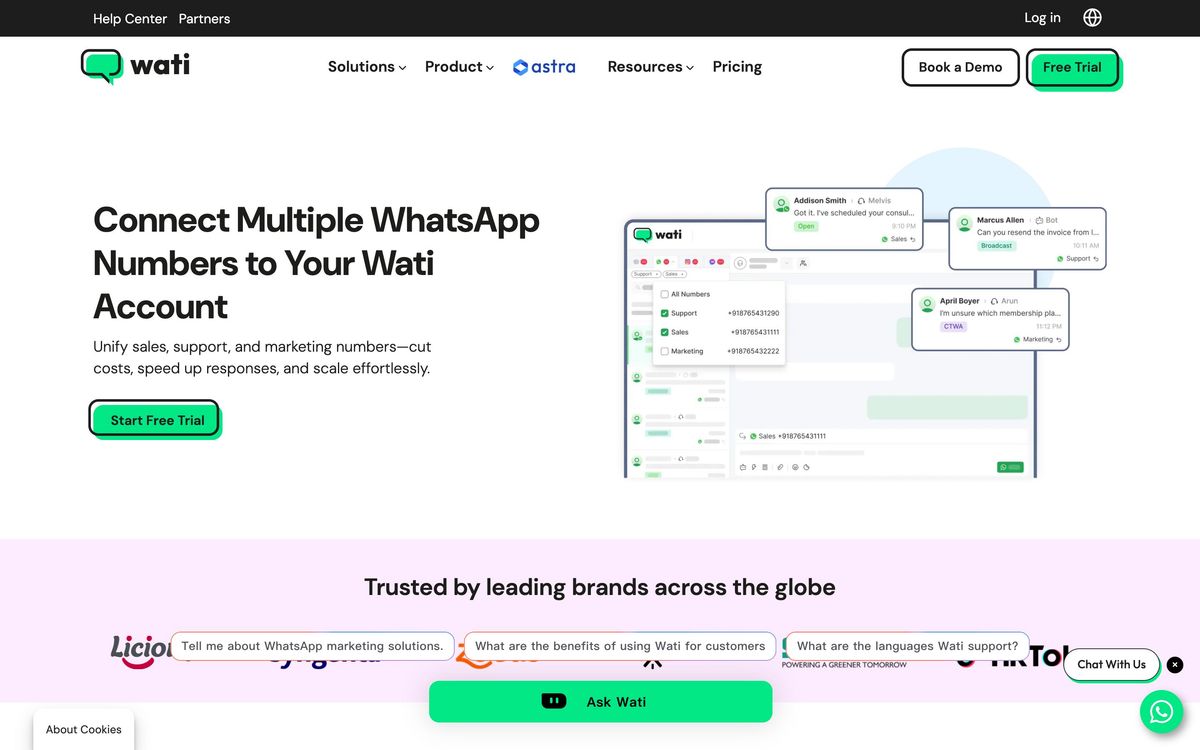
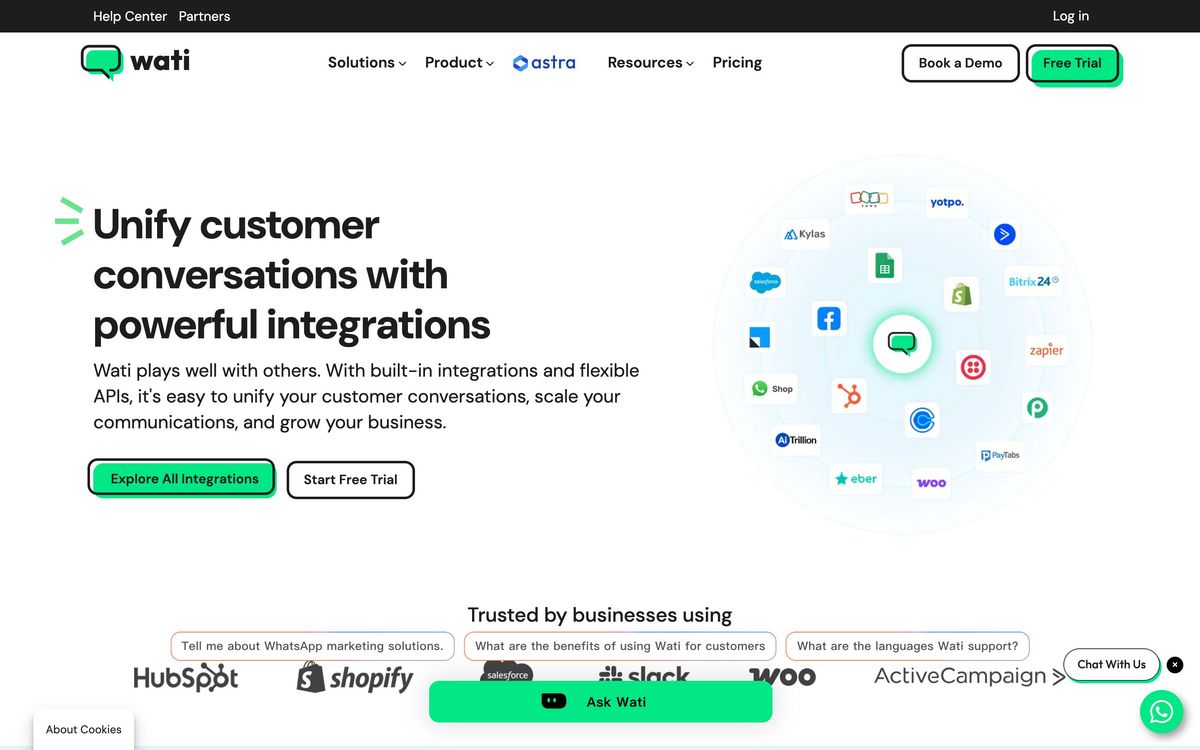
The inbox turns WhatsApp from a personal app into a team channel. Conversations arrive in a queue, get assigned to named agents, carry tags and internal notes, and stay attached to a contact record with custom attributes. Broadcasts send approved message templates to segmented lists with delivery and read reporting, which is the piece most businesses buy it for. Automation comes in two forms: a no-code flow builder that handles branching conversations such as order lookup or lead qualification, and an AI support agent that answers from the company's own content and hands over when it cannot. Integrations cover Shopify and WooCommerce for order events, HubSpot, Salesforce and Zoho on the CRM side, and Zapier, Make and webhooks for everything else.
Key features
The capabilities that define the working day for a team using it.
- Shared WhatsApp inbox with assignment, tagging, notes and canned replies
- Broadcast campaigns with template submission, segmentation and delivery analytics
- No-code chatbot builder with conditional branching and human handover rules
- AI support agent trained on the business's own documents and FAQs
- Contact records with custom attributes, segments and automation triggers
- API, webhooks and an integration directory for CRM and storefront events
Who it's for
Wati makes sense where customers already treat WhatsApp as the default channel, which in practice means India, Southeast Asia, the Middle East, Latin America and southern Europe. The clearest fits are direct-to-consumer stores sending order updates and recovering abandoned carts, clinics and salons confirming appointments, and education or real estate businesses qualifying inbound leads. A team of three to five agents is the sweet spot, matching the seat allowances on the mid tiers.
It is a poor choice for a business whose customers are on email, where the conversation fees buy nothing. It is also awkward for teams that need several channels at once, since Wati is WhatsApp-first and its handling of other channels is not the reason anyone buys it. Larger support organizations should model the seat and conversation costs carefully, because both scale in ways that surprise buyers who priced only the subscription.
How it compares
Interakt is the closest competitor for ecommerce specifically, with tighter native Shopify workflows around carts and orders. AiSensy undercuts Wati on entry pricing and appeals to budget-conscious teams that can live with a rougher interface and thinner support. Respond.io is the better platform for genuine omnichannel routing across WhatsApp, Instagram, email and web chat, at a higher price and with more configuration work. Twilio sits below all of them as raw infrastructure, cheaper per message and requiring a developer to build everything Wati provides ready-made. Wati's position is the middle: easier than Twilio, broader than AiSensy, more WhatsApp-native than Respond.io.
Verdict
Wati does the boring, necessary work of making WhatsApp usable by a team, and it does it without demanding a developer. Onboarding to the official API, template management, a genuine shared inbox and a chatbot builder that non-technical staff can operate together justify a subscription for any business whose customers message rather than email. What holds the rating down is cost opacity and support. The stacked model of subscription, Meta conversation fees and a markup on those fees makes budgeting difficult, per-seat limits push growing teams up tiers faster than expected, and the volume of complaints about response times and cancellation friction is too consistent to dismiss. Worth shortlisting, worth pricing against Interakt and AiSensy before signing.
Ready to try Wati?
More marketers tools like Wati
Interakt
4.1WhatsApp commerce platform by Jio Haptik: in-chat storefronts, checkout, shared inbox, and AI agents
Read Interakt review →Manychat
4.0Automates Instagram, WhatsApp and Messenger conversations, including comment-to-DM keyword replies.
Read Manychat review →Motion
4.5Creative analytics for paid social: visual reports and AI tagging that show which ad creatives perform.
Read Motion review →Vista Social
4.5Social media management covering publishing, inbox, listening, reviews, and reporting across 11+ networks.
Read Vista Social review →Unbounce
4.4Landing page builder with AI traffic routing (Smart Traffic), A/B testing, popups, and sticky bars.
Read Unbounce review →ActiveCampaign
4.3Email marketing and automation platform with a built-in CRM, contact scoring, and SMS and WhatsApp sending.
Read ActiveCampaign review →