
Fast Bundle review
Shopify app for fixed, mix-and-match, volume and BOGO bundles, billed against the bundle revenue it generates.
The broadest set of bundle formats a Shopify merchant can get from a single app, though the revenue-capped plans mean the bill climbs exactly when the offers start working.
Pros
- Six offer types, fixed, mix-and-match, volume, BOGO, add-ons and frequently bought together, run from one subscription and one dashboard
- Discounts apply through Shopify's own checkout, so express and accelerated payment paths keep the bundle price
- Inventory syncs back to the component SKUs, so a bundle sold as one line item still draws down individual stock
- A free tier and a free setup session make the app testable before any spend, and every plan includes round-the-clock support
- Frequently-bought-together pairings are generated from the store's own order history rather than a generic catalogue model
Cons
- Plans are capped by monthly bundle-attributed revenue, so the subscription escalates as the offers succeed and the jumps between tiers are steep
- Merchants have reported bundle components reaching orders without clear grouping data, which turns a merchandising win into a warehouse packing error
- Shopify only, there is no WooCommerce, BigCommerce or headless build, and POS bundles are gated to the top tier
Fast Bundle pricing
List prices in USD per month, taken from the vendor at review time.
| Plan | Per month | What it covers |
|---|---|---|
| Free | Free | development stores and merchants under $500 in monthly bundle revenue |
| Standard | $19 | up to $1,000 monthly bundle revenue; $15/mo billed annually |
| Professional | $49 | up to $3,000 monthly bundle revenue; $39/mo billed annually |
| Premium | $139 | up to $10,000 monthly bundle revenue; $115/mo billed annually |
| Enterprise | $249 | unlimited bundle revenue, Shopify POS, priority onboarding |
What Fast Bundle actually does
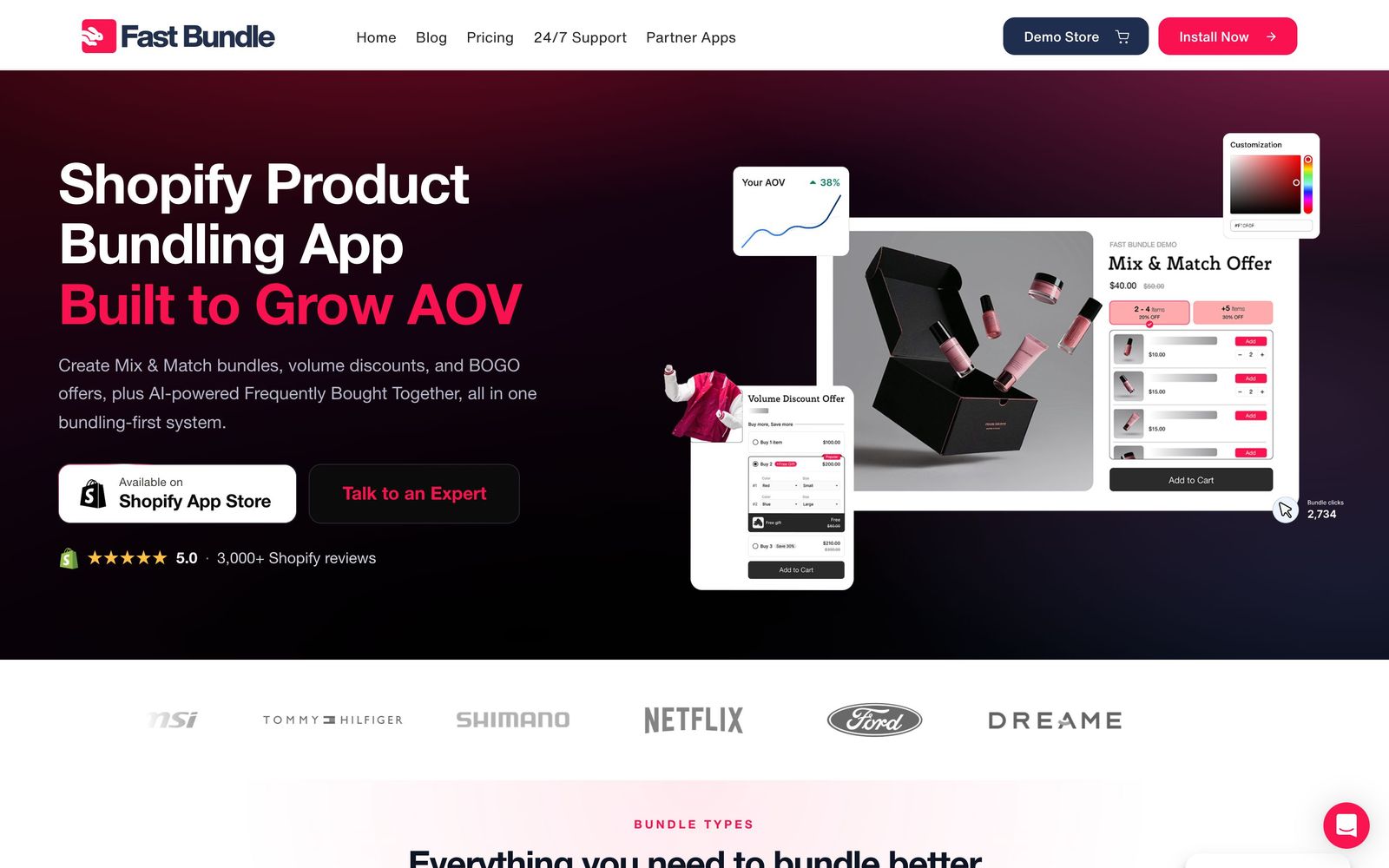
Fast Bundle is a Shopify app that assembles discounted product groupings and puts them in front of a shopper at the moment the buying decision is still open. Six offer shapes run from one admin: fixed bundles sold as a single product, mix-and-match builders where the customer assembles a box from a collection, volume and quantity-break discounts, buy-X-get-Y and free-gift promotions, cart-triggered product add-ons, and a frequently-bought-together widget drawing its pairings from the store's own order history. The job behind all six is the same one, move average order value without spending more on acquisition.
Delivery is entirely inside Shopify. The app installs from the App Store, renders through theme blocks on product, cart and collection pages, and applies its discounts through Shopify's native discount and checkout mechanics rather than through a parallel cart of its own. That distinction matters for stores running accelerated checkouts, because the bundle price survives the express payment path instead of falling back to list. Inventory stays synced against the component SKUs, so a bundle sold as one line item still decrements the individual products behind it. Shopify POS is supported on the top tier, which is the first question most merchants running retail alongside online tend to ask. Billing runs through Shopify and is tiered by how much bundle-attributed revenue the app produces in a month rather than by traffic or catalogue size.
Key features
Six offer types configured from a single dashboard, with control over where each one renders.
- Fixed bundles that publish as a standalone product with their own page, images and SKU
- Mix-and-match and build-a-box builders that let a shopper pick a set number of items from a chosen collection
- Volume discounts and quantity breaks with tiered thresholds across a product or variant group
- Buy X get Y, free gift with purchase, and add-on offers triggered by what is already in the cart
- A frequently-bought-together block whose pairings are generated from the store's historical orders
- Inventory sync back to component SKUs, so bundle sales draw down individual stock levels correctly
Who it's for
Fast Bundle suits Shopify merchants whose catalogue is deep enough that grouping means something, supplements, coffee, apparel, skincare, anything where a customer plausibly buys three of one thing or a starter set. Stores in the low tens of thousands of monthly revenue get the most out of it, since the plan caps stay proportionate to the lift at that scale. Setup does not require a developer: theme blocks and the visual editor cover most placements, and the vendor runs a setup session even for merchants on the free tier.
It is a weak fit for anyone who has already built bundling logic into a headless storefront, and for merchants whose fulfilment depends on a bundle arriving at the warehouse as an obviously grouped unit. Several stores have reported components landing in orders without clear grouping metadata, which becomes a packing problem rather than a merchandising one. Anyone not on Shopify is out of scope entirely.
How it compares
Rebuy Engine is the more capable merchandising platform, with rules-based recommendations across the whole journey, but it costs materially more and expects someone to maintain the rule set. Bundler and Kaching Bundles are cheaper and simpler, covering fixed bundles and volume discounts competently while lacking both the mix-and-match builder and the order-history recommendation model. AfterSell works the post-purchase and checkout upsell instead of pre-cart bundling, so it addresses a neighbouring problem and the two are often installed side by side. Fast Bundle's edge is breadth of offer types under one subscription with unusually fast support; its cost is the revenue-capped ladder that flat-rate competitors do not impose.
Verdict
Fast Bundle earns its rating on coverage. Few bundling apps handle fixed, mix-and-match, volume, BOGO, add-on and frequently-bought-together offers from one install and one bill, and the support response is quick enough that merchants mention it unprompted. The caveat is the pricing model: plans are capped by bundle-attributed revenue, so the subscription rises as the app does its job, and the gap between tiers is wide enough that one strong month can change the bill category. Merchants should also confirm how bundle line items reach their fulfilment provider before a peak season, since the grouping metadata has caused packing errors. For a Shopify store testing whether bundling works at all, this is the cheapest way to try six formats at once.
Ready to try Fast Bundle?
There's a free tier, so you can test it before committing.
More ecommerce tools like Fast Bundle
DataHawk
4.3Enterprise-grade Amazon and Walmart analytics: SKU-level dashboards, anomaly alerts and AI diagnostics.
Read DataHawk review →Gorgias
4.3Ecommerce help desk where order data and refunds live inside the conversation, with an AI agent priced per resolution.
Read Gorgias review →Teikametrics
4.3AI marketplace optimization for Amazon, Walmart and TikTok Shop: ads automation, listings and forecasting.
Read Teikametrics review →AliDrop
4.2Dropshipping app importing AliExpress, Alibaba and Temu products into Shopify with automated fulfillment.
Read AliDrop review →BidX
4.2AI ad automation for Amazon and Walmart: Sponsored ads, DSP, AMC analytics and optional managed services.
Read BidX review →Finale Inventory
4.2Multichannel stock control and barcode warehouse operations for sellers who have outgrown spreadsheets but not an ERP.
Read Finale Inventory review →