
Subbly review
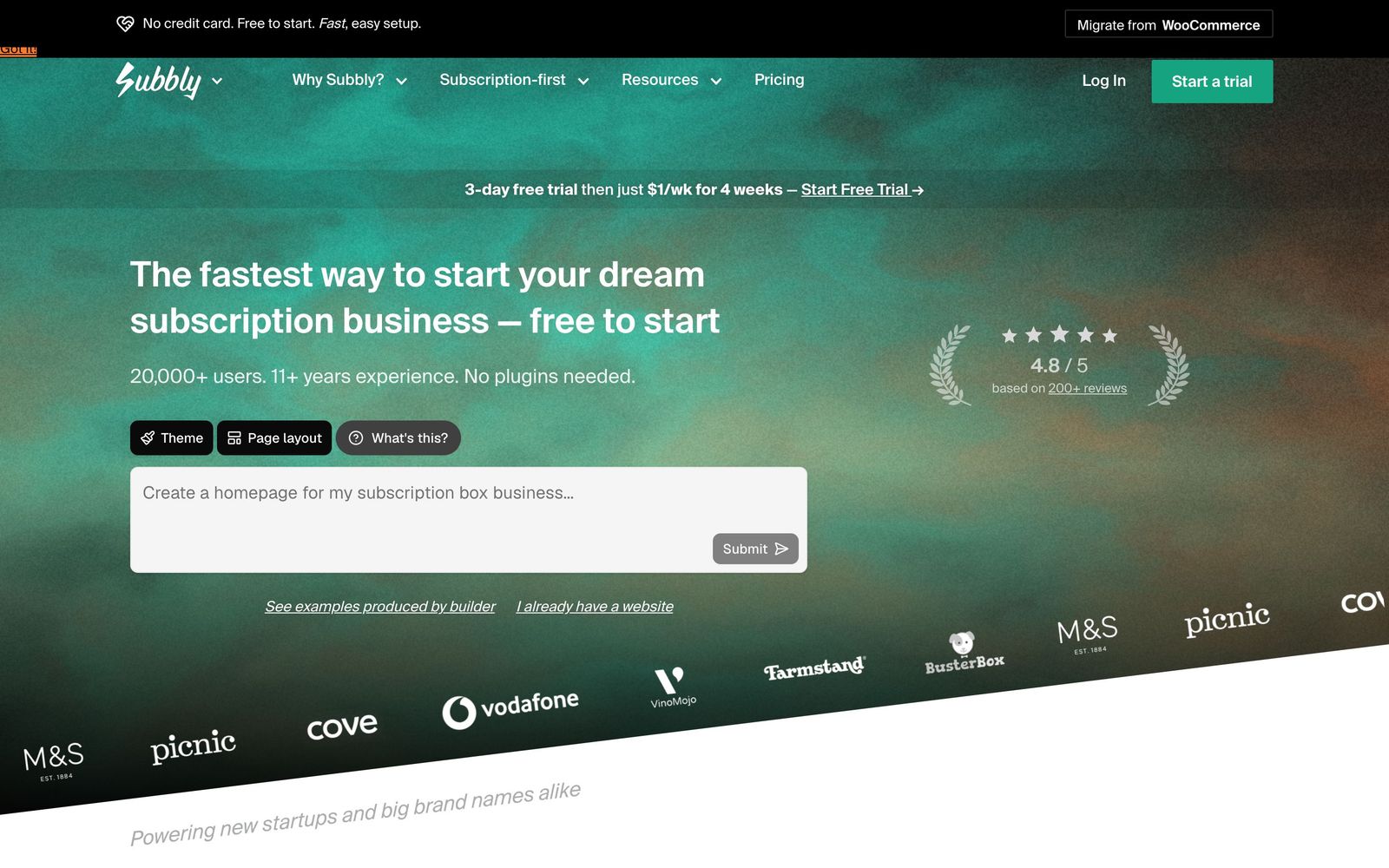
A commerce platform built subscription-first: storefront, checkout, recurring billing and churn tools in one account.
The most complete option for running a subscription box without stitching plugins onto Shopify, though design freedom and the third-party app ecosystem are far narrower than Shopify's.
Pros
- Recurring billing, dunning and churn offers are native rather than bolted on, so a failed card is handled without a third-party app
- Checkout is subscription-aware, supporting gifting, prepaid terms, trials, pre-orders and multi-step surveys for personalised boxes
- Migration paths exist from Shopify, WooCommerce, Cratejoy, Recharge, Squarespace and others, which is unusual for a platform this size
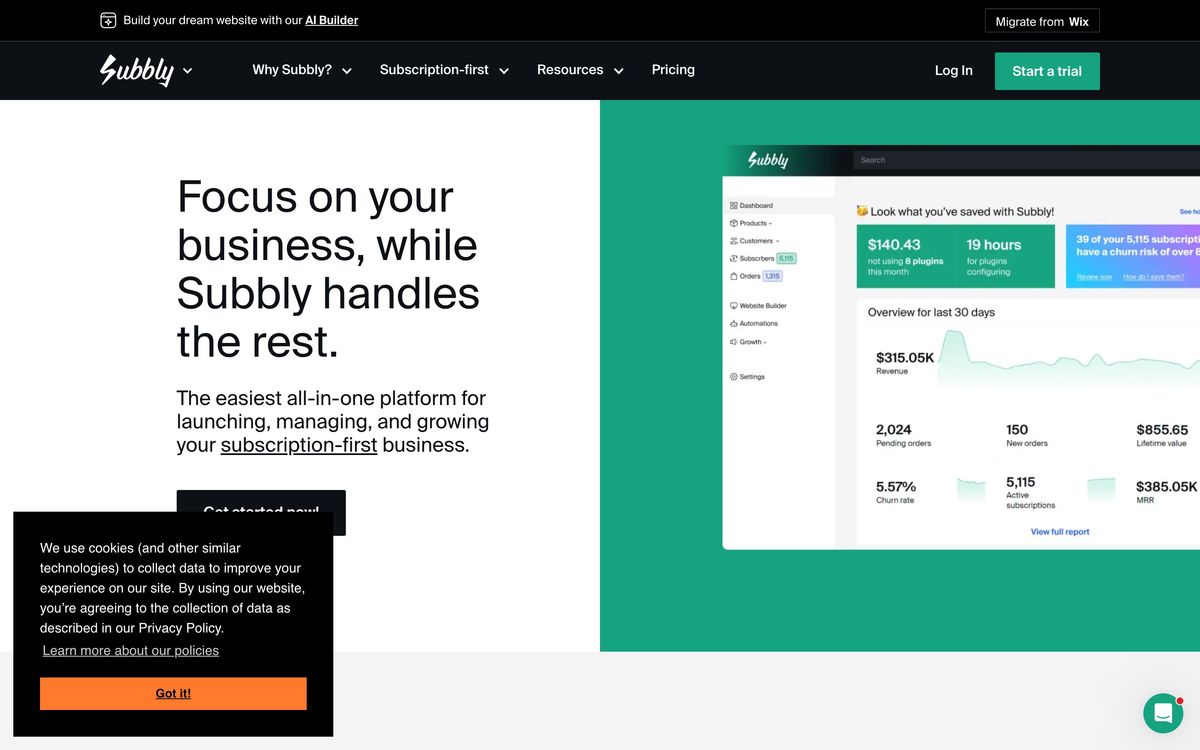
- Subscriber analytics report the metrics that matter to this model, including MRR, churn, lifetime value and failed payments
- Subscriber counts are unlimited on every plan, so growth is not punished with a tier jump
Cons
- Every plan adds a percentage cut of each transaction on top of the gateway fee, which erodes margin as volume grows
- Theme customisation is limited compared with Shopify: merchants wanting a distinctive storefront hit the ceiling of the builder quickly
- The app ecosystem is small, so a niche requirement for reviews, loyalty or accounting often means the API rather than an install
Subbly pricing
List prices in USD per month, taken from the vendor at review time.
| Plan | Per month | What it covers |
|---|---|---|
| Lite | $14 | billed annually; 2% + $0.19 per transaction |
| Basic | $29 | billed annually ($39 month-to-month); 1% + $0.15 per transaction on Stripe |
| Subbly | $59 | billed annually ($79 month-to-month); 1% + $0.15 per transaction on Stripe |
| Advanced | $119 | billed annually ($159 month-to-month); 1% + $0.15 per transaction |
What Subbly actually does
Subbly is an ecommerce platform whose primitives are subscriptions rather than one-off orders. Most stores in this market are built the other way around: a general commerce platform plus a recurring-billing app plus a retention app plus a survey tool, each with its own settings and its own failure mode. Subbly puts the storefront, the checkout, the billing engine and the retention tooling in one account, so a skipped box, a paused plan, a gift subscription or a failed card is handled by the same system that renders the product page.
The platform has been running since 2014 and now covers the models that fill this niche: curated boxes, replenishment, meal delivery, memberships, farm shares and personalised bundles. Recent releases lean on an AI-assisted site builder that assembles a store from a description, alongside forecasting on the analytics side. Pricing is a monthly plan plus a percentage of each transaction, which falls as the plan rises, and there is a trial before any card is required. Subscriber counts are not capped on any tier.
Key features
The interesting parts are the ones a general commerce platform can only approximate with plugins.
- Billing cycles by week, month, quarter or a custom interval, with prepaid terms, sequential plans, trials and pre-orders
- Subscription-aware checkout with gifting, one-time add-ons and multi-step surveys that assign the right box to a new subscriber
- Retention tooling covering dunning on failed cards, pause and skip, automated win-back offers and churn reporting
- No-code site builder with templates and AI-assisted setup, plus funnels, upsells and abandoned cart recovery
- Operations layer with subscription-first inventory, dynamic shipping rules, local pickup, bulk actions and team roles
- Payment coverage including Stripe, PayPal, Braintree, Authorize.Net, Apple Pay, Google Pay, SEPA and ACH
Who it's for
Subbly suits an owner-operated subscription business between launch and a few thousand active subscribers, where the person configuring the store is also packing the boxes. The value is coherence: one vendor to call, one place where the billing rules live, and default behaviours that already assume recurring revenue. Brands migrating off a marketplace platform benefit most, because they gain their own storefront and customer relationship without rebuilding the billing logic from parts.
It is the wrong choice for a brand whose subscription is a small share of a large catalogue business, where Shopify plus a subscription app keeps the wider ecosystem intact. It is also wrong for teams with a strong design vision or an existing agency relationship, since the builder does not offer the control a bespoke theme would, and for anyone whose stack depends on a long list of third-party apps that simply do not exist here.
How it compares
Cratejoy is the obvious comparison for subscription boxes and brings a marketplace with existing buyers, but it takes a substantial commission on marketplace sales and its own storefront and billing features are thinner. Shopify with Recharge is the more capable combination, with a vastly larger app and theme ecosystem, at the cost of paying two vendors and maintaining the seams between them. Chargebee handles far more complex billing for software companies but has no storefront at all. Subbly's argument is consolidation for a specific business model, not breadth.

Verdict
For a subscription-first brand that wants to stop maintaining a Shopify stack held together with apps, Subbly is a credible consolidation: the billing engine is mature, the checkout understands gifting and prepaid terms without workarounds, and the retention features address the metric that decides whether these businesses survive. The reservations are the transaction percentage layered on top of the subscription, which becomes a real cost as volume grows, and a storefront builder that will frustrate anyone with a specific design in mind. Choose it for the billing and the operations, and accept a plainer shop front in return.
Ready to try Subbly?
More ecommerce tools like Subbly
DataHawk
4.3Enterprise-grade Amazon and Walmart analytics: SKU-level dashboards, anomaly alerts and AI diagnostics.
Read DataHawk review →Gorgias
4.3Ecommerce help desk where order data and refunds live inside the conversation, with an AI agent priced per resolution.
Read Gorgias review →Teikametrics
4.3AI marketplace optimization for Amazon, Walmart and TikTok Shop: ads automation, listings and forecasting.
Read Teikametrics review →AfterSell by Rokt
4.2Adds one-click upsells to the cart, checkout and thank-you pages of a Shopify store.
Read AfterSell by Rokt review →AliDrop
4.2Dropshipping app importing AliExpress, Alibaba and Temu products into Shopify with automated fulfillment.
Read AliDrop review →BidX
4.2AI ad automation for Amazon and Walmart: Sponsored ads, DSP, AMC analytics and optional managed services.
Read BidX review →