
Auware review
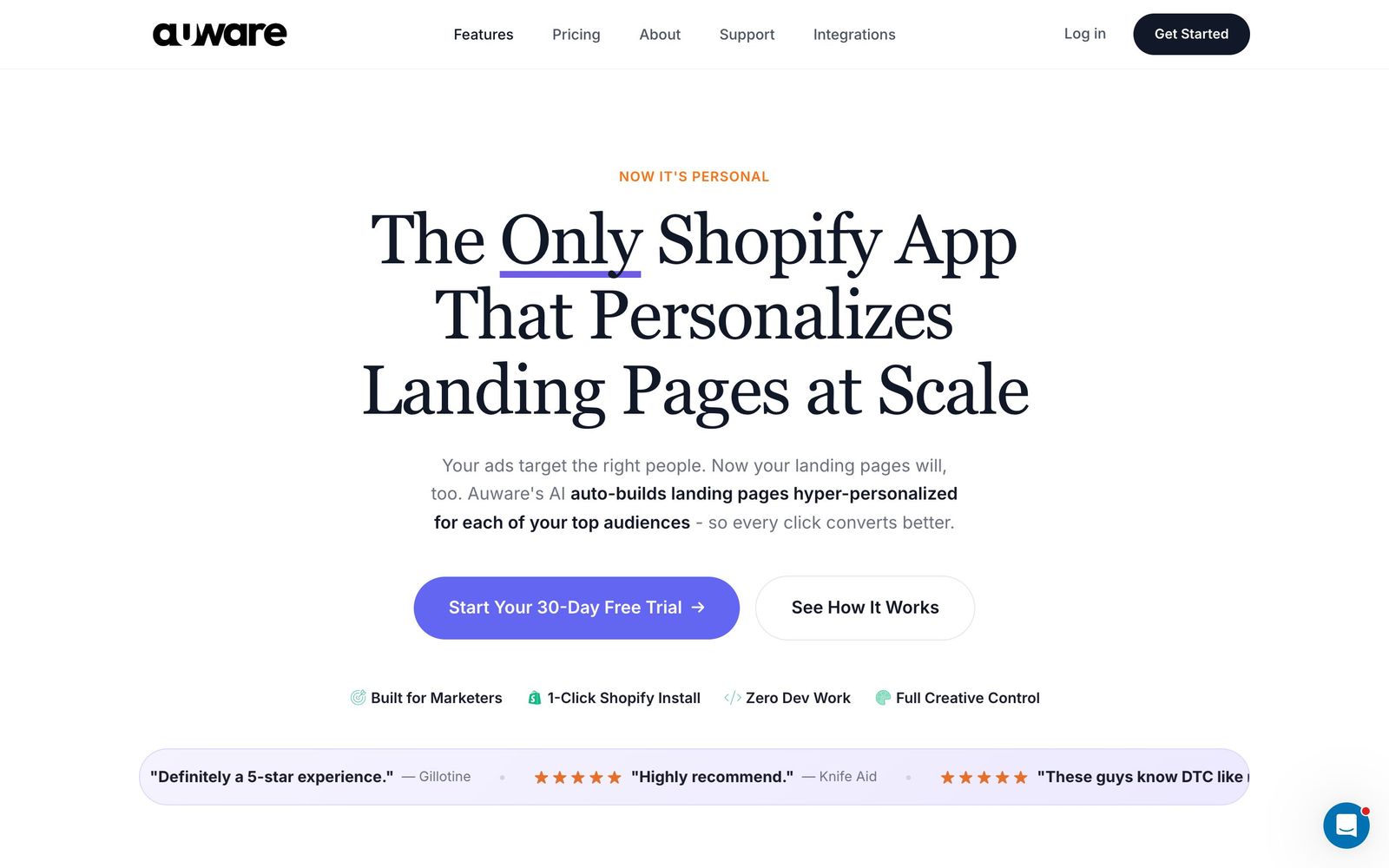
Generates persona-specific Shopify landing pages for each ad audience, then reports which variant converts.
A sharp answer to the generic post-click page for Shopify advertisers, though it is a young app with a thin review record and a single flat price that only heavy spenders recover.
Pros
- Generates a distinct page variant per audience, each with its own URL, so ad-to-page message match is maintained without hand-building every page
- Pulls brand styling from the existing theme and publishes natively into Shopify rather than hosting pages on a separate domain
- Selects customer reviews per persona from the review app already installed, and applies Shopify discounts automatically
- Reporting is broken out per audience on conversion rate, average order value, cost per acquisition and return on ad spend
- Formats extend past the product page to advertorials, listicles, comparison pages and testimonial layouts
Cons
- Launched in late 2025 with only a handful of public reviews, so there is little independent evidence about durability or support
- One flat monthly price per store with a campaign cap means a low-spend merchant pays the same as a high-spend one and recovers far less
- Shopify-only, and dependent on the store's product, review and discount data, so it is unavailable to merchants on other platforms
Auware pricing
List prices in USD per month, taken from the vendor at review time.
| Plan | Per month | What it covers |
|---|---|---|
| Pro | $199 | per store, 10 active campaigns, 30-day free trial |
| Influencer Pages add-on | $99 | optional add-on for influencer-attributed page layers |
What Auware actually does
Auware is a Shopify app that builds landing pages per audience rather than per product. The premise will be familiar to anyone who buys paid social: the ad speaks to a specific person with a specific reason to care, and then delivers everyone to the same product page written for nobody in particular. Auware generates a variant of that page for each audience, with different headline and body copy, different reviews surfaced and a different framing of the same product, each on its own URL for tracking.
Audiences are either defined by the merchant or suggested by the app from store data. From there it generates the page, pulling brand styling from the existing theme, selecting customer reviews that fit the persona, and applying Shopify discounts automatically. A visual editor sits over the output for headline edits, image swaps and copy changes without touching code. Formats go beyond the standard product page to advertorials, listicles, comparison pages and testimonial layouts. Reporting is per audience rather than aggregated: conversion rate, average order value, cost per acquisition and return on ad spend, broken out by variant. There is also a developer API and an MCP server for teams that want to drive generation programmatically. It is sold at a flat monthly price per store with a campaign cap, plus an enterprise tier priced on request for multi-store operations.

Key features
The product is a generator and a report, not another drag-and-drop canvas.
- Audience discovery from store data, or personas defined by hand per product
- Generated page variants per audience with distinct copy, review selection and tracking URLs
- Visual editor for headlines, images and copy over the generated output
- Formats beyond the product page: advertorials, listicles, comparison pages and testimonial showcases
- Automatic application of Shopify discounts, with native publishing into the existing theme
- Per-audience reporting on conversion rate, average order value, cost per acquisition and return on ad spend, plus a developer API and MCP server
Who it's for
Shopify merchants with steady paid spend and more than one plausible buyer for the same product: the supplement sold to runners and to new parents, the tool sold to hobbyists and to trades. Below a certain spend the arithmetic fails, because the flat monthly price has to be recovered from incremental conversions and a store testing a single audience will never generate the variance the product exists to exploit.
It is also the wrong tool when the problem is the offer rather than the page, and it is unavailable off Shopify, since it is built on that platform's product, review and discount data. Merchants already running a page builder alongside a testing tool will find overlap; Auware's argument is that generation and per-audience reporting arrive together, not that it is a better editor. The app is young, listed in late 2025 with a handful of reviews, so there is little independent evidence of durability, and the conversion multiples on the marketing site are vendor figures rather than measured results.
How it compares
Replo and Shogun are stronger page builders with more layout control and a longer history, but they build one page at a time and leave the audience thinking to the merchant. Unbounce brings mature testing and traffic routing, at the cost of living outside Shopify and its data. Instant and GemPages compete on speed of page creation without the persona generation. Auware's narrow claim is that it produces the variants and then tells you which audience paid for itself.
Verdict
Auware is well aimed. The post-click page really is where paid social spend leaks, and generating a variant per audience with review selection and discount handling built in is more useful than another canvas. The reservations are age and evidence: it launched recently, the public review base is tiny, and the single flat price means low-spend stores carry the same cost as heavy ones. For a merchant already testing audiences seriously it is worth the trial month; for anyone else it is early.
Ready to try Auware?
More ecommerce tools like Auware
DataHawk
4.3Enterprise-grade Amazon and Walmart analytics: SKU-level dashboards, anomaly alerts and AI diagnostics.
Read DataHawk review →Gorgias
4.3Ecommerce help desk where order data and refunds live inside the conversation, with an AI agent priced per resolution.
Read Gorgias review →Teikametrics
4.3AI marketplace optimization for Amazon, Walmart and TikTok Shop: ads automation, listings and forecasting.
Read Teikametrics review →AfterSell by Rokt
4.2Adds one-click upsells to the cart, checkout and thank-you pages of a Shopify store.
Read AfterSell by Rokt review →AliDrop
4.2Dropshipping app importing AliExpress, Alibaba and Temu products into Shopify with automated fulfillment.
Read AliDrop review →BidX
4.2AI ad automation for Amazon and Walmart: Sponsored ads, DSP, AMC analytics and optional managed services.
Read BidX review →